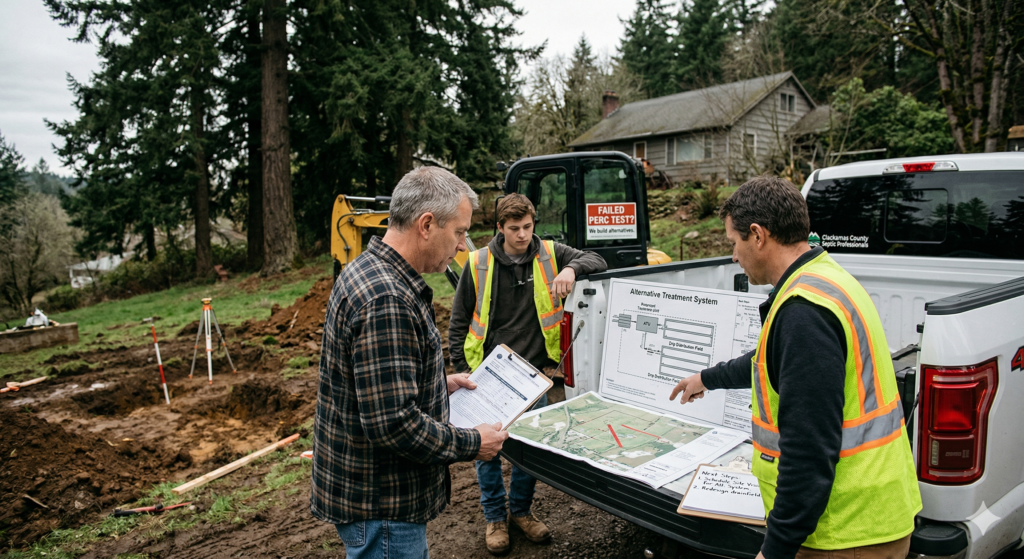
A failed perc test in Clackamas County doesn’t have to mean the end of your building plans. In many cases, a failed percolation test simply means that a conventional septic system won’t work on your property — not that wastewater treatment is impossible. There are legitimate, county-approved pathways forward, and understanding your options is the most important step you can take right now.
We’ve seen property owners assume a failed perc test makes their land worthless or unbuildable, but that’s rarely the full picture. The situation depends heavily on your soil type, lot size, setback requirements, and local regulations — all of which we’ll walk through in this post.
From understanding what a failed test actually means, to exploring Advanced Treatment Technology (ATT) systems as a viable alternative to conventional septic, to navigating Clackamas County’s permitting process, we’ll cover what you need to know to move forward with confidence.
Understanding Perc Tests in Clackamas County
In Clackamas County, a perc test is a required step before any new septic system can be approved — and the results directly shape what type of system you’re allowed to install on your property.
What Is a Perc Test?
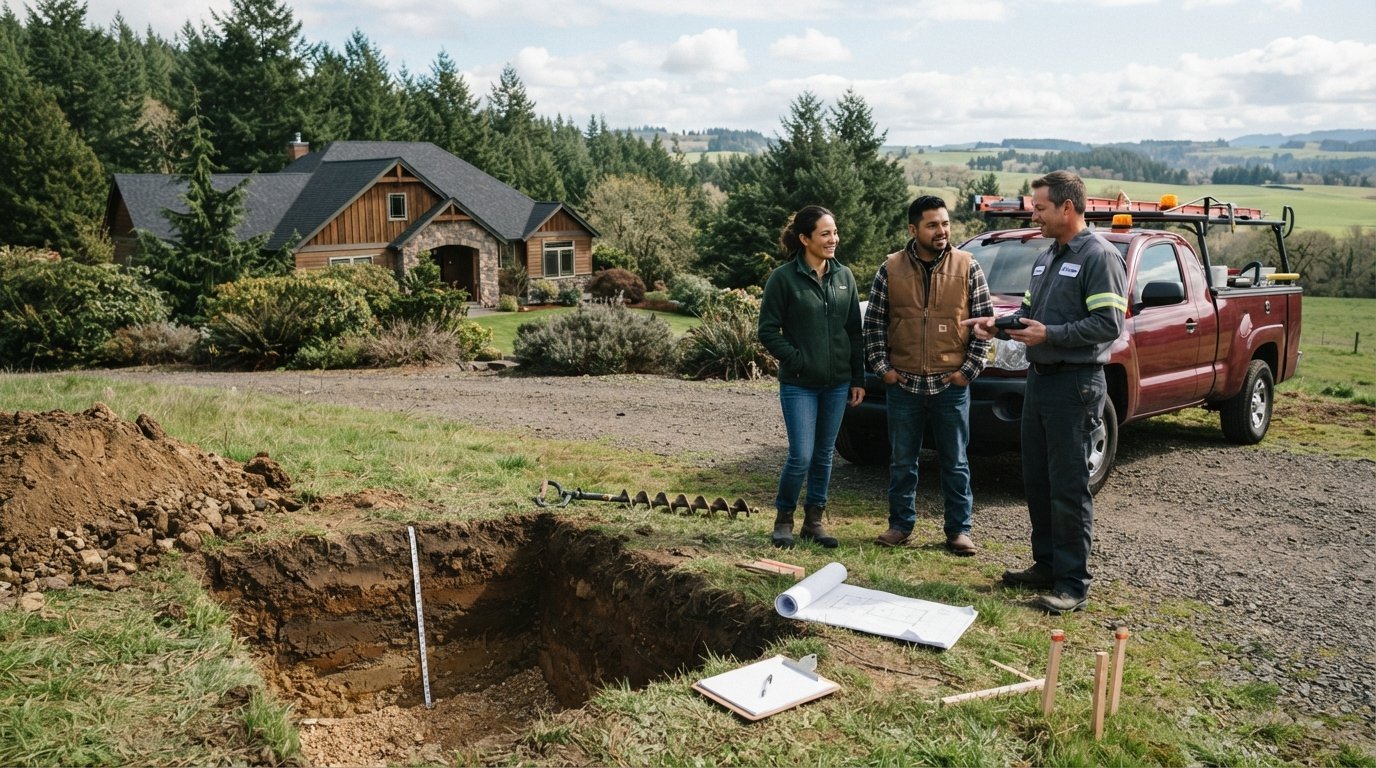
A percolation test, or perc test, measures how quickly water drains through the soil on your property. We dig test holes to a specified depth, fill them with water, and then measure the rate at which the water absorbs into the ground. This is expressed in minutes per inch (MPI).
Clackamas County Environmental Health oversees this process and requires a licensed soil scientist or certified professional to conduct the evaluation. The results determine whether the soil can adequately treat wastewater through a conventional drain field.
Why Perc Tests Matter for Septic Approval
Without a passing perc test, Clackamas County will not issue a septic system permit. That means no building permit, no development approval, and no legal path to occupancy on an unsewered lot.
The perc rate directly determines what type of septic system is permitted:
| Perc Rate | Typical System Allowed |
| Under 60 MPI | Conventional gravity system |
| 60–120 MPI | Pressure distribution system |
| Over 120 MPI | ATT or engineered alternative required |
| No absorption | Standard systems not permitted |
For buyers and builders, this makes the perc test one of the most consequential evaluations tied to a property.
Common Reasons for Perc Test Failure
Clackamas County properties fail perc tests for several soil and site-related reasons. Understanding the cause matters because it influences what solutions are available to us.
Common causes include:
-
- Clay-heavy soils — Clay absorbs water slowly and is widespread in the Willamette Valley foothills
-
- High seasonal water table — Groundwater rises in winter months and reduces effective soil depth
-
- Compacted soils — Construction activity or years of heavy use can restrict drainage
-
- Shallow bedrock — Limits the usable soil column for wastewater treatment
-
- Saturated conditions during testing — Testing after heavy rain can produce artificially poor results
Timing and soil type together are the two biggest variables we see affecting outcomes in this county.
Immediate Steps After a Failed Perc Test
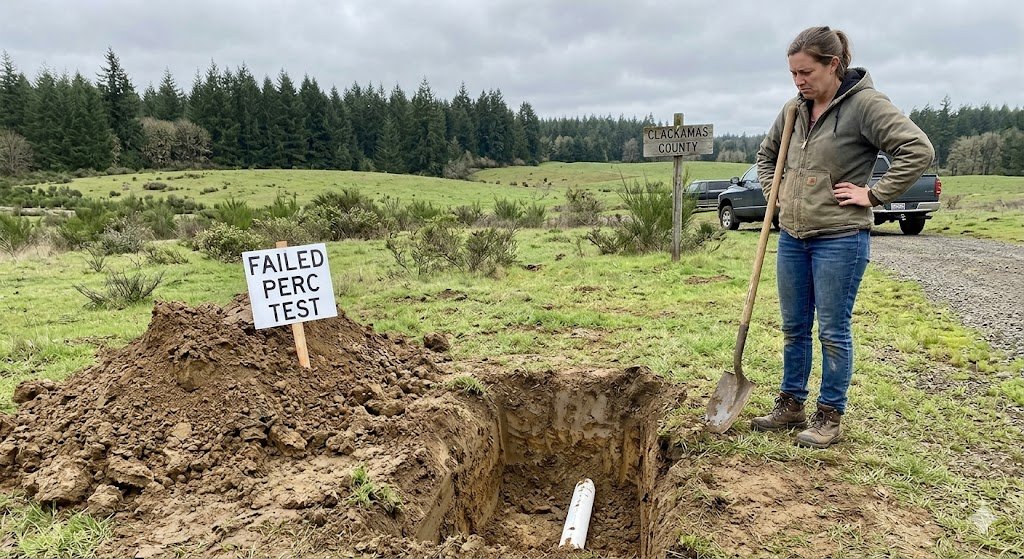
A failed perc test in Clackamas County doesn’t have to end your project — but the next moves you make matter. Interpreting the results correctly, notifying the right authorities, and consulting a licensed professional quickly are the three actions that will define your path forward.
Interpreting Your Perc Test Results
A failed perc test result isn’t a single outcome — it comes in degrees. The test measures how fast water absorbs into the soil, reported in minutes per inch (MPI). Here’s what those numbers mean:
| Result | MPI Range | Meaning |
| Pass | 1–60 MPI | Soil can support a conventional system |
| Marginal | 61–120 MPI | May qualify for alternative systems |
| Fail | 120+ MPI or no absorption | Conventional system not permitted |
A high MPI typically points to clay-heavy soil, which is common in parts of Clackamas County. The report will also note the depth at which groundwater was encountered, which is equally important when evaluating your options.
Notifying Relevant Parties and Authorities
In Clackamas County, perc test results are submitted to the Clackamas County Water Environment Services (WES) or the Oregon Department of Environmental Quality (DEQ), depending on jurisdiction. If your results indicate a failure, WES will typically issue a formal denial of a conventional septic permit.
You should notify the following parties promptly:
-
- Your real estate agent or broker — a failed test affects property value and disclosure requirements
-
- Your lender or mortgage company — financing may be contingent on an approved septic plan
-
- Your general contractor or builder — timelines and site plans may need to be adjusted
Don’t wait. Oregon requires disclosure of known site limitations to prospective buyers, so acting quickly protects everyone involved.
Seeking Professional Guidance
A licensed Oregon onsite system designer is your most important next contact. They can review your perc test data, assess site conditions, and determine whether an alternative system like an ATT (Advanced Treatment Technology) system is viable on your lot.
Look for a designer with:
-
- DEQ certification for onsite wastewater systems
-
- Experience with alternative systems in Clackamas County
-
- Familiarity with local soil profiles, especially clay and high-water-table sites
A site evaluation from a qualified designer typically costs between $500 and $1,500 in this region. That cost is worth it — they can identify solutions that aren’t obvious from the perc test report alone.
Alternative Solutions for Unbuildable Lots
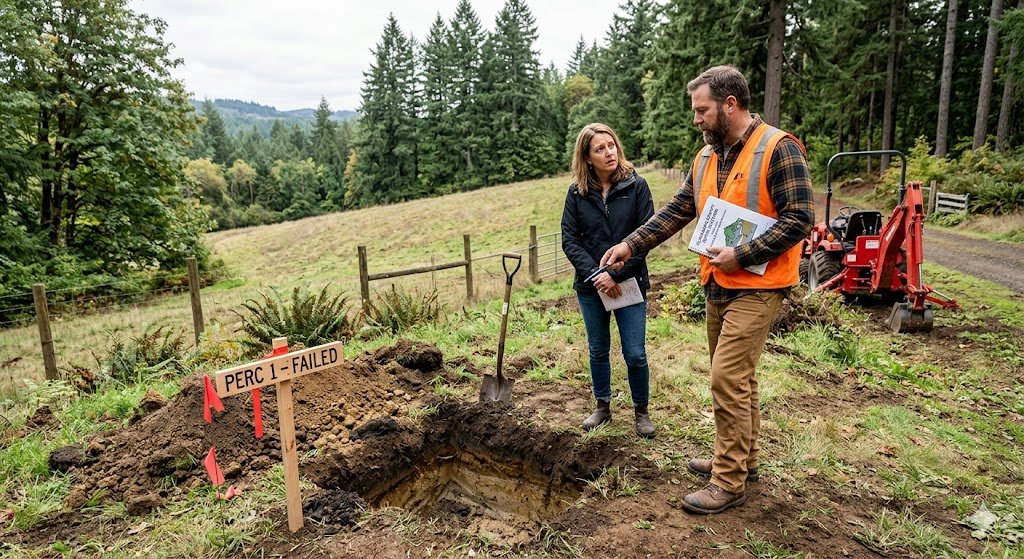
A failed perc test doesn’t automatically mean a lot is unbuildable. Soil modification, regulatory review, and alternative disposal options can open paths forward that a standard test result doesn’t reveal.
Site Re-Evaluation and Soil Modification
A single perc test result isn’t always the final word. Test conditions—soil moisture, season, or test location—can influence results significantly. Requesting a re-evaluation under different conditions or in a different area of the lot is a reasonable first step.
If the soil itself is the problem, engineered fill or mound systems can sometimes correct drainage issues. These approaches involve importing suitable soil material to create an adequate absorption layer above the native ground.
Key options worth exploring:
-
- Mound system installation over imported fill material
-
- Soil fracturing to improve drainage in compacted clay
-
- Re-testing in alternate lot areas with better drainage characteristics
A licensed soil scientist or civil engineer familiar with Clackamas County requirements should assess feasibility before investing further.
Considering Lot Constraints and Regulations
Clackamas County has specific setback requirements, minimum lot sizes, and system placement rules that affect what solutions are physically allowed. A lot may fail not because soil is uniformly poor, but because usable soil area is restricted by setbacks from wells, property lines, or waterways.
| Constraint Type | Common Impact |
| Setback from wells | Limits system placement area |
| Slope restrictions | Reduces viable drain field zones |
| Minimum lot size rules | May block subdivision or variance options |
Reviewing the county’s Onsite Wastewater Management Program rules with a permit specialist can identify whether a variance or lot line adjustment creates a workable solution.
Exploring Off-Site Disposal or Community Systems
When on-site options are exhausted, off-site disposal may be viable. Shared or community septic systems serve multiple parcels from a single treatment site located on more suitable soil nearby.
Connecting to an existing municipal sewer system is another option if the lot is within a service boundary or if extension is feasible. This requires coordination with the local utility district.
Some rural areas in Clackamas County allow holding tanks as a temporary permitted solution, though these carry ongoing pumping costs and are rarely approved for permanent residential use.
Advanced Treatment Technology (ATT) Systems: The Modern Septic Alternative
When a perc test fails in Clackamas County, ATT systems offer a code-compliant path forward by treating wastewater to a higher standard than conventional systems, making them viable on sites where traditional septic cannot be permitted.
What Sets ATT Systems Apart?
A conventional septic system relies on the soil to filter and absorb wastewater passively. If the soil fails a perc test, that process breaks down — literally. ATT systems take a different approach by treating the wastewater before it ever reaches the soil.
Most ATT systems used in Clackamas County use one or more of the following treatment stages:
-
- Primary treatment – settling solids in a standard septic tank
-
- Secondary treatment – aerobic processing using a media filter, textile filter, or aerobic treatment unit (ATU)
-
- Dispersal – drip irrigation, mounded systems, or pressure-dosed drain fields
The effluent leaving an ATT system is significantly cleaner than what exits a conventional septic tank. This reduces the demand placed on the soil, which is exactly why these systems can work on sites with poor drainage or low percolation rates.
Why ATT Systems Are Often Required After Perc Test Failure
In Clackamas County, the Oregon Administrative Rules (OAR 340-071) govern onsite wastewater systems. When a site fails a standard perc test, the county will not approve a conventional system. An ATT system is one of the few approved alternatives that can still get a permit issued.
The reason comes down to how the rules define “site suitability.” A failed perc test means the soil cannot handle untreated septic effluent. ATT systems produce Class B or Class A effluent, which meets a lower dispersal standard and can legally be applied to soils that would otherwise be unsuitable.
Sites with clay-heavy soils, high seasonal water tables, or limited lot area — all common in parts of Clackamas County — are frequent candidates for ATT approval after a failed test.
ATT Success Stories in Clackamas County
We have worked with property owners in areas like Sandy, Estacada, and rural parts of Oregon City where failed perc tests initially stalled construction or sale. In several cases, a textile media filter ATT system with drip dispersal was the approved solution that allowed the project to move forward.
One example involved a 1.2-acre parcel near Estacada with silty clay loam soil that absorbed water at roughly 90 minutes per inch — well outside conventional limits. After an ATT design was submitted and approved by Clackamas County Environmental Health, the owner was able to build and occupy the home within the same construction season.
Cost Considerations and Long-Term Value
ATT systems cost more upfront than conventional systems. A standard gravity septic system in Oregon may run $10,000–$18,000, while an ATT system typically ranges from $20,000–$40,000+ depending on system type, lot conditions, and dispersal method.
| Cost Factor | Conventional Septic | ATT System |
| Installation | $10,000–$18,000 | $20,000–$40,000+ |
| Annual Maintenance | Minimal | $300–$600/year |
| Permit Feasibility (failed perc) | Not approved | Potentially approvable |
| System Lifespan | 20–30 years | 20–30 years with proper maintenance |
The ongoing maintenance requirement is real — ATT systems in Oregon require a signed maintenance agreement with a certified service provider. That said, for a property that would otherwise be unbuildable or unsellable, the added cost is often justified. The ability to obtain a permit and move forward has real financial value.
Comparing ATT Systems and Conventional Septic Solutions
ATT systems treat wastewater more thoroughly than conventional septic systems, require less land, and reduce nutrient discharge into the surrounding soil and groundwater — all of which matter significantly on Clackamas County properties that have failed a perc test.
Treatment Efficiency in Challenging Conditions
Conventional septic systems rely on the soil itself to filter and treat wastewater after it leaves the tank. When a perc test fails, it means that soil cannot do that job adequately — whether due to clay content, a high water table, or low absorption rates.
ATT systems don’t depend on soil absorption to achieve treatment. Instead, they use mechanical and biological processes inside the unit to treat wastewater to a much higher standard before it ever reaches the drainfield.
| Feature | Conventional Septic | ATT System |
| Primary treatment location | Soil absorption field | Inside the unit |
| Effluent quality | Basic | Advanced (reduced BOD, TSS, nitrogen) |
| Soil permeability required | High | Low |
| Performance in clay soil | Poor | Functional |
| Performance near high water table | Poor | Functional with proper design |
This is why ATT systems are the approved pathway in Oregon for sites that cannot support a standard system.
Space Requirements and Lot Size Adaptations
A conventional drainfield typically requires a large footprint — often 1,000 to 2,500 square feet or more, depending on soil and household size. That’s a significant portion of a smaller residential lot.
ATT systems produce higher-quality effluent, which means the drainfield that follows can be substantially smaller. In some Clackamas County installations, the reduced drainfield area is half or less of what a conventional system would need.
This makes ATT systems viable on:
-
- Smaller urban lots with limited yard space
-
- Irregular parcels where usable area is constrained by slopes or setbacks
-
- Properties near wetlands or water features with strict buffer requirements
Environmental Impact and Sustainability
Conventional septic systems discharge effluent with relatively high levels of nitrogen, phosphorus, and biological oxygen demand (BOD) into the surrounding soil. Near streams, drainage ditches, or shallow groundwater, this creates measurable water quality risk.
ATT systems reduce nitrogen and BOD significantly before discharge. This directly reduces the nutrient load reaching Clackamas County’s waterways, including tributaries that feed into the Willamette River basin.
Oregon DEQ recognizes this difference, which is reflected in the permitting requirements. ATT systems are not just an alternative — they are required on sensitive sites because their environmental performance is measurably better.
Navigating Permitting and Installation in Clackamas County
Getting an ATT system approved and installed in Clackamas County involves a defined process through the county’s Department of Health, Housing, and Human Services (HHS), and working with a licensed installer from the start saves significant time and cost.
Understanding the Local Approval Process
In Clackamas County, all onsite sewage system permits — including ATT systems — are issued through the Environmental Health division of HHS. We need to submit a site evaluation application before any system design is approved.
The county requires a licensed site evaluator to assess soil conditions, lot size, setbacks, and proximity to water sources. If our perc test failed, that site evaluation report is actually still useful — it documents the soil limitations that justify an ATT system application.
Key items required for the permit application include:
-
- Completed site evaluation report
-
- System design stamped by a licensed designer or engineer
-
- Property deed and site map
-
- Applicable permit fees (typically $1,500–$3,000+ depending on system complexity)
Working With Licensed Installers
In Oregon, ATT systems must be installed by an Oregon DEQ-licensed onsite installer with experience in the specific ATT technology being used — not just any general contractor.
We strongly recommend choosing an installer who has hands-on experience with the ATT brand or system type approved for our site. Some manufacturers, such as Advantex or Orenco, maintain their own lists of certified installers familiar with their systems.
The installer typically coordinates directly with Clackamas County HHS for inspections, which reduces our administrative burden. Confirm before hiring that your installer:
-
- Holds a current Oregon onsite installer license
-
- Has prior ATT installations in Clackamas County specifically
-
- Can manage permit coordination and inspection scheduling
Timelines and Inspection Milestones
Realistic timelines matter when we’re planning a build or property sale. In Clackamas County, the permitting process for an ATT system typically takes 6 to 14 weeks from application to permit issuance, depending on review workload and whether revisions are needed.
Inspections are required at multiple stages:
| Milestone | When It Occurs |
| Excavation inspection | Before any system components are placed |
| Component installation inspection | During active installation |
| Final inspection | Before the system is covered and activated |
We cannot legally cover any portion of the system before the relevant inspection is completed and approved. Scheduling inspections promptly avoids delays that can push timelines out by weeks.
Planning Ahead to Avoid Future Setbacks
A failed perc test in Clackamas County doesn’t have to catch you off guard — knowing what to check before you buy, how to stay compliant after installation, and what costs to expect can save significant time and money.
Tips for Pre-Purchase Due Diligence
Before purchasing a property in Clackamas County, we recommend requesting the full site evaluation history from Clackamas County’s Department of Transportation and Development (DTD). This includes any existing perc test results, soil logs, and prior permit applications.
Key steps to take before closing on a property:
-
- Order a site feasibility study through a licensed Oregon onsite system designer
-
- Check for DEQ-listed soil limitations such as high clay content or seasonal high water tables
-
- Confirm lot size meets minimum requirements for the system type being considered
-
- Ask if any previous systems failed or were denied permits
If the property already has a system, request the as-built drawing and the most recent inspection report. A system with no documentation is a red flag.
Maintaining System Compliance
In Clackamas County, many ATT systems operate under a mandatory maintenance contract with a licensed service provider. Missing scheduled service visits can result in permit violations and fines.
We recommend keeping a dedicated folder — physical or digital — that contains:
-
- Maintenance logs and service reports
-
- Alarm test records
-
- Any correspondence with the county or DEQ
Annual inspections are the minimum for most ATT systems. Some systems, particularly those with UV disinfection or drip irrigation components, require quarterly servicing. Staying current with these requirements protects both your system and your property value.
Budgeting for Upgrades or Repairs
ATT system components have defined lifespans. Planning for replacement costs ahead of time prevents financial surprises.
| Component | Typical Lifespan | Estimated Replacement Cost |
| UV disinfection unit | 5–10 years | $500–$1,500 |
| Control panel/alarm | 10–15 years | $800–$2,000 |
| Pump(s) | 7–12 years | $400–$1,200 |
| Drip tubing/laterals | 15–25 years | $3,000–$8,000+ |
We suggest setting aside $300–$600 per year in a dedicated maintenance fund to cover routine servicing and prepare for eventual component replacements.
Conclusion
A failed perc test in Clackamas County is frustrating, but it is not the end of the road for your project. There are real, code-compliant paths forward.
The most important steps after a failed test are:
-
- Get a licensed site evaluator to assess your specific soil and site conditions
-
- Explore ATT systems as a primary alternative to conventional septic
-
- Work with Clackamas County Environmental Health early to understand permit requirements
-
- Consult a licensed Oregon onsite wastewater installer before making any financial decisions
ATT systems have allowed many properties with poor drainage, clay-heavy soil, or high water tables to move forward with development. We see this regularly in Clackamas County, where challenging soil conditions are common.
The financial picture matters too. Here is a quick comparison to keep in mind:
| Factor | Conventional Septic | ATT System |
| Works after failed perc test | Rarely | Often yes |
| Suitable for difficult soils | No | Yes |
| Ongoing maintenance required | Minimal | Yes |
| Permit approval likelihood | Low | Higher |
We understand that navigating this process can feel overwhelming. The key is acting quickly, getting the right professionals involved, and knowing that solutions exist even when the initial test results are discouraging.
Contact a licensed site evaluator or ATT system specialist in Clackamas County to review your options and move your project forward.
Frequently Asked Questions
Failed perc tests in Clackamas County raise consistent questions about what the results mean, which site conditions trigger them, and how advanced treatment technology can turn an unbuildable lot into a permitted, functional property.
What does it mean if a soil evaluation indicates the site cannot support a standard drainfield?
A standard drainfield relies on soil to absorb and treat wastewater at a rate that matches household output. When a soil evaluation determines the site cannot support this, it means the absorption rate is too slow, the seasonal high water table is too close to the surface, or there is insufficient depth to limiting layers like fractured rock or hardpan.
This does not automatically mean the property cannot have an onsite wastewater system. It means a conventional gravity-fed or pressure-distribution drainfield is not a viable option under Oregon Administrative Rule 340-071.
Which site conditions typically cause a property to fail infiltration or dispersal requirements?
In Clackamas County, the most common conditions that lead to a failed perc test or unfavorable site evaluation include:
-
- Clay-heavy soils with a long-term acceptance rate below 0.2 gallons per day per square foot
-
- High seasonal water tables that rise within 2 to 4 feet of the proposed drainfield bottom
-
- Shallow soil depth over restrictive layers like basalt, compacted gravel, or cemented soil horizons
-
- Steep slopes that reduce the available area for dispersal
-
- Small lot size that limits setback-compliant placement of a standard system
Many rural parcels in the Clackamas foothills and valley floor areas encounter more than one of these conditions simultaneously.
What immediate steps should a homeowner take after receiving an unfavorable site evaluation report?
We recommend reading the report carefully and identifying the specific reasons the site was flagged. The Oregon DEQ or Clackamas County Environmental Health office will note whether the denial is due to soil texture, limiting layers, water table depth, or available area.
From there, contact a licensed professional engineer or a certified installer who has experience with alternative onsite systems. They can assess whether an ATT system, a mound system, or a constructed wetland approach could satisfy the site’s treatment and dispersal needs.
Do not assume the property is a total loss for development. Many sites that fail conventional evaluation are still approvable under a different system design.
How can an advanced treatment option make a previously unsuitable lot buildable or permit-ready?
ATT systems treat wastewater to a higher effluent quality before it reaches the soil. This matters because Oregon rules allow reduced setbacks and shallower dispersal depths when effluent meets NSF 245 or equivalent treatment standards.
On a Clackamas County lot where clay soils or a high water table would reject a standard drainfield, an ATT system can make the dispersal component viable by reducing the loading rate required and allowing installation closer to restrictive soil layers. We have seen properties with as little as 18 inches of usable soil depth become permit-ready with the right ATT design.
The system does the treatment work that the soil cannot do on its own, which shifts the burden away from soil conditions and toward engineered performance.
What permitting, design, and inspection steps are usually required when installing a non-conventional wastewater system?
In Clackamas County, the permitting process for an alternative or ATT-based system typically involves:
-
- Site evaluation conducted by a licensed soil scientist or professional engineer and submitted to County Environmental Health
-
- System design prepared by a licensed engineer, specifying the ATT unit model, tank sizing, dispersal field dimensions, and setback compliance
-
- Permit application submitted to Clackamas County with design documents and fees
-
- Installation by a licensed contractor, often with staged inspections at excavation, tank placement, and dispersal field installation
-
- Final inspection and approval before the system is covered or put into service
-
- Operation and maintenance agreement filed with the county, since ATT systems require ongoing servicing
Oregon DEQ also maintains oversight on NSF-certified ATT units, and the specific unit installed must appear on the state’s approved product list.
How do installation costs, maintenance responsibilities, and long-term performance compare between advanced treatment and conventional onsite systems?
A conventional septic system in Clackamas County typically costs between $15,000 and $30,000 installed, depending on soil conditions and system size. An ATT-based system generally runs $25,000 to $50,000 or more, depending on the treatment unit, dispersal method, and site complexity.
Maintenance is a meaningful difference. Conventional systems require pumping every 3 to 5 years. ATT systems require a service contract with a certified maintenance provider, typically involving quarterly or semi-annual inspections, effluent sampling, and mechanical checks on components like pumps, blowers, and controls.
Long-term performance on challenging sites often favors ATT systems. A conventional system placed in marginal soil may fail within 10 to 15 years, requiring costly repairs or full replacement. An ATT system sized and maintained correctly typically performs reliably for 20 to 30 years on the same site where a conventional system would have struggled.