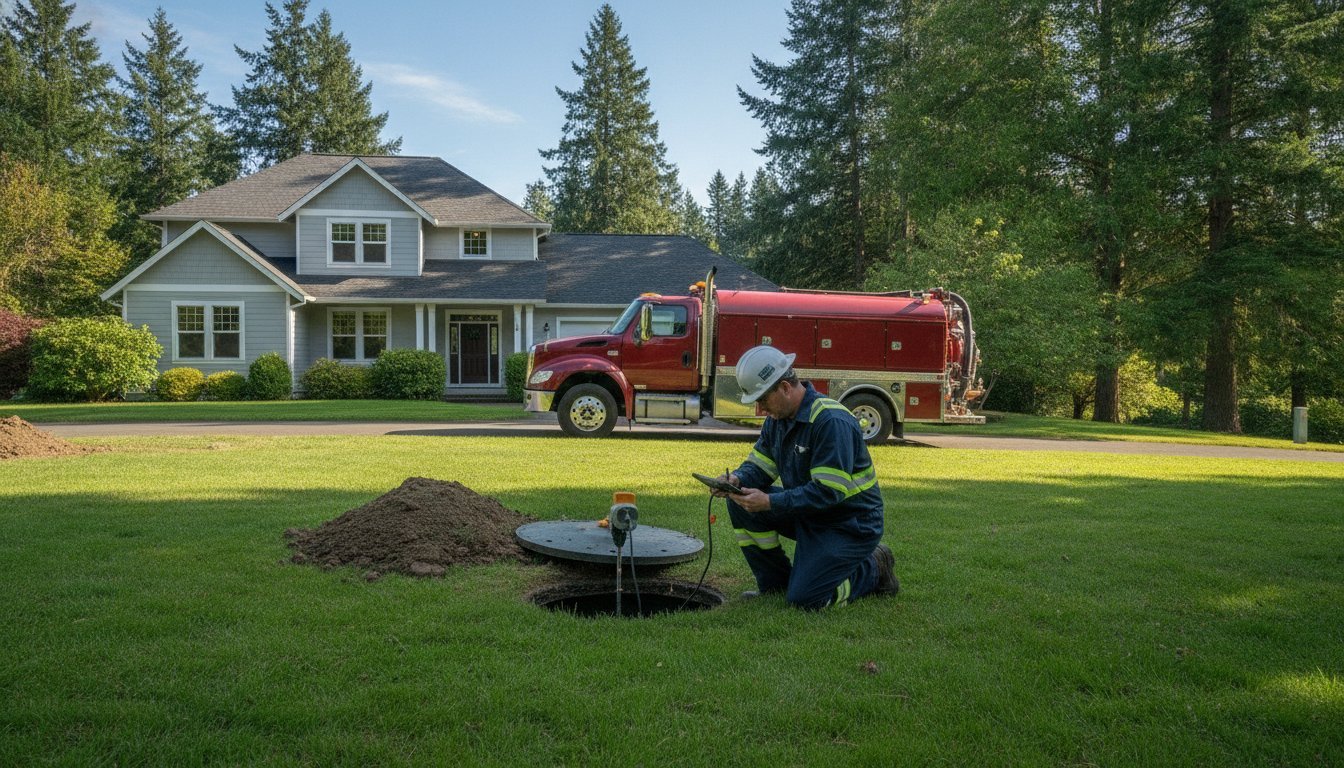
A failed perc test in Washington County doesn’t mean your property is unbuildable or that your dream of installing a septic system is over. In many cases, a failed percolation test simply means a conventional septic system isn’t the right fit — and that alternative solutions, particularly Advanced Treatment Technology (ATT) systems, may be exactly what the situation calls for.
We know how stressful this moment can be, especially if you’re a homeowner mid-project or a buyer who just received unexpected news. The good news is that Washington County, like much of the region, recognizes that soil conditions vary widely, and the regulatory framework reflects that reality by allowing approved alternatives.
In this post, we’ll walk through what a failed perc test actually means, why conventional systems fall short in certain conditions, and how ATT systems have helped property owners in similar situations move forward successfully. We’ll also address some of the most common misconceptions that cause unnecessary confusion along the way.
Understanding Perc Tests in Washington County
A failed perc test doesn’t automatically mean your land is unbuildable — but it does mean you need to understand exactly what the test measures and what Washington County’s rules require before moving forward.
What Is a Perc Test?
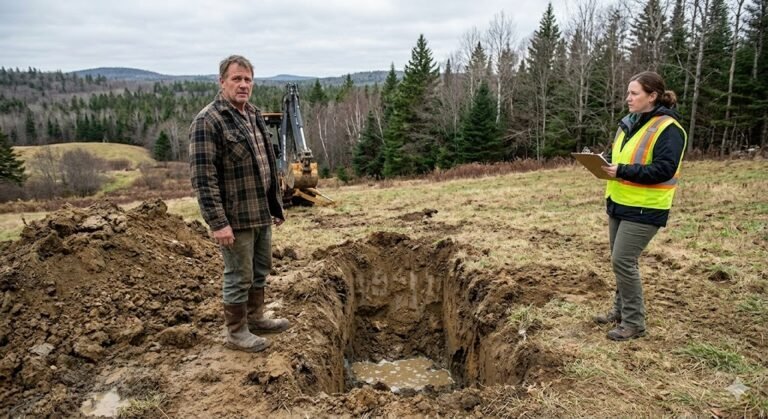
A percolation test, or perc test, measures how quickly water drains through soil. We dig test holes at specific depths, fill them with water, and record how fast the water absorbs. The result is expressed in minutes per inch (MPI).
| Result | Interpretation |
| 1–60 MPI | Generally suitable for a conventional septic system |
| 61–120 MPI | Marginal — may require engineered solutions |
| 120+ MPI | Typically fails conventional septic requirements |
Slow drainage usually points to clay-heavy soil, which is common throughout much of Washington County.
Why Perc Tests Matter for Septic Systems
A conventional septic system relies on a drain field to disperse treated wastewater into the surrounding soil. If the soil drains too slowly — or too quickly — that process breaks down.
When we see a failed perc test, it means the soil cannot safely absorb effluent at the rate a standard system produces it. This creates a direct risk of:
- Sewage surfacing in the yard
- Groundwater contamination
- Failure to meet Washington County health department approval
Without passing results, Washington County will not issue a septic permit, which blocks new construction or property development entirely.
How Local Regulations Impact Your Options
Washington County follows Oregon’s Department of Environmental Quality (DEQ) standards for onsite wastewater systems. The county’s Environmental Health division reviews all perc test results and determines which systems are permitted on a given parcel.
A failed conventional perc test doesn’t mean a blanket denial. Washington County does allow alternative system approvals when supported by a licensed site evaluator’s report.
Key regulatory factors we encounter in Washington County include:
- Minimum lot size requirements for drain field setbacks
- Seasonal high water table restrictions, particularly in the Tualatin Valley floor
- Soil profile evaluations that go beyond the basic perc test
Working with a licensed Oregon onsite wastewater designer is essential to navigate these requirements accurately.
What to Do After a Failed Perc Test
A failed perc test in Washington County doesn’t automatically mean your land can’t support a septic system. Knowing the next concrete steps, understanding why the test failed, and reaching out to the right professionals can reopen options you may not have considered.
Immediate Steps to Take
First, don’t make any rushed decisions about the property. A single failed test is not a final verdict.
Request a copy of the official test results. The report will include soil absorption rates, depth readings, and any notation about restrictive layers. These details matter for your next steps.
From there, consider the following actions:
- Wait for a retest window — Washington County may allow a retest under different seasonal or moisture conditions
- Commission a full soil evaluation — a licensed soil scientist can identify whether specific areas of the lot perform differently
- Review the site layout — sometimes a different location on the parcel will pass where another failed
- Explore alternative system eligibility — not all properties need to pass a conventional perc test to qualify for a permitted system
Acting quickly and methodically gives you the most options going forward.
Common Causes of Perc Test Failure
Understanding why the test failed helps determine what solutions are actually viable.
| Cause | What It Means |
| Clay-heavy soil | Water drains too slowly for conventional absorption |
| High water table | Saturated soil can’t accept effluent safely |
| Compacted soil | Prior construction or grading has reduced permeability |
| Shallow bedrock | Insufficient depth between the surface and rock layer |
| Seasonal saturation | Testing during wet months can skew results |
Clay soil and high water tables are the two most common failure reasons in Washington County. Both limit conventional drainfield function but don’t necessarily eliminate all system options.
Who to Contact for Guidance
Start with the Washington County Environmental Health department. They issue permits, maintain records of prior tests on the parcel, and can clarify what alternative systems are approved for use in the county.
Next, contact a licensed septic designer or engineer with experience in alternative systems. They can assess your specific site conditions and identify whether an ATT system or other engineered solution fits your lot.
A certified soil scientist is also worth consulting if your soil profile is unclear or contested. Their independent evaluation carries weight with the county during the permitting process.
Conventional Septic Systems: Limitations and Concerns
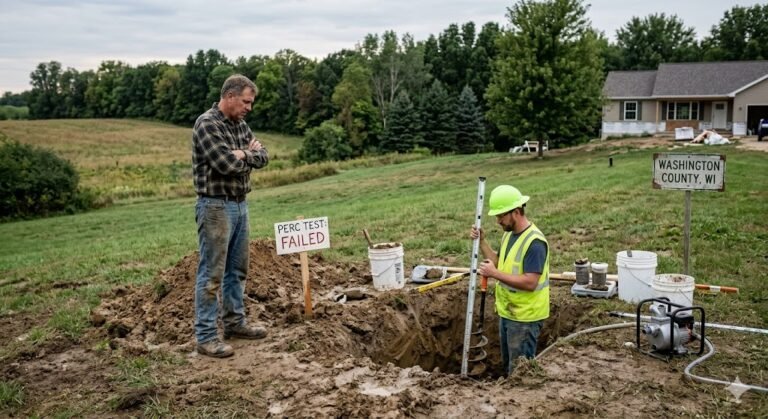
Conventional septic systems depend heavily on soil conditions, lot size, and groundwater depth — and in Washington County, those factors frequently work against them.
Impact of Soil and Site Conditions
Soil type determines whether a conventional drain field can safely absorb and filter wastewater. In Washington County, clay-heavy soils are common, and clay absorbs water very slowly. When a perc test measures absorption rates below the acceptable threshold, it’s a direct signal that the soil cannot handle a standard system.
Common soil-related failure triggers:
- Clay soil — absorbs water too slowly, causing effluent to back up
- Compacted soil — limits percolation regardless of soil type
- Rocky or shallow bedrock — leaves insufficient depth for a drain field
- Saturated soil — already holding too much moisture to accept more
When soil fails to perc, installing a conventional system anyway creates a public health risk, not just a regulatory problem.
Risks of Forcing a Traditional System
Installing a conventional septic system on a site that failed its perc test isn’t just inadvisable — it’s a code violation in Washington County. Unpermitted or improperly designed systems can result in sewage surfacing in your yard, contaminating soil and nearby water sources.
Beyond the health risks, we also face serious financial exposure:
- Fines and mandatory remediation costs from the county
- Potential liability if neighboring wells are contaminated
- Property devaluation and complications during resale
A failed system doesn’t just stop working quietly. It typically fails visibly and expensively.
Why Small Lots and High Water Tables Pose Challenges
Conventional drain fields require a minimum amount of usable land and adequate vertical separation between the drain field and the seasonal high water table. Washington County requires at least 2 feet of separation in most cases.
On small lots, there simply isn’t enough horizontal space to lay out a compliant drain field. On sites with a high water table — common near rivers, wetlands, or low-lying areas — that vertical separation disappears seasonally.
| Challenge | Why It Matters |
| Small lot size | Not enough space for a standard drain field footprint |
| High water table | Effluent reaches groundwater before adequate treatment |
| Both combined | Conventional systems become effectively impossible to permit |
These aren’t edge cases in Washington County. They’re conditions we encounter regularly on buildable lots.
Advanced Treatment Technology (ATT) Systems: A Modern Solution
A failed perc test in Washington County doesn’t close the door on development — ATT systems are a state-approved pathway that treats wastewater to a higher standard, making them viable where conventional systems cannot be permitted.
How ATT Systems Work in Challenging Conditions
ATT systems use multi-stage treatment processes to reduce biological oxygen demand (BOD), suspended solids, and pathogens before effluent ever reaches the soil. This matters because Washington County sites that fail percolation tests typically have clay-heavy soils or high water tables that cannot safely absorb minimally treated wastewater.
The treatment process typically includes:
- Primary treatment – settling tanks remove solids
- Secondary treatment – aeration or media filtration breaks down organic matter
- Disinfection – UV or chlorination reduces pathogens to safe levels
Because the effluent is significantly cleaner, it places far less demand on the absorption field, allowing it to function in soil conditions that would overwhelm a standard system.
Why ATT Is Ideal for Failed Perc Test Sites
Washington County requires a perc test to confirm soil can absorb septic effluent at an acceptable rate. When soil absorbs too slowly — often below 60 minutes per inch — a conventional system is denied.
ATT systems sidestep this limitation by producing effluent that is cleaner and lower in volume of contaminants, reducing the hydraulic and biological load on the drainfield. Washington State’s Department of Health recognizes ATT systems under WAC 246-272A as an approved alternative when conventional systems are not feasible.
This means a property that would otherwise be unbuildable can move forward — with the right system design and a licensed O&M provider in place.
ATT System Advantages Over Traditional Septic
| Feature | Conventional Septic | ATT System |
| Effluent quality | Basic | Advanced (NSF 40 or higher) |
| Suitable for clay soils | Rarely | Yes, with proper design |
| Approved after failed perc | No | Yes (WAC 246-272A) |
| Drainfield size required | Larger | Often reduced |
| Ongoing maintenance | Minimal | Required O&M contract |
The trade-off is real — ATT systems require a mandatory maintenance contract with a licensed service provider. Inspections typically occur two to four times per year. That cost is predictable and manageable, especially compared to a property that cannot be developed at all.
Real-World Example: Successful Installation in Washington County
A homeowner in the rural areas of Washington County purchased a half-acre parcel and failed the perc test due to silty clay soil with an absorption rate exceeding 90 minutes per inch. A conventional gravity system was not approvable.
We worked with a licensed designer to specify a recirculating media filter ATT system paired with a pressure-dosed drainfield. The Washington County sanitarian approved the design under the alternative system provisions.
The homeowner was able to build, and the system has operated within compliance parameters for over three years with routine semi-annual inspections. The lot that appeared unusable became a permitted, functioning residential property.
Steps to Move Forward With ATT System Installation
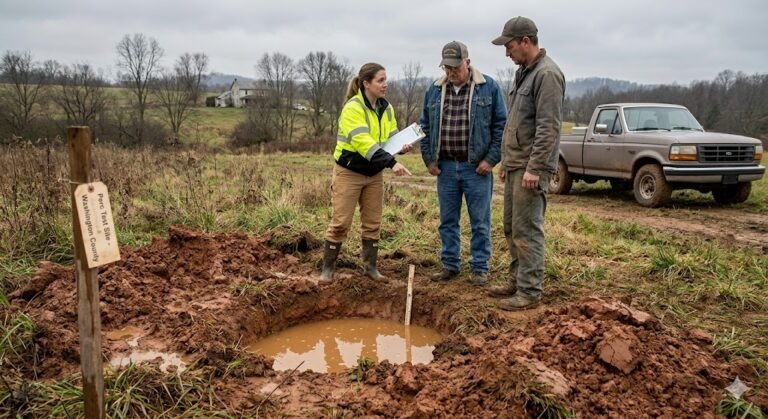
Getting an ATT system installed in Washington County involves navigating permits, hiring the right licensed professionals, and understanding realistic costs — all of which are manageable with the right information.
Assessment and Permitting Process
The first step is a site evaluation conducted by a licensed on-site sewage designer. Even if your perc test failed, this evaluation determines which ATT system design is appropriate for your specific soil conditions, lot size, and setback requirements.
In Washington County, permits for ATT systems are issued through the Oregon Department of Environmental Quality (DEQ) and the county environmental health department. The process typically includes:
- Site evaluation and soil assessment
- System design submitted by a licensed designer
- DEQ review and permit approval
- Inspection during and after installation
Permit timelines vary, but plan for 4 to 12 weeks from application to approval depending on system complexity and workload.
Working With Qualified Professionals
ATT systems must be designed by a DEQ-licensed designer and installed by a licensed installer with ATT certification. This is not optional — unapproved installations will not pass inspection and can void your permit entirely.
Ask any contractor you consider for:
- Their Oregon DEQ license number
- Experience with the specific ATT system type being proposed
- References from Washington County projects
We recommend getting at least two quotes. ATT systems require ongoing maintenance contracts, so evaluate the installer’s long-term service reliability, not just the upfront price.
Cost Considerations and Incentives
ATT systems typically cost between $15,000 and $30,000 installed, depending on system type, site conditions, and required components. Drip irrigation systems and mound systems tend to fall on the higher end.
Ongoing costs include:
- Annual maintenance contracts: $300–$600/year
- DEQ-required monitoring reports: often included in the maintenance contract
- Pump and component replacements every 7–15 years
Some financing options exist through USDA Rural Development loans and Oregon DEQ’s Onsite Loan Program, which offers low-interest financing specifically for onsite septic system upgrades. Check eligibility early in the process — approval takes time.
Addressing Common Misconceptions About Alternative Septic Solutions
ATT systems are frequently misunderstood — dismissed as a last resort or assumed to be high-maintenance burdens. In reality, they are engineered solutions with a strong track record in Washington County’s specific soil and land conditions.
Are ATT Systems Only for Emergency Cases?
Many property owners assume ATT systems are only installed after everything else has failed. That is not accurate. We see ATT systems chosen proactively by builders and developers who know their site has challenging soil conditions — such as heavy clay or shallow bedrock — before a perc test is even attempted.
ATT systems are a legitimate first-choice solution, not a fallback. In Washington County, where certain soil profiles make conventional septic approval unlikely, specifying an ATT system from the start saves time, money, and delays in the permitting process.
Bottom line: A failed perc test is one pathway to an ATT system — but it is far from the only one.
Longevity and Maintenance Expectations
A common concern is that ATT systems require excessive upkeep. The reality is more straightforward. Most ATT systems in Washington County require:
- Annual inspection by a licensed service provider
- Periodic filter or media replacement, typically every 3–5 years depending on system type
- Effluent monitoring to confirm treatment levels remain within state standards
Conventional septic systems also require regular pumping and inspection — often every 3 years. The maintenance gap between conventional and ATT systems is smaller than most people expect.
ATT systems do have more components, but those components are designed for durability. With proper servicing, a well-installed ATT system routinely performs for 20–30 years.
Environmental Benefits of ATT Technology
Conventional septic systems treat wastewater to a basic standard before it disperses into the soil. ATT systems go further. They reduce nitrogen, phosphorus, and pathogens to significantly lower levels before the effluent ever reaches the drainfield.
In Washington County, where some properties sit near streams, wetlands, or well water sources, this distinction matters. Lower nutrient loads reduce the risk of groundwater contamination and protect nearby water bodies from excess nitrogen that contributes to algae growth.
For properties on smaller lots where the drainfield is closer to property lines or water features, ATT systems provide a measurable layer of environmental protection that conventional systems simply cannot match.
Conclusion
A failed perc test in Washington County is a setback, not a dead end. We have walked through the options, and the path forward is clearer than most property owners expect.
ATT systems have become a reliable, permitted solution for sites where conventional septic simply won’t work. We see them succeed regularly on properties with clay-heavy soil, high water tables, and tight lot sizes — exactly the conditions that cause perc tests to fail.
Here is a quick recap of what we covered:
- Failed perc tests do not automatically disqualify a property from getting a septic permit
- Soil conditions like clay and shallow depth to groundwater are common in Washington County
- ATT systems treat wastewater to a higher standard before dispersal, which allows them to work in restrictive soil conditions
- Working with a licensed engineer early in the process saves time and reduces costly surprises
- Permits and approvals are still required, but ATT systems are a recognized pathway through Washington County’s regulatory process
We recommend contacting a licensed on-site sewage designer or civil engineer as your first step. They can evaluate your specific site conditions and determine which ATT system fits your property.
Don’t let a single failed test stop a project that may still be fully viable. The right system, designed correctly, can turn a difficult lot into a buildable one. Reach out to our team to schedule a site consultation and get a clear picture of your options.
Frequently Asked Questions
A failed perc test in Washington County raises specific questions about soil conditions, local regulations, and what realistic options remain for moving forward with an onsite wastewater system.
What does it mean when a site evaluation indicates the soil will not support a standard drainfield?
When a site evaluation returns this result, it means the soil’s ability to absorb and treat effluent from a conventional septic system does not meet Washington County’s minimum standards. The soil may be too dense, too slow to drain, or too shallow above a restrictive layer like bedrock or clay.
This does not mean your property cannot support any wastewater system. It means a standard gravity-fed drainfield is not an approved option for that specific site.
What are the most common local conditions that lead to an onsite wastewater system being denied in this area?
Washington County has a mix of terrain and soil types that frequently cause conventional system denials. The most common conditions we see include:
- Heavy clay soils with low permeability that do not allow effluent to move through at acceptable rates
- Shallow seasonal high water tables, particularly in low-lying areas near streams or wetlands
- Shallow bedrock, which limits the depth available for trench installation
- Small lot size that restricts the physical footprint required for a standard drainfield and its required reserve area
What immediate steps should be taken after receiving an unfavorable soil or seasonal water table report?
First, do not assume the property is unbuildable. Request a copy of the full site evaluation report and review exactly which conditions caused the failure. Understanding the specific limiting factor — whether it is water table depth, soil texture, or slope — determines which alternative pathway is available to you.
Next, contact a licensed designer or onsite wastewater professional who has experience with alternative systems in Washington County. They can assess whether a variance, a modified design, or an alternative treatment technology is a viable path forward based on the documented site conditions.
Which alternative onsite wastewater options are typically considered when conventional trenches are not feasible?
When conventional trenches are ruled out, Washington County regulators and licensed designers typically evaluate the following alternatives:
- Mound systems, which place the drainfield above grade using imported fill material to create separation from the limiting layer
- Drip irrigation systems, which distribute treated effluent through a pressurized network of tubing closer to the soil surface
- ATT (Advanced Treatment Technology) systems, which treat wastewater to a higher standard before dispersal, allowing placement in areas where untreated effluent would not be permitted
- Holding tanks, which are generally considered a last resort due to ongoing pumping costs and no treatment benefit
The right option depends on the specific limiting conditions documented in the site evaluation.
How do advanced treatment technologies reduce risk on challenging sites such as clay soils, shallow bedrock, or high groundwater?
ATT systems work by treating wastewater to a significantly higher quality before it ever reaches the soil. Conventional systems rely on the soil itself to do much of the treatment work. When the soil cannot perform that function — because it is too tight, too shallow, or too wet — the risk of system failure or groundwater contamination increases substantially.
By delivering cleaner effluent to the dispersal area, ATT systems reduce the hydraulic and biological load placed on the soil. On a site with slow-draining clay, for example, a lower volume of higher-quality effluent is far less likely to cause surfacing or system backup than raw septic tank effluent would be.
This is why Washington County and Oregon DEQ regulations specifically allow ATT systems in locations where conventional systems are prohibited. They are not a workaround — they are an engineered response to the actual site conditions.
What documentation, design work, and approvals are usually required before installing an alternative treatment system on a constrained lot?
The process typically involves several steps, and skipping any one of them will delay or invalidate the permit. Here is what we generally see required:
- Completed site evaluation documenting soil texture, permeability, seasonal high water table depth, and any restrictive layers
- System design prepared by a licensed onsite wastewater designer, specifying the ATT unit, dispersal method, setbacks, and maintenance requirements
- DEQ or county permit application submitted with the approved design and supporting site data
- Installer qualifications — Washington County requires that alternative systems be installed by a licensed and DEQ-registered installer with experience in the specific technology being used
- Operation and Maintenance agreement — most ATT systems require a signed O&M contract with a certified service provider before final approval is granted
The timeline from site evaluation to permit approval varies, but having a qualified designer involved from the beginning typically reduces delays significantly.