A failed perc test in Multnomah County doesn’t mean your property is unbuildable or that your plans are finished. It means you need to understand what went wrong, what your options are, and how to move forward with the right alternative system. Many properties that fail conventional percolation testing go on to successfully support compliant, functional wastewater systems through alternative approaches.
Multnomah County has specific soil conditions, lot sizes, and regulatory requirements that make failed perc tests more common than people expect. We’ll walk through what a failed test actually means, how to evaluate your next options, and what the approval and installation process looks like from a practical standpoint.
A significant part of that path forward involves ATT systems — Advanced Treatment Technology systems — which are designed specifically for properties where conventional septic systems can’t perform. We’ll also cover costs, maintenance, environmental considerations, and answers to the questions we hear most often from property owners in this situation.
Understanding Perc Tests in Multnomah County
A perc test determines whether your soil can absorb wastewater at a safe rate, and in Multnomah County, specific soil types and county regulations make this process more demanding than in many other Oregon jurisdictions.
What Is a Perc Test and Why Is It Required?
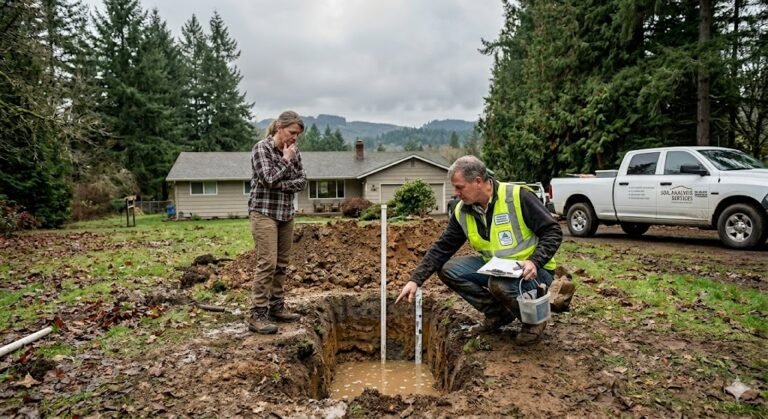
A percolation test — commonly called a perc test — measures how quickly water drains through the soil at a proposed septic system site. We conduct this test by digging test holes, saturating the soil, and timing how fast the water level drops. The result is expressed in minutes per inch (MPI).
Multnomah County requires a perc test before approving any on-site septic system permit. Without a passing result, the county will not authorize a conventional septic installation.
| Result | Absorption Rate | Implication |
| Passing | 1–60 MPI | Eligible for conventional system |
| Marginal | 61–120 MPI | May require engineered system |
| Failing | 120+ MPI or no absorption | Alternative system required |
Common Reasons Perc Tests Fail
Perc tests fail when the soil cannot absorb water fast enough to handle typical household wastewater output. Several site-specific factors cause this.
- Clay-heavy soil — clay particles hold water and severely restrict drainage
- High water table — seasonal saturation limits the available absorption depth
- Compacted soil — often found on previously developed or graded lots
- Shallow bedrock — limits how deep a drain field can be installed
- Restrictive soil layers — hardpan or fragipan layers that block downward water movement
In Multnomah County, clay soil and high seasonal water tables are the two most common failure causes, particularly in lower-elevation areas near the Columbia and Willamette rivers.
Regulations and Unique Soil Conditions in Multnomah County
Multnomah County operates under Oregon DEQ’s OAR 340-071 rules, but county environmental health staff apply local site assessment standards that account for the region’s distinct geology.
Much of the county sits on Willamette silt loam and Columbia River alluvial deposits — soil types that compact easily and drain poorly. Properties in areas like Sauvie Island or the East County floodplain face especially difficult conditions.
We are also required to have a licensed site evaluator conduct the test and submit results directly to Multnomah County Environmental Health. DIY testing is not accepted. Lot size, setback requirements from wells and water features, and slope all factor into whether a site can even proceed to the testing stage.
Immediate Next Steps After a Failed Perc Test
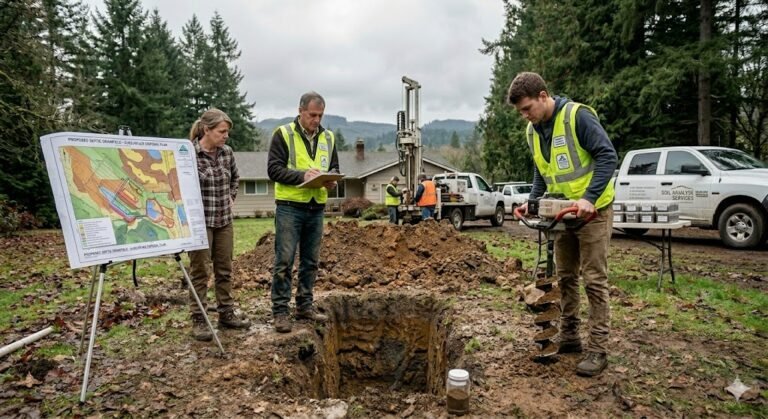
A failed perc test in Multnomah County doesn’t end your project — but it does require a clear plan. Understanding what your results mean, who to contact, and what physical constraints exist on your site will shape every decision that follows.
Interpreting Your Perc Test Results
A perc test measures how quickly water drains through soil, reported as minutes per inch (MPI). Multnomah County uses these numbers to determine whether a conventional septic system is feasible.
| Result | Meaning |
| 1–60 MPI | Generally acceptable for conventional systems |
| 61–120 MPI | Marginal; may require engineered solutions |
| 120+ MPI | Failed — conventional septic not permitted |
A result above 120 MPI typically means your soil drains too slowly to support a standard drainfield. This is common in areas with heavy clay soils, which are widespread throughout Multnomah County.
It’s also worth noting why the soil failed — seasonal saturation, compacted subsoil, and shallow bedrock each point toward different solutions.
Communicating with County Officials and Inspectors
Your first call should go to Multnomah County Environmental Health, the department responsible for on-site septic permitting. Ask for a written copy of your test results if you don’t already have one.
When you speak with the inspector, ask these specific questions:
- What was the measured MPI at each test location?
- Were multiple test sites evaluated across the parcel?
- Is a variance, site evaluation, or alternative system permit available for this property?
County staff can tell you exactly which permit pathways remain open. Don’t assume a single failed test closes all options — site-specific variances exist, and inspectors can sometimes recommend retesting in a different location on the property.
Exploring Site-Specific Constraints
Before pursuing any solution, we need a complete picture of the physical limitations on the lot. A licensed site evaluator can assess factors that the basic perc test doesn’t capture.
Key constraints to evaluate include:
- Depth to seasonal high water table — affects drainfield placement depth
- Soil profile and layering — clay lenses or hardpan layers restrict lateral drainage
- Setback requirements — distance from wells, property lines, and waterways limits placement options
- Lot topography — steep or irregular terrain may rule out gravity-fed systems
These findings directly determine which alternative systems Multnomah County will approve for your parcel.
Evaluating Alternative Septic Solutions
When a perc test fails in Multnomah County, conventional septic systems are no longer an option — but that doesn’t mean the property is undevelopable. Understanding how alternative systems compare, when they apply, and how site conditions affect your choices is the starting point for moving forward.
Overview of Conventional vs. Alternative Systems
Conventional septic systems rely on soil absorption to treat and disperse wastewater. When soil percolation rates fall outside the acceptable range, the soil cannot perform that function safely.
Alternative systems are engineered to treat wastewater before it reaches the soil, reducing the demands placed on absorption. This distinction matters because it expands the range of conditions under which a lot can still support an onsite sewage system.
| Feature | Conventional System | Alternative System |
| Requires passing perc test | Yes | No |
| Pre-treats wastewater | No | Yes |
| Works in poor soil | No | Often yes |
| Higher upfront cost | No | Yes |
When to Consider an Alternative Septic Solution
A failed perc test is the most direct trigger, but it isn’t the only one. We also recommend evaluating alternatives when:
- Soil percolation is too slow (common with Multnomah County’s clay-heavy soils)
- The water table is too shallow to provide adequate separation distance
- The lot is too small to fit a standard drainfield with required setbacks
- An existing system has failed and replacement in kind isn’t feasible
Multnomah County follows Oregon DEQ rules, which outline approved alternative system types. Knowing which category your situation falls into helps narrow the options quickly.
Impact of Property Size, Soil, and Water Table
These three factors — lot size, soil type, and water table depth — are the core variables we assess after a failed perc test.
Lot size determines whether there’s physical space for any system, including a reduced-footprint alternative. Smaller lots often leave ATT systems as the only viable path.
Soil type affects how well treated effluent can disperse. Multnomah County’s clay soils drain poorly, which is a primary reason perc tests fail here.
Water table depth sets a hard limit on system placement. Oregon DEQ requires minimum vertical separation between the drainfield bottom and the seasonal high water table — typically 24 inches for alternative systems.
ATT Systems: Advanced Solutions for Challenging Properties
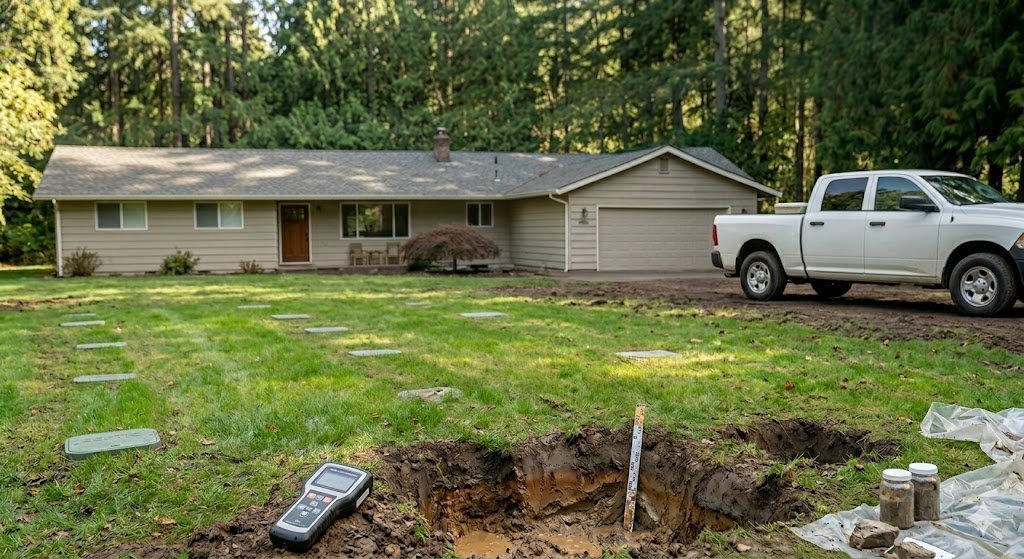
When a perc test fails in Multnomah County, ATT systems offer a licensed, code-compliant path forward for properties that can’t support a conventional septic system. They treat wastewater to a higher standard, which allows installation in soil conditions and lot sizes that would otherwise make development impossible.
What Is an ATT System and How Does It Work?
An ATT (Advanced Treatment Technology) system is a type of onsite wastewater treatment system that processes sewage to a significantly higher quality than a standard septic tank before dispersing it into the soil.
Where a conventional system relies on the soil alone to filter partially treated effluent, an ATT system does most of the treatment work mechanically or biologically before any liquid reaches the drain field. This matters because it reduces the burden on the soil significantly.
Most ATT systems include:
- A primary settling tank — removes solids before treatment
- An advanced treatment unit — uses aeration, media filtration, or textile-based filters to break down contaminants
- A dispersal field — spreads the treated effluent, often at a shallower depth than conventional systems require
Oregon DEQ certifies specific ATT models for use in the state, so any system we install must appear on the approved product list.
Why ATT Systems Are Often Necessary After a Failed Perc Test
A failed perc test in Multnomah County typically means the soil absorbs water either too slowly or too quickly to safely handle conventional septic effluent. Clay-heavy soils, which are common throughout the Portland metro area, often absorb water at rates below the minimum threshold Oregon DEQ requires.
ATT systems produce effluent that meets Treatment Level 2 or Treatment Level 3 standards under Oregon Administrative Rule 340-071. This higher-quality output can be dispersed using pressure-dosed systems or drip irrigation, which spreads the effluent more evenly and reduces the volume any one area of soil must absorb at once.
This is why ATT approval often unlocks a permit on a lot that previously had no viable path to onsite sanitation.
Benefits of ATT Systems for Small Lots and Difficult Soils
Small lots in Multnomah County face a compounding problem: limited space for a drain field and soil that may not perform well enough for a standard system. ATT systems address both issues directly.
| Challenge | How ATT Systems Help |
| Clay or compacted soil | Higher-quality effluent requires less soil absorption capacity |
| Small lot size | Smaller drain fields are permitted when effluent quality is higher |
| Shallow soil depth | Drip dispersal systems operate closer to the surface |
| High seasonal groundwater | Reduced effluent loading lowers contamination risk |
Because the treatment unit handles most of the processing, the drain field can be smaller and placed in areas that a conventional system couldn’t use.
Case Study: Overcoming a High Water Table with ATT Technology
A property in the west hills of Multnomah County failed its perc test due to a seasonal high water table sitting within 18 inches of the surface — well above Oregon DEQ’s minimum separation requirements for conventional systems.
We worked with the property owner and a licensed designer to specify a textile-filter ATT unit paired with a subsurface drip dispersal system. The drip system operated at a shallow depth with timed, low-volume doses, which prevented saturation and maintained the required separation from groundwater.
The permit was approved. The property, which had been listed as unbuildable, moved forward with a new single-family home.
This outcome isn’t unusual. ATT systems with drip dispersal are one of the most consistently successful approaches we see used on Multnomah County lots where high water tables caused the initial perc test failure.
Planning and Installing an ATT System in Multnomah County
Getting an ATT system approved and installed in Multnomah County involves navigating county-specific permitting, site-specific design requirements, and working with installers who hold the right certifications under Oregon state rules.
Permitting and Approval Process
In Multnomah County, ATT systems are regulated under Oregon Administrative Rules (OAR) Chapter 340, Division 71, and permits are issued through Multnomah County Environmental Health.
The process typically follows these steps:
- Site evaluation — A licensed site evaluator assesses soil conditions and confirms a conventional system cannot be used.
- System design submission — A licensed designer submits ATT system plans to the county for review.
- Permit issuance — County Environmental Health reviews and approves the design before any installation begins.
- Final inspection — An inspector verifies the installation meets approved plans before the system goes live.
Permit fees vary depending on system complexity. We recommend contacting Multnomah County Environmental Health directly for current fee schedules, as they are updated periodically.
Design Considerations for Challenging Sites
ATT systems in Multnomah County are often installed on sites with one or more of the following constraints:
- Shallow restrictive layers (hardpan or clay)
- High seasonal water tables, common in lower-elevation areas of the county
- Small lot sizes with limited drainfield space
- Steep slopes that restrict conventional drainfield placement
The design must account for the specific treatment level required. Oregon classifies ATT systems by treatment performance — Level 2, Level 3, or Level 4 — with higher levels required when the soil or site poses greater risk to groundwater.
For example, a site near the Columbia Slough may require a Level 4 system with nitrogen reduction due to proximity to sensitive waterways. The designer selects the appropriate technology — such as a textile filter, drip irrigation dispersal, or mound system — based on these site-specific factors.
Working with Certified Installers
Not every contractor can legally install an ATT system in Oregon. Installers must hold an Oregon DEQ-issued onsite system installer license, and the designer must be a licensed onsite system designer.
We recommend verifying credentials through the Oregon DEQ license lookup before hiring anyone. Working with an uncertified contractor can result in permit denial, required system removal, or fines.
Key questions to ask a prospective installer:
- Are you licensed under Oregon DEQ for ATT system installation?
- Have you installed systems in Multnomah County specifically?
- Can you coordinate directly with the designer and county inspector?
Experienced installers familiar with Multnomah County’s review process can help avoid delays and ensure the system is installed correctly the first time.
Costs, Maintenance, and Long-Term Considerations
ATT systems come with higher upfront costs than conventional septic systems, but they also carry specific maintenance obligations and compliance requirements that owners in Multnomah County need to plan for from the start.
Comparing Costs: ATT Systems Versus Traditional Septics
A conventional septic system in Multnomah County typically runs between $10,000 and $20,000 installed. An ATT system costs more — generally $15,000 to $40,000 depending on the technology, site conditions, and required treatment level.
| System Type | Estimated Install Cost | Lifespan |
| Conventional Septic | $10,000–$20,000 | 20–30 years |
| ATT System | $15,000–$40,000 | 20–30+ years |
The higher cost reflects the added engineering, components, and site-specific design. For a lot that has already failed a perc test, an ATT system is often the only path to development — making the cost comparison less about preference and more about necessity.
Ongoing Maintenance for ATT Systems
ATT systems require annual inspections and servicing contracts, which Multnomah County mandates as a condition of permit approval. Expect to pay $300 to $600 per year for a service agreement with a licensed O&M (Operation and Maintenance) provider.
Maintenance typically includes:
- Inspecting mechanical components like pumps and aerators
- Testing effluent quality
- Adjusting dosing cycles as needed
- Submitting inspection reports to the county
Missing an inspection isn’t just a mechanical risk — it can put your system out of compliance and trigger county enforcement. Staying current on your O&M contract protects both your property and your permit status.
Ensuring Compliance with County Requirements
Multnomah County requires that all ATT systems operate under an approved O&M plan filed with Environmental Health. The county tracks compliance through required reporting from your licensed service provider.
If your system falls out of compliance — due to missed inspections or component failure — the county can issue a notice of violation, which may restrict occupancy or use of the property. Keeping documentation organized and renewing your O&M contract on time prevents most compliance issues before they start.
Environmental and Lifestyle Advantages of ATT Systems
ATT systems treat wastewater to a higher standard before it disperses into the soil, which directly reduces contamination risk to groundwater and opens up more flexible options for where and how a drainfield can be placed on your property.
Protecting Local Water Resources
Multnomah County sits within the Columbia River Basin, and groundwater here connects directly to drinking water sources, streams, and wetlands. A conventional septic system that fails — or was never properly suited to the soil — can leach nitrogen, phosphorus, and pathogens into that groundwater.
ATT systems use multi-stage treatment processes, such as aerobic digestion and UV disinfection, to reduce those contaminants before any effluent reaches the soil. The result is treated water that meets significantly stricter quality standards than conventional septic output.
This matters most on properties near seasonal streams, low-lying areas, or lots with shallow soil depth — all common conditions in Multnomah County.
Increasing Usable Land on Small Lots
A failed perc test on a small lot often means a conventional drainfield simply won’t fit within the required setbacks and square footage. ATT systems change that equation.
Because ATT-treated effluent is cleaner, county regulations typically allow:
- Reduced setback distances from property lines, wells, and structures
- Smaller drainfield footprints due to higher-quality effluent
- Shallow or alternative dispersal methods like drip irrigation systems
On a half-acre lot where a conventional system would consume most of the buildable area, an ATT system with drip dispersal can free up space for a garage, garden, or accessory structure. That’s a practical difference in how you can actually use your land.
Supporting Future Property Value
A lot with a documented, permitted ATT system is a buildable lot. A lot with no approved wastewater solution is often unbuildable — or heavily discounted on the market.
Real estate professionals in Multnomah County consistently flag septic feasibility as a deal-breaker during transactions. Having an installed and permitted ATT system:
| Factor | Impact |
| Buildability | Confirms the lot can legally support a dwelling |
| Buyer confidence | Reduces inspection contingency risk |
| Financing eligibility | Lenders often require confirmed septic solutions |
An ATT system isn’t just a workaround — it’s documentation that your property meets county standards, which carries real weight during a sale or refinance.
Conclusion and Your Next Steps
A failed perc test in Multnomah County is not the end of the road for your property. It simply means the path forward requires a different approach — and that approach often leads to a better, more durable solution.
If your perc test has failed, here is what we recommend doing next:
- Request a detailed copy of your test results from the county or your licensed site evaluator
- Schedule a site assessment with a licensed Oregon onsite wastewater specialist
- Ask specifically about ATT systems and whether your site qualifies
- Contact Multnomah County Environmental Health to understand your permit options
- Consult a real estate attorney if the failed test affects a pending property transaction
The sooner you take action, the more options you preserve. Waiting can limit your choices, especially if a property sale or construction timeline is involved.
| Situation | Recommended Next Step |
| Building a new home | Site evaluation + ATT system design |
| Buying/selling property | Legal review + feasibility assessment |
| Existing failing system | Emergency evaluation + county notification |
| Undeveloped land | Full site assessment before purchase |
We work with homeowners, builders, and real estate professionals across Multnomah County to find workable solutions even on the most challenging sites. ATT systems have made buildable what many assumed was unbuildable.
Reach out to our team today to schedule a consultation and find out what options are available for your specific property.
Frequently Asked Questions
Percolation test failures in Multnomah County raise specific questions about soil conditions, permitting pathways, and what treatment systems are actually approved for problematic sites. We’ve addressed the most common concerns homeowners and builders bring to us when conventional septic options fall through.
What does it mean when a site fails a percolation test, and how does that affect septic eligibility?
A percolation test measures how quickly water moves through soil. When a site fails, it means the soil absorbs water too slowly — or sometimes too quickly — to safely treat and disperse wastewater through a conventional drainfield.
In Multnomah County, a failed perc test does not automatically disqualify a site from having an onsite wastewater system. It does mean that a standard gravity-fed septic system is no longer an approved option, and the project must pursue alternative treatment pathways to move forward.
Which site factors most commonly cause percolation issues in this area, such as clay soils, shallow groundwater, or restrictive layers?
The most frequent culprits we see in Multnomah County are heavy clay soils, high seasonal water tables, and shallow restrictive layers such as fragipans or bedrock. These conditions are common throughout the West Hills, parts of Sauvie Island, and lower-elevation rural parcels near the Columbia River floodplain.
Clay soil is particularly problematic because water moves through it at rates far below what Oregon DEQ requires for a standard drainfield. When groundwater sits within two to four feet of the surface seasonally, there simply isn’t enough vertical separation to protect groundwater quality.
What are the immediate steps to take after an unsuccessful percolation evaluation to keep a project moving forward?
The first step is requesting the written test results from your licensed site evaluator and reviewing exactly which failure criteria were triggered. That detail determines which alternative system types are eligible for your specific site conditions.
From there, we recommend:
- Consulting a licensed designer who has experience with ATT and alternative systems in Multnomah County
- Contacting Multnomah County Environmental Health to confirm which approved system technologies apply to your failure type
- Commissioning a more detailed site assessment if soil borings were limited during the initial evaluation
Acting quickly matters if you’re working within a real estate transaction timeline, since county review periods can add several weeks to the process.
When is an advanced treatment option likely to be required, and what performance benefits can it provide compared with a conventional drainfield?
Advanced Treatment Technology (ATT) systems are typically required when a site cannot meet the minimum soil and separation standards for a conventional drainfield. In Multnomah County, this commonly applies to lots with clay-dominated soil profiles, seasonal high water tables above the required separation depth, or sites where available drainfield area is too limited.
ATT systems treat wastewater to a significantly higher standard before dispersal. Where a conventional system discharges primary-treated effluent into the soil, an ATT system can deliver secondary or tertiary-level treatment — reducing suspended solids, biochemical oxygen demand, and in some cases pathogens — before the water ever reaches the drainfield. This means the dispersal area can function safely even in soils that would fail under conventional loading.
What documentation, design work, and local approvals are typically needed to permit an alternative onsite wastewater system?
Permitting an ATT or alternative system in Multnomah County requires more documentation than a standard septic permit. The core requirements generally include:
- A licensed site evaluation report documenting soil morphology, perc rates, and groundwater data
- A system design prepared by an Oregon-licensed onsite wastewater designer
- A DEQ-approved technology designation for the specific ATT unit being proposed
- A Multnomah County Environmental Health permit application with applicable fees
- An operations and maintenance agreement, which is required for most ATT systems
Some systems also require a recorded maintenance contract with a certified service provider before the county will issue final approval. We strongly recommend confirming the current checklist directly with the county, as requirements are updated periodically.
How do costs, timelines, and long-term maintenance responsibilities compare between alternative treatment systems and traditional septic installations?
ATT systems carry higher upfront costs than conventional septic installations. Depending on system type and site complexity, installed costs in the Portland metro area typically range from $20,000 to $45,000 or more, compared to $10,000 to $20,000 for a straightforward conventional system. Site-specific factors like access, excavation depth, and required dispersal method all influence the final number.
Timelines are also longer. Between design, county review, and installation scheduling, plan for three to six months from permit application to a functioning system, though complex sites or incomplete applications can extend that further.
Ongoing maintenance is a real difference to account for. ATT systems require regular inspections, mechanical servicing, and effluent monitoring — often on a quarterly or semi-annual basis — under a maintenance contract. Conventional systems generally require pump-outs every three to five years with no required mechanical servicing. That said, for sites where no other option exists, the maintenance obligation is simply the cost of having a compliant, functioning system.