If you are planning a build in the Willamette Valley and just learned your soil won’t support a standard gravity drainfield, you aren’t alone. For many local property owners, an ATT system installation in Canby is the only path forward to turn a piece of land into a home. It’s frustrating to realize that your “dream lot” has difficult soil or high groundwater, and it is even more confusing when you start looking for an “ATT” septic system and get results for AT&T internet instead. We know the stress that comes with these high-tech requirements and the strict Oregon DEQ regulations that follow them.
You deserve a clear, local perspective on what these systems actually involve without the corporate jargon. We agree that the permitting process feels like a maze and the potential costs can be intimidating. This guide provides the straight talk you need regarding Alternative Treatment Technology costs, specific Clackamas County requirements, and the physical installation factors that matter most for your property. We will walk you through the components of the system and explain how to find a licensed installer who handles the heavy lifting, both in the dirt and with the paperwork.
Key Takeaways
- Discover why Alternative Treatment Technology is often the only viable solution for building on Canby lots with challenging clay soil or high water tables.
- Understand how an ATT system installation in Canby uses advanced oxygenation to protect local groundwater and allows for smaller drainfields on restricted lots.
- Learn about the specific site variables, such as soil morphology and terrain slope, that dictate the complexity and equipment requirements of your septic design.
- Identify the importance of hiring a licensed local specialist who understands Clackamas County DEQ regulations and can handle the entire permitting process from start to finish.
What is an ATT Septic System? (And Why Canby Lots Need Them)
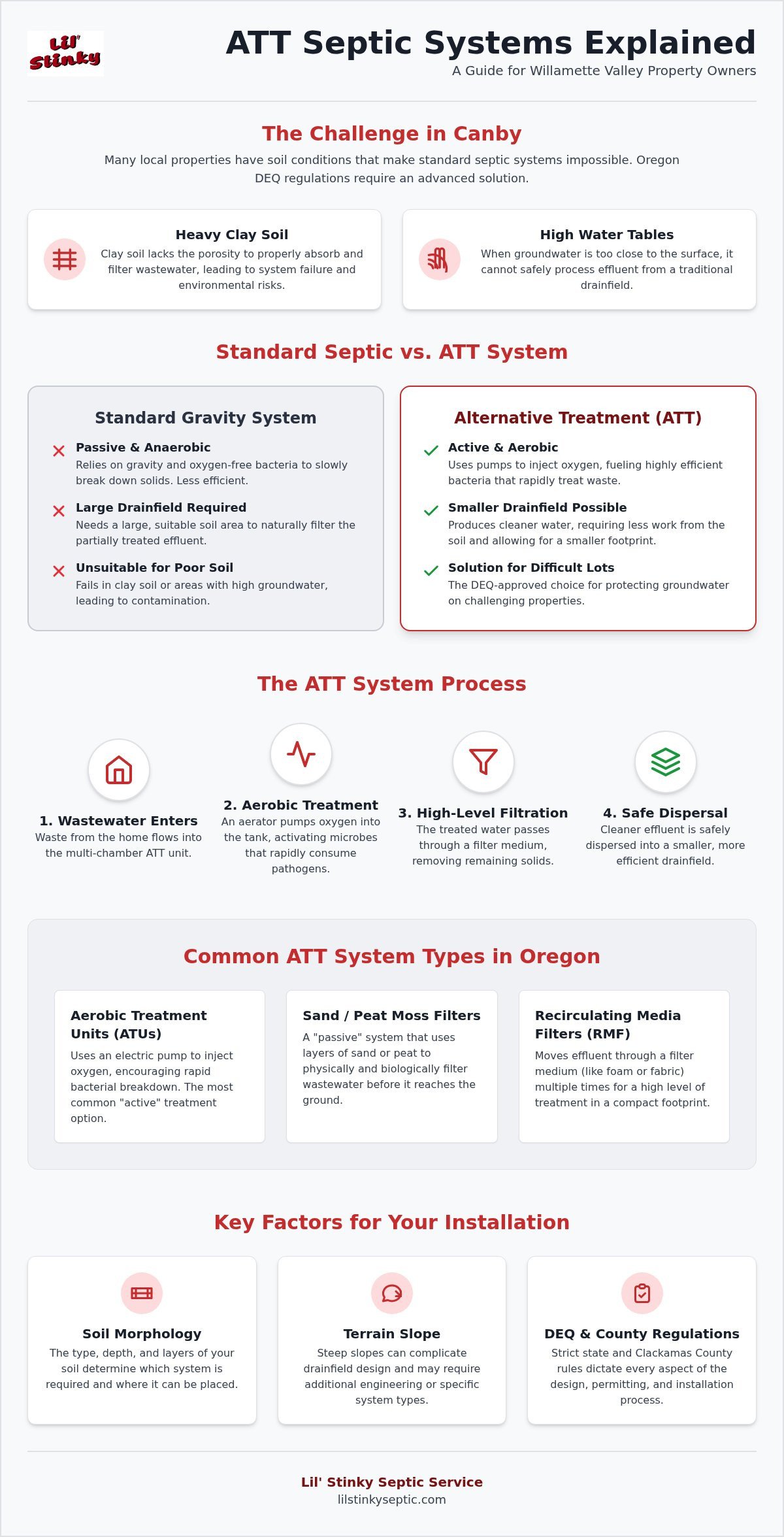
An Alternative Treatment Technology (ATT) system is essentially a high-performance wastewater treatment plant scaled down for residential use. While a standard septic tank relies on gravity and time to settle solids, an ATT system uses advanced sewage treatment processes to actively break down waste. This results in effluent that is significantly cleaner than what leaves a traditional tank. Because the water is pre-treated to a higher standard, it’s safer for the environment and much easier for the soil to absorb.
In the Willamette Valley, soil conditions vary wildly. Many properties in our area sit on heavy clay or have high seasonal water tables that prevent traditional drainfields from working. The Oregon Department of Environmental Quality (DEQ) requires an ATT system installation in Canby when the natural soil lacks the depth or porosity to treat wastewater on its own. Without this technology, many local lots would be considered unbuildable. Choosing an ATT system isn’t about luxury; it’s a regulatory necessity that protects our local groundwater and makes your property functional.
ATT vs. AT&T: Clearing Up the Acronym Confusion
We often hear from homeowners who are frustrated by their online research. When you search for “ATT system installation Canby,” your screen might fill up with cell phone plans and fiber optic internet deals. It’s a common digital mix-up, but the two couldn’t be more different. While one connects you to the web, the other keeps your home sanitary and compliant with state law. At Lil’ Stinky, we focus exclusively on the wastewater side of things. We’re the local specialists who understand the pipes and permits, not the towers and cables.
Common ATT System Types in Oregon
Oregon homeowners typically choose from a few DEQ-approved technologies based on their specific site evaluation. Each type has different maintenance needs and footprints.
- Aerobic Treatment Units (ATUs): These systems use an electric pump to inject oxygen into the wastewater. This encourages “aerobic” bacteria to grow, which are much faster and more efficient at breaking down pathogens than the bacteria found in standard tanks.
- Sand and Peat Moss Filters: These are reliable “passive” ATT options. They use layers of specialized sand or peat to physically and biologically filter the effluent before it reaches the ground.
- Recirculating Media Filters (RMF): These are the workhorses for tight lots. They move the effluent through a filter medium multiple times, achieving a very high level of treatment in a compact footprint.
The right choice depends entirely on your site evaluation. We help you look at the results from Clackamas County and determine which technology fits your land and your budget best.
How ATT Systems Work: Protecting Canby’s Groundwater
Understanding How septic systems work is the first step toward appreciating the complexity of an Alternative Treatment Technology setup. While a standard system simply holds waste and lets it settle, an ATT system is an active environment. It uses a multi-stage process to strip away pathogens and solids before the water ever touches your drainfield. This level of treatment is vital for Canby properties located near the Willamette River or low-lying areas with high groundwater. By reducing nitrogen levels in the effluent, these systems prevent harmful nutrients from leaching into our local waterways and sensitive ecosystems.
For many homeowners, the biggest benefit of this advanced filtration is the space it saves. Because the water leaving the tank is significantly cleaner, the soil doesn’t have to work as hard to finish the job. This efficiency allows the DEQ to approve smaller drainfields, which is a lifesaver for smaller or “unbuildable” lots in Clackamas County. If you’re dealing with a difficult site, a professional ATT system installation in Canby can make your project feasible where a standard system would fail.
The Aerobic Pre-Treatment Stage
A standard septic tank is anaerobic, meaning it operates without oxygen. In contrast, an ATT system features an aerobic chamber that introduces air into the wastewater. Beneficial bacteria in ATT systems act as microscopic workers that consume organic matter and neutralize pathogens at a rapid pace. To keep these bacteria alive and hungry, the system uses mechanical aerators or blowers to maintain high oxygen levels. This process breaks down waste much faster than a traditional tank, resulting in a dramatic reduction in the “strength” of the sewage before it moves to the next phase.
Pressure Distribution and Final Dispersal
Once the aerobic stage is complete, the effluent is often clear enough to be mistaken for tap water, though it’s still not potable. This high-quality output is then sent to the drainfield, usually through a pressure distribution system. Unlike gravity flow systems that can saturate one spot, pressure distribution uses a pump to spread the effluent evenly across the entire absorption area. This prevents “hot spots” in the soil and significantly extends the lifespan of your drainfield. Investing in this technology doesn’t just satisfy the DEQ; it protects your property value by ensuring your septic infrastructure remains healthy for decades.
ATT System Cost vs. Standard Septic Installation
When you compare the price of a standard gravity system to an ATT system installation in Canby, the difference is noticeable. A traditional septic setup is a passive collection of pipes and a concrete tank. An Alternative Treatment Technology system, however, is a sophisticated piece of environmental machinery. The higher initial investment covers advanced aerobic tanks, multi-stage filtration media, and high-tech control panels equipped with telemetry and alarms. While the upfront cost is greater, it’s often the only way to secure a building permit on land with poor soil. Without this technology, many prime Canby properties would remain undeveloped and lose a significant portion of their market value. It’s the difference between a vacant lot and a functional home.
Initial Investment and Equipment Factors
The complexity of Oregon’s Alternative Treatment Technologies (ATTs) requires a more involved planning phase. You aren’t just paying for a tank and some gravel. These projects require detailed engineering designs and rigorous site evaluations to satisfy strict Clackamas County DEQ standards. Beyond the design, the hardware itself is specialized and site-specific. Depending on the system type, you might need high-grade peat moss, specialized sand, or synthetic textile modules to act as the filter bed. These materials are more expensive to source and transport than standard drainfield rock. For a deeper look at how these factors influence the total project budget, you can read our guide on Septic System Installation Cost in Oregon.
Ongoing Operating and Maintenance (O&M) Costs
Owning an ATT system comes with long-term responsibilities that standard septic owners don’t face. Oregon law mandates that owners of systems installed after January 1, 2014, must maintain a service contract with a certified provider. As of 2026, these contracts must meet specific state requirements to ensure your system continues to protect the local environment. These annual inspections ensure the mechanical components are functioning and the effluent meets environmental standards. You should also account for small increases in your utility bill. Because these systems use aerators, blowers, and pumps that often run 24/7, they consume more electricity than a passive gravity system. Regular maintenance is the best way to avoid expensive repairs; replacing a filter or a small mechanical part during a scheduled visit is much cheaper than a total system failure. We recommend budgeting for these annual check-ups as a standard part of your home maintenance plan.
Factors Influencing Your ATT Installation in Canby
No two properties in Clackamas County are identical. When you’re planning an ATT system installation in Canby, the physical characteristics of your land dictate the final design and the total project effort. Soil morphology is the primary factor. If your lot consists of heavy, “clayey” soil common in the Willamette Valley, it won’t absorb water as quickly as sandy loam. This requires a more complex ATT design to ensure the effluent is treated thoroughly before it enters the ground. Similarly, the slope of your lot plays a major role. Steep terrain often makes gravity-fed systems impossible, requiring us to install specialized pressure pumping components to move waste uphill to the dispersal area.
Logistics also impact your timeline and labor costs. Property access is a variable many homeowners overlook. If your site is tucked away behind narrow driveways or heavy timber, getting excavators and delivery trucks to the installation site becomes a puzzle. This increases the hours our crew spends on-site. You also need to account for the administrative side of the project. In Clackamas County, the construction permit for an ATT system is $2,000, plus an Oregon DEQ surcharge of $117. These aren’t just “red tape” expenses; they cover the rigorous oversight that keeps our local environment and groundwater safe.
The Clackamas County Permitting Process
Before you can even choose a tank, you must undergo a formal site evaluation. This evaluation, which currently costs $1,571 for a single-family dwelling in Clackamas County, involves a sanitarian visiting your property to test the soil and determine its “loading rate.” We work closely with local DEQ agents in the Portland area to ensure your application moves through the system without hitches. If you’re buying an existing property with an older system, you’ll also need to follow specific Certified Septic Inspection Oregon rules to remain in compliance with state law.
Site-Specific Engineering Requirements
Alternative Treatment Technology isn’t a “one size fits all” product. Every system we install requires a custom engineering plan that accounts for specific setbacks. Your system must maintain a safe distance from property lines, water bodies, and existing wells. This is especially critical for Canby properties near creeks or low-lying areas where groundwater contamination is a concern. Lil’ Stinky handles the heavy lifting by coordinating directly with engineers and county officials to ensure your design is both functional and legal. If you’re ready to start your project with a team that knows the local dirt, contact us for a professional ATT system installation in Canby today.
Choosing the Right ATT Installer in Canby
Selecting the right contractor for an ATT system installation in Canby is the most critical decision in your building process. These systems are significantly more complex than traditional septic setups. They require a level of technical precision that only comes with specialized training and local expertise. You need a partner who understands both the mechanical side of aerobic treatment and the specific regulatory landscape of Clackamas County. Lil’ Stinky Septic Service brings 25 years of local experience to every project. We’re fully licensed, bonded, and insured (CCB #189693), which protects your investment and ensures every component meets state standards. Unlike providers who only handle the excavation, we manage the entire lifecycle of your system. We coordinate the design, navigate the permit process, perform the physical installation, and set up your mandatory annual maintenance contract.
We believe in transparency and integrity. Because we’re committed to our neighbors, we offer a best-price guarantee for Clackamas County residents. If you receive a lower bid for the same scope of work from a licensed competitor, we’ll match it. Our goal is to provide high-quality environmental solutions that fit your budget while making your property fully functional. We take pride in doing the job correctly the first time, preventing the stress and expense of future system failures.
The Lil’ Stinky Advantage for Canby Homeowners
We are Canby locals who live and work in the same community as you. This gives us a deep familiarity with the specific soil morphology of the Willamette Valley. We know how the heavy clay in our area reacts to a wet Oregon winter and how to design systems that remain reliable when groundwater levels rise. Our communication style is built on straight talk. We don’t use corporate jargon or ambiguous sales pitches. Instead, we offer clear, honest advice rooted in decades of field experience. For those with existing systems, we also provide 24/7 emergency response throughout the Portland area. We’re the dependable ally you can call when things go wrong, ensuring your property stays safe and sanitary.
Next Steps for Your Canby Property
The path to a successful ATT system installation in Canby starts with a thorough site visit. We’ll walk your land, review your site evaluation results, and provide a realistic project estimate based on your specific terrain. To get started, ensure your proposed drainfield area is clear of heavy brush and accessible for machinery. If you’re currently facing a system emergency or a sudden backup, refer to our guide on Emergency Septic Service in Portland Oregon for immediate help. For new construction, involving us early in the design phase is the best way to ensure a smooth permitting process. Contact us today to schedule your consultation and get your project moving forward.
Secure Your Canby Property’s Future
Building on a challenging lot doesn’t have to be a source of constant anxiety. By understanding the role of Alternative Treatment Technology, you can transform a piece of land with poor soil into a safe and compliant home. An ATT system installation in Canby is a long-term investment in your property’s value and the health of the Willamette Valley’s groundwater. It ensures that even the most difficult terrain meets strict DEQ standards while providing a high level of wastewater treatment that protects our local environment for years to come.
Choosing an experienced partner makes all the difference in navigating the complex permitting and technical requirements. With 25 years serving Canby and our status as a fully licensed specialist (CCB #189693), we take the guesswork out of advanced septic projects. We stand behind our work with a best-price guarantee, ensuring you get the most reliable service at the best value. Ready to move forward with your project? Request an ATT System Quote from Lil’ Stinky Septic today. We look forward to helping you build a solid foundation for your new home.
Frequently Asked Questions
Is an ATT system the same as an aerobic septic system?
Yes, in most residential applications, they are very similar. Most Alternative Treatment Technology systems are Aerobic Treatment Units (ATUs) that use oxygen to break down waste faster than traditional tanks. However, “ATT” is the broader regulatory term used by the Oregon DEQ. It includes any advanced technology, such as peat moss or textile filters, that treats effluent to a higher standard than a standard gravity setup.
Why did the DEQ tell me I need an ATT system in Canby?
The Oregon DEQ requires an ATT system installation in Canby when a site evaluation reveals challenging soil or a high water table. Standard gravity systems need deep, porous soil to safely treat wastewater. If your Canby lot has heavy clay or shallow groundwater, the DEQ mandates advanced pre-treatment to protect the environment. This technology makes many lots buildable that would otherwise be rejected for development.
How much more does an ATT system cost compared to a gravity system?
An ATT system requires a higher initial investment because it involves sophisticated machinery rather than just a passive tank. You are paying for advanced aerobic chambers, pumps, and electronic control panels. While these systems are more expensive than gravity setups, they provide the necessary engineering to turn “unbuildable” land into a functional home site. We recommend a professional site visit to understand the specific variables affecting your property’s budget.
How often does an ATT system need to be inspected in Oregon?
All Alternative Treatment Technology systems in Oregon must be inspected at least once a year. This is a state requirement to ensure the mechanical blowers and biological filters are working correctly. In Clackamas County, owners must also pay a $123 fee for the annual evaluation of their Operations and Maintenance (O&M) reports. Keeping up with these inspections is vital for staying in compliance with local environmental regulations.
Can I install an ATT septic system myself to save money?
No, you cannot legally perform this installation yourself. Oregon law requires that ATT systems be installed by DEQ-licensed professionals who also hold specific certifications from the system’s manufacturer. These systems involve complex electrical controls and precise engineering that a standard homeowner isn’t equipped to handle. Attempting a DIY install would violate state law and prevent you from receiving a final certificate of completion for your home.
What happens if my ATT system alarm goes off?
If your alarm sounds, it usually indicates a high water level or a mechanical failure like a pump or blower malfunction. You should immediately reduce your water usage to prevent a backup. Check your control panel for any specific error lights and contact a certified technician right away. We provide 24/7 emergency response for these situations, ensuring a specialist can diagnose the issue before it becomes a major property emergency.
Do ATT systems smell worse than standard septic tanks?
A properly functioning ATT system actually produces less odor than a traditional gravity tank. Because these systems use oxygen to facilitate aerobic digestion, they avoid the “rotten egg” sulfuric gases common in anaerobic tanks. If you notice a foul smell coming from your system, it’s often a sign that the aerator has stopped working or the biological balance is off. A quick professional inspection can usually resolve the issue.
What are the maintenance requirements for an ATT system in Clackamas County?
Maintenance for these systems is mandatory and more detailed than standard septic care. You must maintain a continuous service contract with a certified provider. Requirements include annual inspections, cleaning the internal filters, and testing the mechanical blowers and pumps. As of January 1, 2026, these service contracts must meet specific requirements under Oregon Administrative Rule 340-071-0132 to ensure the system continues to protect the local groundwater and Willamette River.