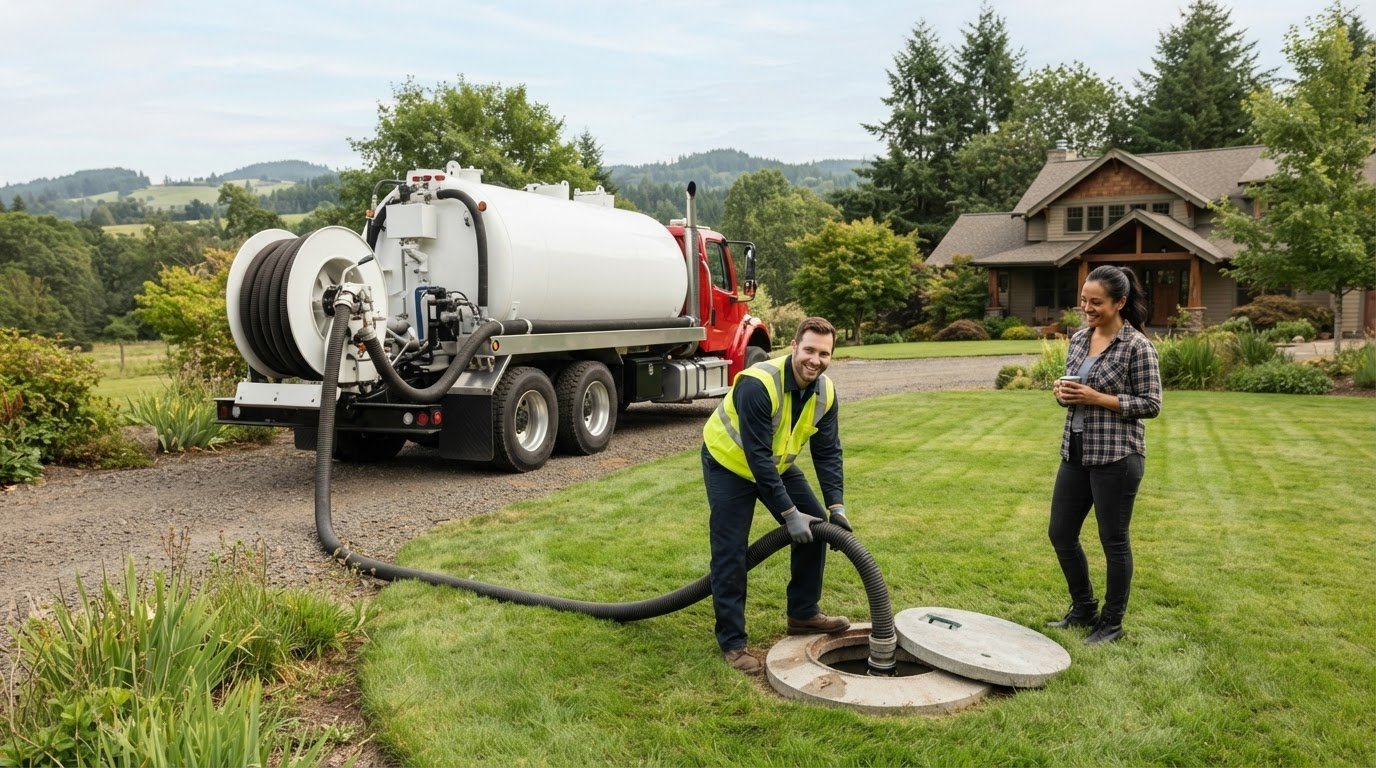
Commercial septic management isn’t routine plumbing; it’s operational risk management. When wastewater backs up at a retail site, restaurant, or business park, it triggers immediate public health closures, lost revenue, and lasting disruption. Staying ahead with the commercial septic pumping Canby businesses count on is your frontline defense against sudden operational failure.
You already have enough on your plate without deciphering complex Oregon DEQ discharge rules or worrying that heavy commercial effluent might ruin an expensive drainfield. Coordinating service without blocking customer parking or disrupting staff is a headache you shouldn’t have to handle alone. Discover how regular commercial septic pumping keeps your Canby facility DEQ-compliant, prevents costly operational downtime, and protects your bottom line.
Below, we break down Clackamas County compliance thresholds, ideal commercial pumping frequencies, and practical steps to safeguard your underground assets while maintaining uninterrupted day-to-day operations.
Key Takeaways
- Learn how heavy wastewater volume accelerates tank accumulation and why routine commercial septic pumping Canby businesses schedule protects expensive drainfield infrastructure.
- Understand Oregon DEQ and Clackamas County compliance requirements, including mandatory on-site pump logs and waste discharge rules.
- Discover staging techniques that allow technicians to service underground tanks cleanly without blocking customer parking or disrupting daily operations.
- Find out why combining scheduled tank pumping with full septic inspections identifies hidden baffle and filter wear before an emergency backup occurs.
- Gain peace of mind by partnering with a Canby-based specialist who understands Willamette Valley soil conditions and delivers dependable, local service.
Understanding Commercial Septic Pumping Requirements for Canby Businesses
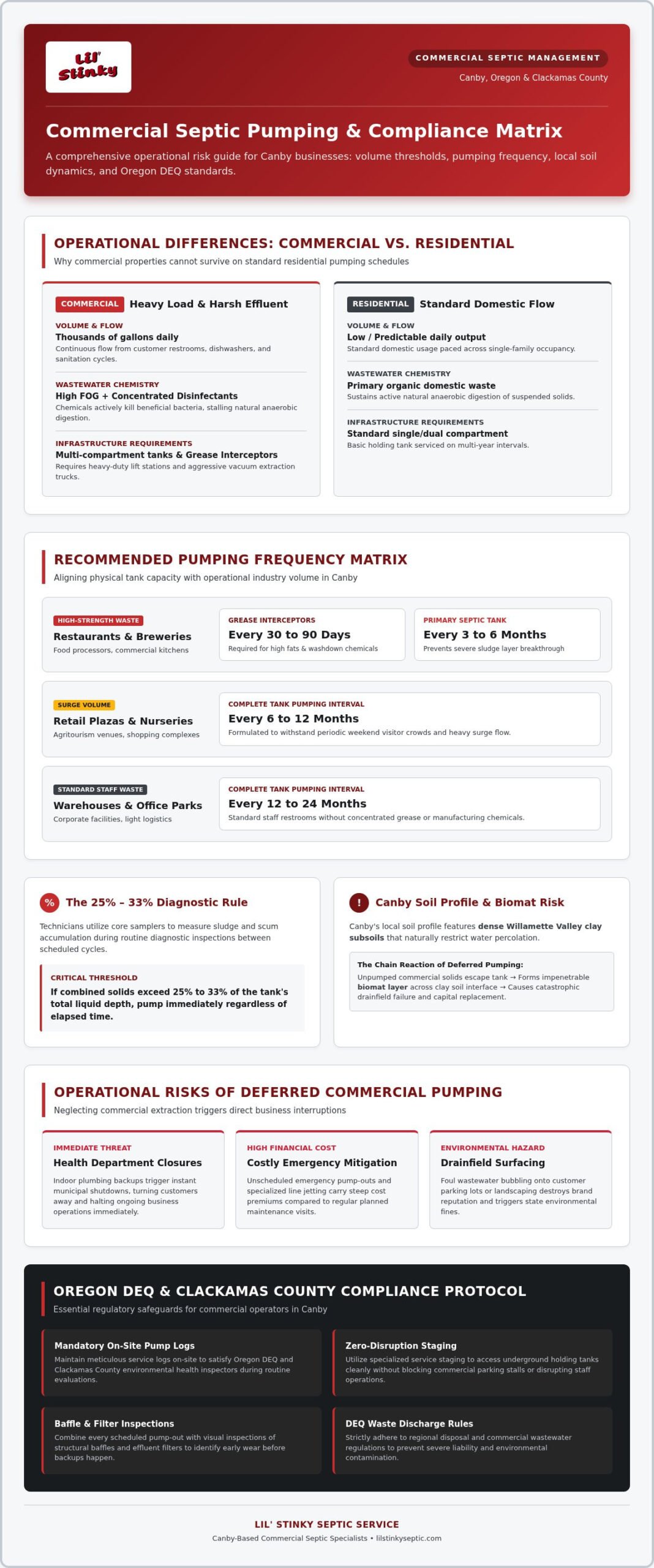
Commercial properties generate significantly higher wastewater volumes and far harsher effluent than any standard household. Between customer restrooms, industrial dishwashers, and recurring sanitation cycles, commercial plumbing takes a relentless beating. In peripheral business corridors outside Canby’s municipal sewer boundary, high-strength wastewater loaded with fats, oils, grease (FOG), and harsh sanitizers flows constantly into underground holding tanks. Without proactive care, that heavy organic load quickly overwhelms underground components.
Commercial vs. Residential Systems: Key Operational Differences
A busy retail plaza, restaurant, or light industrial facility discharges thousands of gallons daily, easily dwarfing standard domestic output. Residential tanks primarily manage organic domestic waste, but commercial operations introduce concentrated chemical disinfectants that actively kill beneficial bacteria. This disruption stalls natural anaerobic digestion, preventing the normal breakdown of suspended solids.
To manage this load, commercial configurations rely on larger multi-compartment tanks, heavy-duty lift stations, and dedicated grease interceptors. Thorough vacuum extraction requires high-capacity vacuum trucks to clear deep sludge layers without damaging structural baffles. A firm grasp of septic tank mechanics and desludging shows why commercial setups require aggressive extraction schedules rather than standard residential routines.
The High Cost of Deferred Commercial Pumping
Ignoring tank accumulation pushes thick sludge directly into the distribution pipes and disposal field. Canby’s local soil profile features dense Willamette Valley clay subsoils that naturally restrict water percolation. When unpumped commercial effluent escapes the primary tank, it creates an impenetrable biomat layer across the soil interface, resulting in premature drainfield failure and catastrophic capital replacement costs.
Neglecting your extraction schedule also triggers severe operational setbacks:
- Health department closures: Indoor plumbing backups force instant municipal shutdowns, turning customers away and halting operations.
- Costly emergency mitigation: Emergency pump-outs and specialized line jetting carry steep premiums compared to planned service.
- Drainfield surfacing: Foul wastewater bubbling onto parking areas or landscaping damages customer perception and risks state environmental penalties.
Staying current with scheduled commercial septic pumping Canby facilities depend on keeps your waste moving safely and protects your property investment.
Determining the Right Commercial Septic Pumping Frequency
Applying residential timelines to a business setting is a recipe for disaster. While a single-family home can often go several years between services, a commercial setup cannot survive on that schedule. Pumping frequencies hinge on daily customer volume, staff headcounts, and wastewater composition under Oregon DEQ onsite wastewater regulations. Relying on an arbitrary schedule invites sudden backups right when your business is busiest.
Pumping Schedule Matrix by Canby Industry Sector
Every commercial facility generates a unique waste profile. Establishing the correct timetable requires aligning your physical tank capacity with operational volume:
- Restaurants, breweries, and food processors: High fats and washdown chemicals demand grease interceptor servicing every 30 to 90 days, with primary septic tank pumping required every 3 to 6 months.
- Retail plazas, agritourism venues, and nurseries: Periodic weekend crowds generate significant wastewater spikes. These operations typically require complete tank pumping every 6 to 12 months.
- Warehouses and corporate office parks: Standard domestic waste from staff restrooms allows for longer intervals, typically requiring service every 12 to 24 months.
Diagnostic Monitoring Between Scheduled Pump-Outs
Routine inspections keep your maintenance schedule accurate and eliminate guesswork. Technicians utilize core samplers to measure sludge and scum accumulation. If combined solids exceed 25 to 33 percent of the tank’s liquid depth, pump immediately regardless of elapsed time.
Commercial operators should also monitor these key indicators:
- Effluent filter conditions: Commercial filters catch hair, lint, and micro-solids. Check and rinse them regularly to prevent effluent from choking inside the outlet baffle.
- Dose counters and lift alarms: Facilities with pressurized drainfields rely on digital pump controls. Tracking pump cycle counts helps identify hidden plumbing leaks or sudden surges from industrial shifts.
- Visual scum caps: Excessive floating grease crusts trap gas and signal that your pretreatment schedule needs tightening.
Keeping a predictable timeline preserves underground infrastructure and avoids code violations. If your site is due for an evaluation, scheduling reliable commercial septic pumping in Canby guarantees your operations remain compliant and fully protected.
What to Expect During a Professional Commercial Septic Pumping Service
Professional pumping is an organized, technical operation designed around business continuity. You cannot shut down operations or surrender parking stalls during peak business hours. A seasoned team stages vacuum vehicles strategically, protects customer walkways, and moves swiftly through a rigorous extraction process without spilling grease or releasing lingering odors across your property.
Step-by-Step Pumping and Tank Agitation Protocol
Upon arrival, technicians map out access points and run heavy-duty suction hoses along designated service pathways. The pumper truck stays safely away from customer parking stalls and loading docks to prevent delivery blockages. Both the primary settling chamber and secondary effluent compartment are opened via their 20-inch or 30-inch access risers.
Surface skimming alone doesn’t cut it. Grease caps and bottom sludge compact over months of heavy commercial use. Crews employ high-pressure backflushing; they pump liquid out and immediately re-inject it under pressure to agitate and break apart the hardened sludge layer. Once the solid cake dissolves, vacuum units pull the slurry out completely, leaving bare tank walls. Adhering to federal EPA septic maintenance guidelines, technicians then examine the cleared concrete interior, checking structural dividing walls, seams, and concrete floors for cracks or chemical etching.
Component Inspections and Mechanical Checks
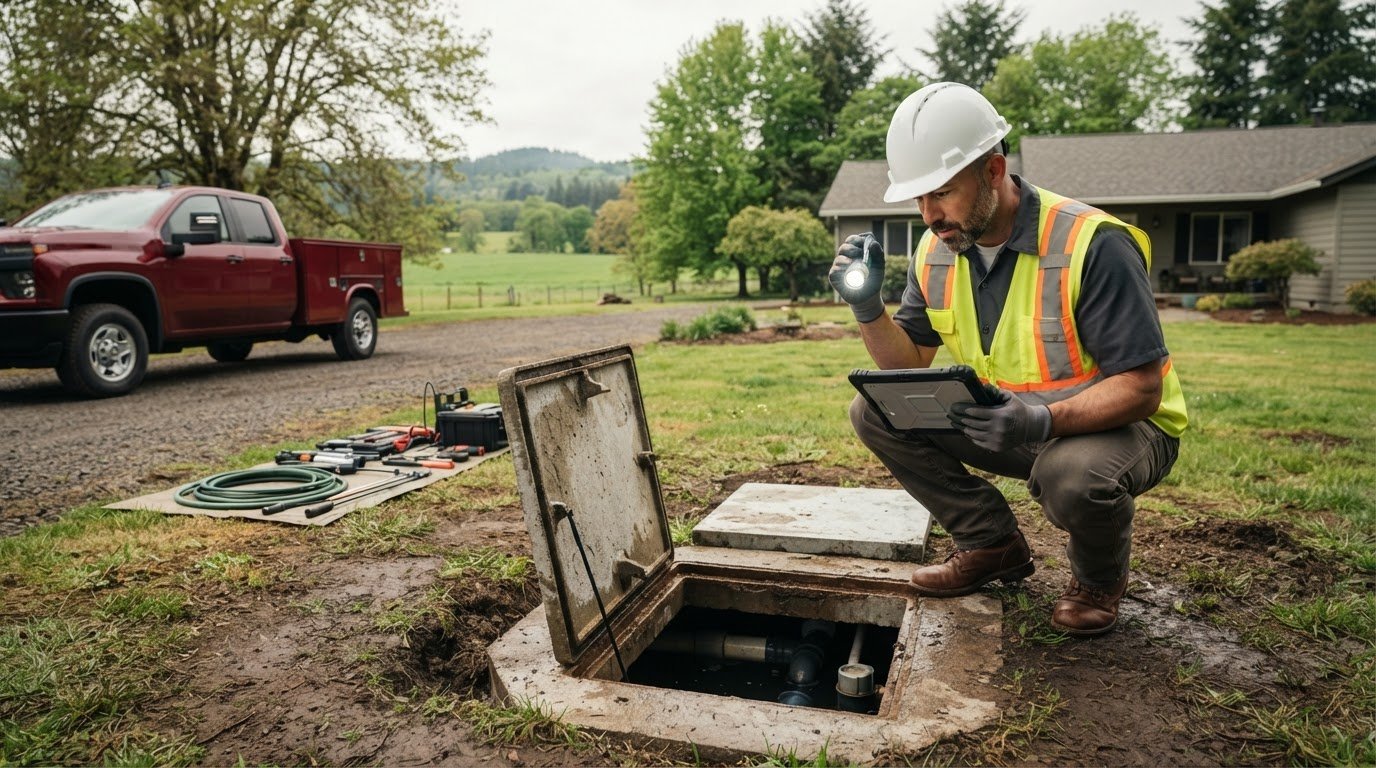
Pumping clears the tank, but a complete evaluation ensures mechanical reliability. Once the vessel is empty, technicians inspect every internal component before resealing the access ports:
- Effluent filter servicing: The reusable filter housed inside the sanitary outlet tee is extracted, cleared of hair, lint, and trapped solids with pressurized water, and secured back in position.
- Sanitary tees and baffles: Technicians inspect the intake and outlet baffles to confirm they aren’t degraded by sewer gases or knocked loose by turbulent flow.
- Float switches and lift controls: High-water alarm floats, mercury switches, and control panel relays undergo manual testing to verify that emergency alerts trigger correctly.
- Discharge piping and check valves: Technicians inspect the check valves in the pump vault to ensure backflow from the drainfield header doesn’t surge into the pump chamber.
Securing thorough commercial septic pumping Canby business managers can trust means you walk away with verified operational records and a fully reset underground system.
Navigating Oregon DEQ Compliance and Environmental Guidelines in Canby
Operating a commercial facility outside Canby’s municipal sewer boundary brings serious environmental oversight. The Oregon Department of Environmental Quality (DEQ) regulates onsite waste treatment, partnering with Clackamas County Septic & Onsite Wastewater to enforce regional water quality standards. Maintaining an active record of commercial septic pumping Canby officials can review keeps your commercial operating permit in good standing and shields your company from sudden code citations.
Oregon DEQ Record-Keeping and Reporting Standards
Under Oregon Administrative Rules (OAR) Chapter 340, Division 071, commercial onsite systems must satisfy stringent operational benchmarks. For commercial setups producing up to 2,500 gallons per day, Clackamas County administers the local regulatory framework. If your site utilizes an Alternative Treatment Technology (ATT) system or commercial sand filter, state law mandates an active service contract with a DEQ-certified maintenance provider alongside annual system inspections.
Every commercial property owner must maintain an organized compliance binder on-site containing:
- Chain-of-custody disposal manifests: Retain all official pump-out receipts proving that extracted septage was legally discharged at an authorized municipal receiving facility.
- Three-year service logs: Keep chronological records of all tank pumping, mechanical component cleanings, and drainfield evaluations ready for county environmental audits.
- System operating permits: Commercial facilities must keep current operating permits readily accessible to visiting health and building inspectors.
Protecting Canby Groundwater and Surrounding Watersheds
Canby’s position in the northern Willamette Valley makes environmental compliance especially urgent. Sitting above alluvial gravel layers and sensitive shallow aquifers, the local water table connects directly to the Willamette River and Molalla River basins. When a commercial tank overflows or discharges under-treated wastewater, nitrates and dangerous pathogens can leach rapidly through porous gravel deposits.
Surface failures create immediate stormwater contamination risks for adjacent properties and agricultural nurseries. Working with an experienced, certified team ensures your waste stream is extracted cleanly and transferred without spillage. Protect your facility and surrounding waterways by scheduling certified commercial septic pumping in Canby to keep your system clean, safe, and fully audit-ready.
Why Partner With Lil’ Stinky Septic Service for Your Commercial Needs
Managing commercial plumbing infrastructure requires an experienced contractor who shows up promptly, understands local standards, and gets the job done cleanly without halting your operations. Locally headquartered right in town, Lil’ Stinky Septic Service brings over 25 years of field-tested septic expertise (CCB #189693) directly to your facility. Our team pairs straight talk with meticulous service to keep your site fully operational and legally compliant across Clackamas, Multnomah, and Washington counties.
Local Canby Roots With Regional Commercial Capability
Large regional corporations dispatch pump trucks from across the metro area, leaving you stuck waiting during an operational bottleneck. Being based right here in Canby allows us to respond rapidly, minimizing business downtime and preventing minor drain issues from escalating into health department closures. Our technicians understand local soil characteristics, regional discharge rules, and commercial property layouts along the Highway 99E corridor and outlying industrial pockets.
We equip our fleet to handle high-capacity multi-compartment tanks, lift stations, and commercial waste setups. We treat your business like a neighbor’s property, staging equipment carefully so suction lines never interfere with customer foot traffic or delivery schedules.
Proactive Commercial Maintenance Programs
Preventing an emergency shutdown is always less expensive than reacting to an unexpected sewer backup. We don’t just evacuate waste; every service visit includes a thorough physical evaluation of baffles, sanitary tees, and system components to catch wear before it leads to structural failure.
Beyond tank servicing, our certified technicians handle comprehensive septic inspections, commercial drain cleaning, new septic installation, and ongoing Alternative Treatment Technology (ATT) system maintenance. You can easily schedule routine visits around your quietest operational hours, whether that means early mornings or planned shift changes. For dependable commercial septic pumping Canby enterprises rely on, partnering with a seasoned local specialist delivers lasting protection for your facility and bottom line.
Protect Your Facility Infrastructure and Business Continuity
Proactive wastewater management is one of the smartest operational investments you can make for your facility. Sticking to a disciplined extraction schedule prevents sudden backups, shields Canby’s delicate Willamette Valley watershed, and keeps your Clackamas County compliance records audit-ready. Routine pumping preserves drainfield longevity and ensures high-strength commercial effluent never disrupts your day-to-day workflow.
Don’t wait for slow drains or foul odors to threaten your operations. When it comes to dependable commercial septic pumping Canby facility managers rely on, our team delivers the straight talk and prompt service you need. Schedule your commercial septic pumping in Canby with Lil’ Stinky Septic Service today. Locally headquartered right here in town with over 25 years of field-tested experience (CCB #189693), our licensed technicians provide thorough tank pumping, DEQ inspections, drain cleaning, and ATT system care. Let us handle your underground infrastructure so you can focus on running a successful business.
Frequently Asked Questions
How often is commercial septic pumping required for Canby businesses?
Pumping intervals depend on your specific daily wastewater volume and business type, ranging from every three months to two years. High-volume restaurants and food processing facilities require servicing every three to six months to handle heavy grease. Standard commercial offices and warehouses usually operate safely on a one- to two-year cycle. Routine pumping keeps your facility compliant with Clackamas County standards and prevents costly drainfield failure.
What makes commercial septic pumping different from residential service?
Commercial systems process far higher wastewater volumes and deal with harsher waste streams than residential tanks. Business facilities introduce industrial sanitizers, high concentrations of grease, and elevated solid waste that disrupts beneficial bacteria and accelerates sludge accumulation. Commercial tanks are also significantly larger, featuring multiple interior compartments and dedicated lift stations that require high-capacity vacuum tankers and aggressive mechanical backflushing to pump cleanly.
Can commercial septic pumping be scheduled outside normal business hours?
Yes, flexible scheduling accommodates retail, restaurant, and industrial shifts so routine maintenance doesn’t disrupt customers or incoming freight. Arranging the commercial septic pumping Canby facilities need during off-peak windows prevents odors from reaching dining or shopping areas and keeps delivery lanes open. Technicians position heavy vacuum equipment and run hoses along dedicated utility pathways to keep parking stalls completely accessible.
What paperwork does the Oregon DEQ require after a commercial pump-out?
Oregon DEQ and Clackamas County regulations require facilities to keep legal disposal manifests and pump-out receipts on-site for at least three years. These records prove that your commercial septage was hauled by a licensed provider and properly offloaded at an approved disposal facility. If your business operates an Alternative Treatment Technology (ATT) system, you must also maintain an active service contract and submit annual inspection reports.
How do I know if my commercial septic system is nearing a backup?
Slow-clearing floor drains, gurgling toilets, and recurring sewer gas odors inside customer restrooms are reliable early warning signs. Outside your building, watch for foul-smelling wet spots or spongy turf above the tank lids and absorption area. If a high-water audio or visual alarm triggers on your pump control panel, contact a professional immediately to inspect the system before waste backs up indoors.
Does pumping out the septic tank clear clogs in the building plumbing lines?
No, pumping extracts solids and liquids from the underground holding tank, but it doesn’t clear obstructions trapped inside your interior plumbing. If sinks or toilets still drain slowly after an extraction, the blockage sits in the building pipes between the fixtures and the tank. Resolving that issue requires specialized commercial drain cleaning to clear out accumulated grease, scale, or physical debris.
Are grease traps pumped at the same time as commercial septic tanks?
They can be serviced during the same visit, but grease interceptors generally require much more frequent pumping than primary septic vessels. Oregon plumbing codes require food service establishments to pump interceptors every 30 to 90 days, or whenever total grease hits 25 percent depth. Coordinating scheduled grease extraction with commercial septic pumping Canby businesses rely on prevents grease carryover from destroying downstream drainfields.