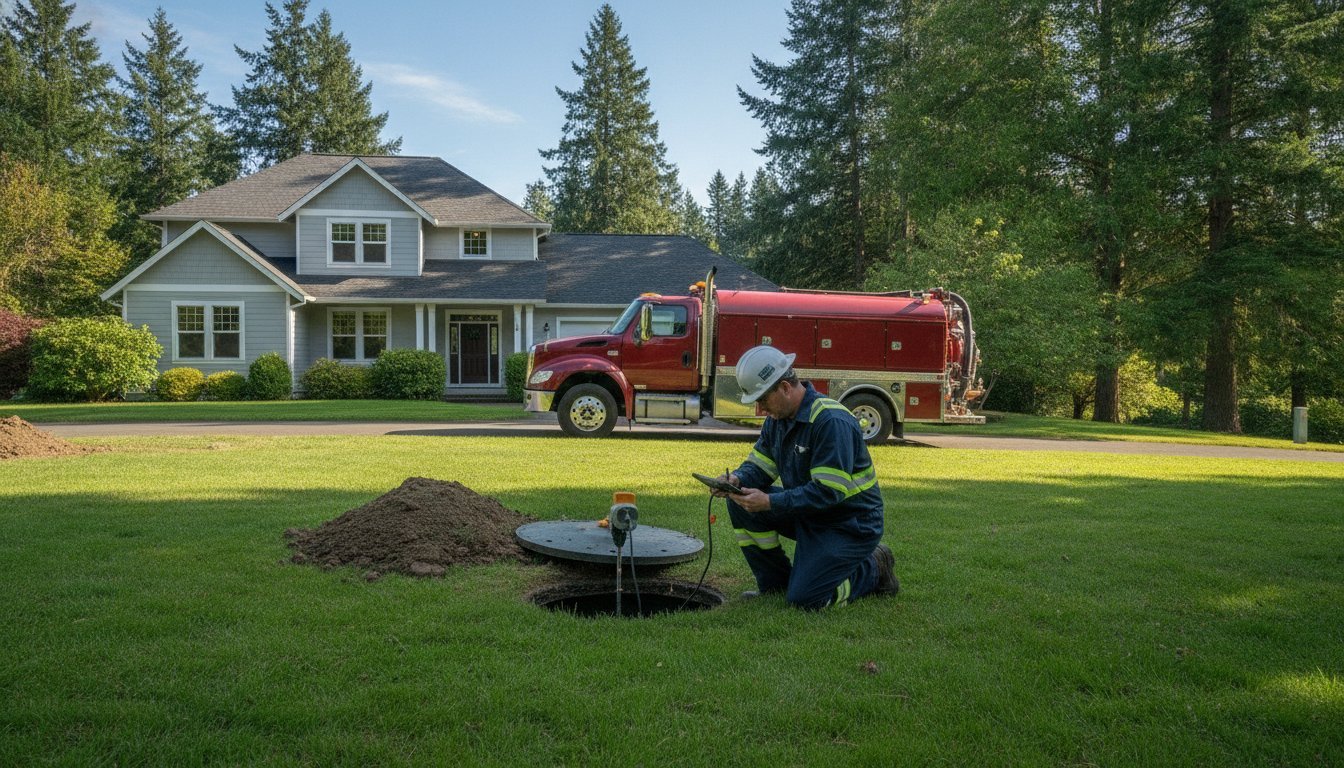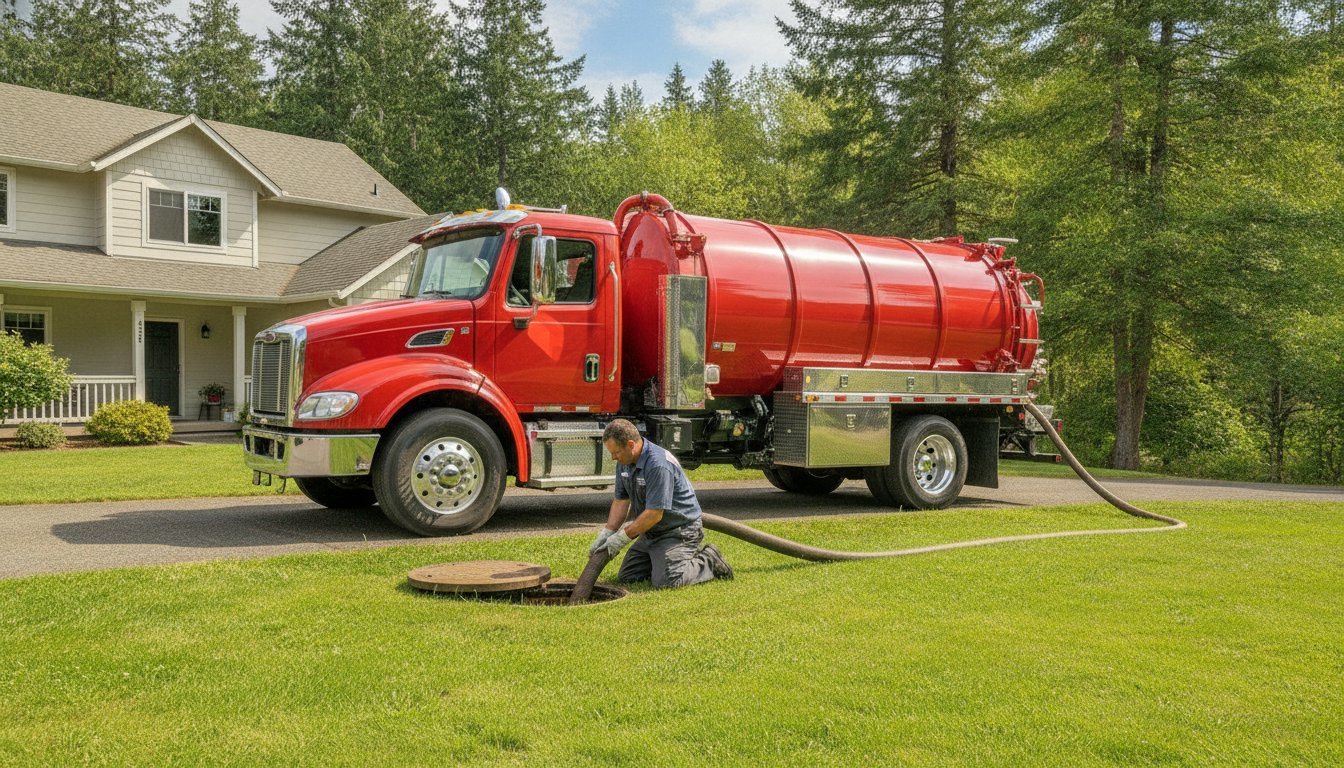
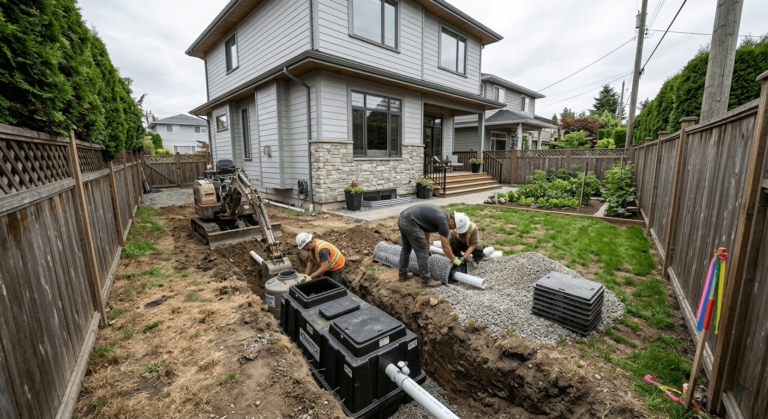
Installing a septic system on a narrow property is possible, but it requires careful planning and the right system design. Lot width and usable area directly affect which septic options are available to you, and in many cases, a conventional system simply won’t fit or won’t pass the required site evaluations. Understanding what’s working against you — and what solutions exist — can save you significant time and money before breaking ground.
Narrow lots present real constraints: limited space for drain fields, setback requirements from property lines, and soil conditions that may fail percolation tests. These challenges push many homeowners and builders toward dead ends when they rely solely on traditional septic designs.
We’ll walk through the specific obstacles narrow properties create, why advanced treatment technology (ATT) systems are increasingly being used as a practical solution in these situations, and answers to the questions we hear most often from property owners navigating this exact problem.
Key Challenges of Installing a Septic System on a Narrow Property
Narrow lots create a specific set of problems for septic installation — limited room for drain fields, strict setback requirements, and fewer options for system placement all make the process more complex than a standard installation.
Site Assessment and Regulatory Considerations
Before any digging starts, the property must pass a perc test (percolation test) and a full site evaluation. This determines how quickly soil absorbs water and whether a conventional drain field is even feasible.
On narrow properties, the challenge isn’t always the soil — it’s fitting the required components within legal setback limits. Most jurisdictions require minimum distances from:
- Property lines: typically 5–10 feet
- Wells or water sources: often 50–100 feet
- Foundations and structures: usually 10–25 feet
- Easements or right-of-ways: varies by municipality
When a lot is only 50–75 feet wide, these setbacks alone can eliminate most viable installation zones. We often find that properties fail not because of bad soil, but because there simply isn’t enough usable space after setbacks are applied.
Space-Efficient Septic Solutions
When conventional systems won’t fit, there are design strategies and alternative systems that work within tighter footprints.
| Solution | How It Helps Narrow Lots |
| Chamber systems | Replace gravel with plastic chambers, reducing trench width |
| Drip irrigation systems | Distribute effluent in smaller, precise doses across a limited area |
| Mound systems | Elevate the drain field, sometimes allowing a more compact footprint |
| ATT systems | Treat wastewater to a higher standard, often requiring less drain field space |
Drip irrigation and ATT systems are particularly useful because they reduce the size of the required absorption area. A smaller drain field means more flexibility in placement on a tight lot.
Common Pitfalls in Small Lot Septic Design
One of the most frequent mistakes we see is underestimating how setback requirements shrink usable space. A lot that looks workable on paper can become non-viable once all buffers are mapped out.
Other common pitfalls include:
- Skipping a professional survey before purchasing the property, leading to costly surprises
- Choosing a conventional system without exploring alternatives, resulting in a failed permit application
- Ignoring future expansion — adding a bedroom later increases required system capacity, which may not fit the existing footprint
- Poor soil documentation during the site assessment, which can delay permits significantly
Working with a licensed septic designer before finalizing a land purchase or building plan is the most effective way to avoid these issues. Early assessments save time, money, and significant frustration.
Advanced Treatment Technology (ATT) Systems: The Superior Solution for Narrow Lots
When a lot is too narrow for a conventional drainfield, ATT systems offer a compact, code-compliant path forward by treating wastewater to a higher standard before it ever enters the soil.
How ATT Systems Address Limited Space Constraints
Conventional septic systems rely on large drainfields to slowly filter partially treated effluent through the soil. On a narrow lot, there simply isn’t enough horizontal space to make that work.
ATT systems solve this by treating wastewater to a much higher level before dispersal. Because the effluent leaving an ATT unit is significantly cleaner, regulators often permit smaller, shorter, or shallower dispersal areas — sometimes a fraction of the size required for a conventional system.
Some ATT units can be configured vertically or in modular segments, allowing us to work around tight setbacks, irregular lot shapes, or obstacles like easements and trees.
Advantages Over Conventional Septic Systems
ATT systems offer several specific advantages that matter most on narrow properties:
- Reduced drainfield footprint — treated effluent requires less soil contact area to disperse safely
- Flexible installation layouts — modular designs can be arranged to fit non-rectangular spaces
- Lower setback risk — higher treatment quality may satisfy reduced setback requirements from property lines and structures
- Better long-term performance — advanced filtration reduces the risk of drainfield failure caused by biomat buildup
- Regulatory acceptance — many jurisdictions require ATT systems specifically because of lot size limitations
| Feature | Conventional System | ATT System |
| Drainfield size needed | Large | Significantly smaller |
| Treatment level | Primary/secondary | Tertiary |
| Layout flexibility | Low | High |
| Suitable for narrow lots | Rarely | Frequently |
Real-World Example: Transforming a Challenging Lot with ATT
Consider a 40-foot-wide residential lot where a conventional system would need a 2,500 sq ft drainfield — physically impossible given the setbacks alone.
We’ve seen situations like this resolved by installing an ATT system with a drip irrigation dispersal field running along the rear yard perimeter. The total dispersal area dropped to under 800 sq ft, fitting comfortably within the available space.
The homeowner received full permit approval and was able to build where a conventional system would have made the lot essentially unbuildable.
Frequently Asked Questions
Narrow lot septic installations raise specific questions about setback distances, site conflicts, layout options, soil limitations, regulatory thresholds, and the real costs of getting a system approved and maintained.
What are the minimum lot width and setback requirements that typically determine whether onsite wastewater is feasible?
Most jurisdictions require a minimum lot width of 50 to 100 feet before an onsite wastewater system is even considered viable. The actual number varies by county and state, so we always recommend pulling the local health department’s standards before purchasing or developing a narrow parcel.
Setback requirements are where narrow lots often fail on paper. A conventional drainfield typically must sit at least:
- 10 feet from property lines
- 50 to 100 feet from drinking water wells
- 10 to 25 feet from structures, driveways, and retaining walls
- 50 to 100 feet from surface water like streams or wetlands
When a lot is 60 feet wide and carries all of those buffers simultaneously, the usable footprint for a drainfield can shrink to almost nothing.
How do site constraints like easements, wells, and neighboring structures affect the placement of the tank and drainfield?
Easements are one of the most overlooked obstacles. A utility or drainage easement running along the rear or side of a narrow lot can eliminate what would otherwise be a workable drainfield area, because most jurisdictions prohibit placing absorption systems within easement boundaries.
Neighboring wells are a serious constraint, especially on rural narrow lots where adjacent properties rely on private groundwater. If a neighbor’s well sits within 100 feet of the proposed drainfield location, that area is typically off-limits regardless of your property line.
Structures on neighboring parcels also create setback conflicts that aren’t always obvious during early planning. We’ve seen cases where a neighboring garage or shed, built close to a shared property line, eliminated an otherwise viable drainfield zone on the adjacent narrow lot.
What layout strategies help fit a drainfield or dispersal area when space is tight without sacrificing performance?
One of the most practical strategies is switching from a standard gravity-fed trench system to a pressure-dosed shallow drainfield. Pressure dosing distributes effluent more evenly across a smaller area, which allows the drainfield to function effectively without requiring the same linear footage as a gravity system.
Serial distribution and chamber systems are also commonly used on tight lots. Chamber systems reduce the excavation footprint and can often be configured in narrower, longer runs that follow the natural geometry of the parcel.
In some cases, we can orient the drainfield parallel to the lot’s longest dimension, running narrow trenches lengthwise rather than across the width. This approach requires careful grading review but is often the difference between a system that fits and one that doesn’t.
What does a failed percolation test indicate, and what alternatives are commonly approved when infiltration is limited?
A failed perc test means the soil absorbs water either too slowly or too quickly to support a conventional drainfield safely. Soil that takes longer than 60 minutes per inch to absorb water is generally considered too slow, while soil that absorbs faster than 1 minute per inch may allow untreated effluent to move too quickly toward groundwater.
When a site fails a perc test, regulators don’t automatically deny a permit. They typically require a more detailed soil morphology evaluation and may approve alternative dispersal methods, including:
- Mound systems, which place the drainfield above native soil using engineered fill
- Drip irrigation systems, which deliver treated effluent directly to shallow soil in small, timed doses
- Evapotranspiration beds, used in dry climates where soil uptake and evaporation can manage effluent without subsurface dispersal
The specific alternative approved depends on the soil type, the water table depth, and the local regulatory framework.
When is an Advanced Treatment Technology (ATT) system required by regulators, and how does it reduce risk on challenging sites?
Regulators require ATT systems when a site cannot safely assimilate effluent using conventional treatment alone. On narrow lots, this threshold is reached quickly — reduced setback distances, limited drainfield area, and proximity to groundwater all increase the risk that partially treated effluent could reach sensitive receptors.
An ATT system treats wastewater to a significantly higher standard before it ever reaches the soil. Where a conventional septic tank discharges effluent with biochemical oxygen demand (BOD) levels around 200 mg/L, a properly functioning ATT unit can reduce that figure to below 10 mg/L. That level of pre-treatment means the drainfield — or dispersal area — carries a much lower pollutant load.
On narrow lots specifically, this matters because it often allows regulators to reduce required setback distances. Some jurisdictions permit setbacks to wells or surface water to be shortened by 25 to 50 percent when an ATT system is installed, which can make a previously non-viable narrow lot fully approvable.
ATT systems also reduce the risk of system failure over time. Because the soil is not receiving concentrated effluent, biomat formation — the layer of organic material that clogs drainfields — develops far more slowly. This extends the functional life of the dispersal area considerably.
What costs, permitting steps, and maintenance responsibilities should owners expect when choosing an alternative septic solution?
The permitting process for an alternative system on a narrow lot typically involves a soil evaluation, a perc test or soil morphology assessment, engineered system design, and review by the local health department or environmental agency. On complex sites, this process can take several months and may require a licensed engineer to stamp the design.
In terms of cost, a conventional septic system on a straightforward lot might run $8,000 to $15,000 installed. An ATT system with a pressure-dosed drainfield on a narrow or constrained lot commonly falls in the range of $20,000 to $40,000 or more, depending on system type, site conditions, and local labor rates.
Maintenance is a firm ongoing requirement for ATT systems, not optional. Most jurisdictions mandate:
- Quarterly or semi-annual inspections by a licensed service provider
- Annual effluent sampling to confirm treatment performance
- Maintenance contracts filed with the permitting authority as a condition of approval
Owners should factor these costs — typically $300 to $600 per year for routine service — into their long-term budget when evaluating whether an alternative system is the right path forward for their property.