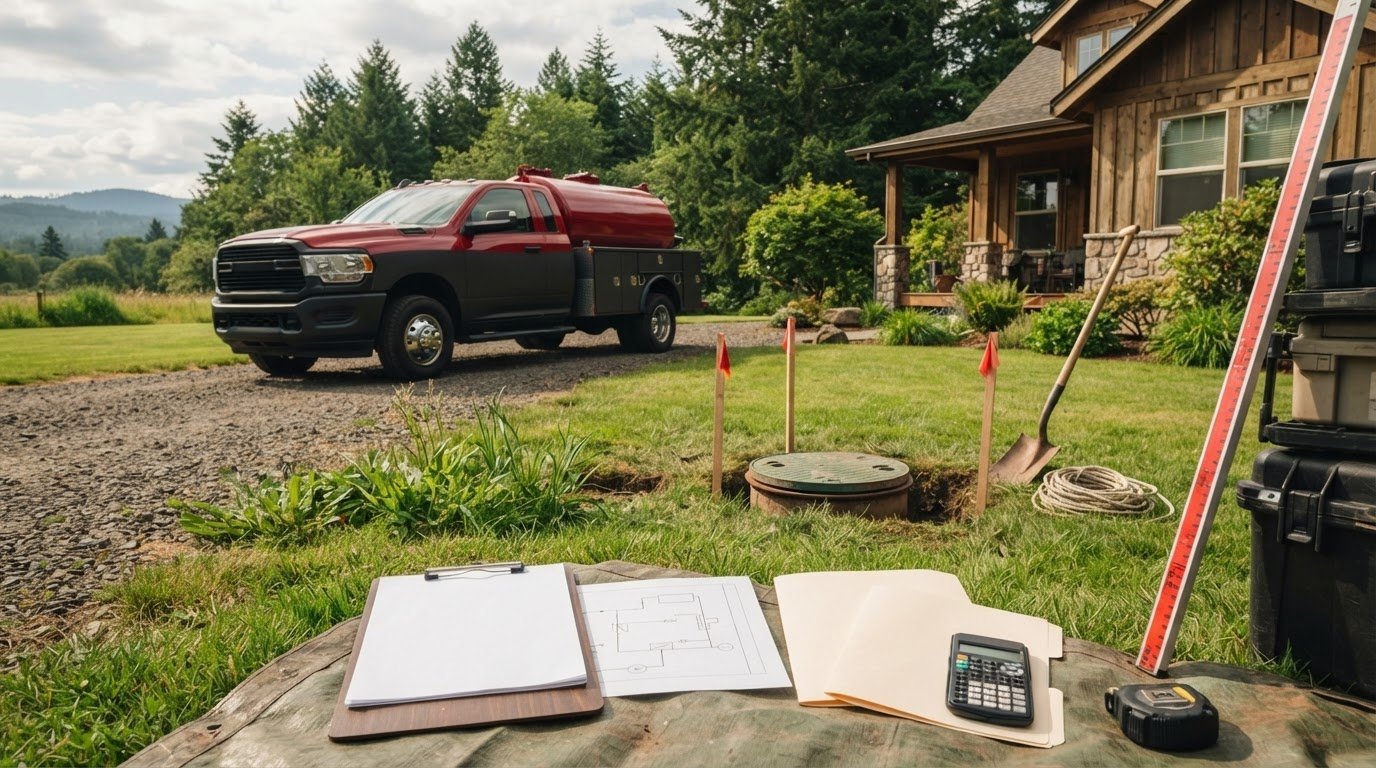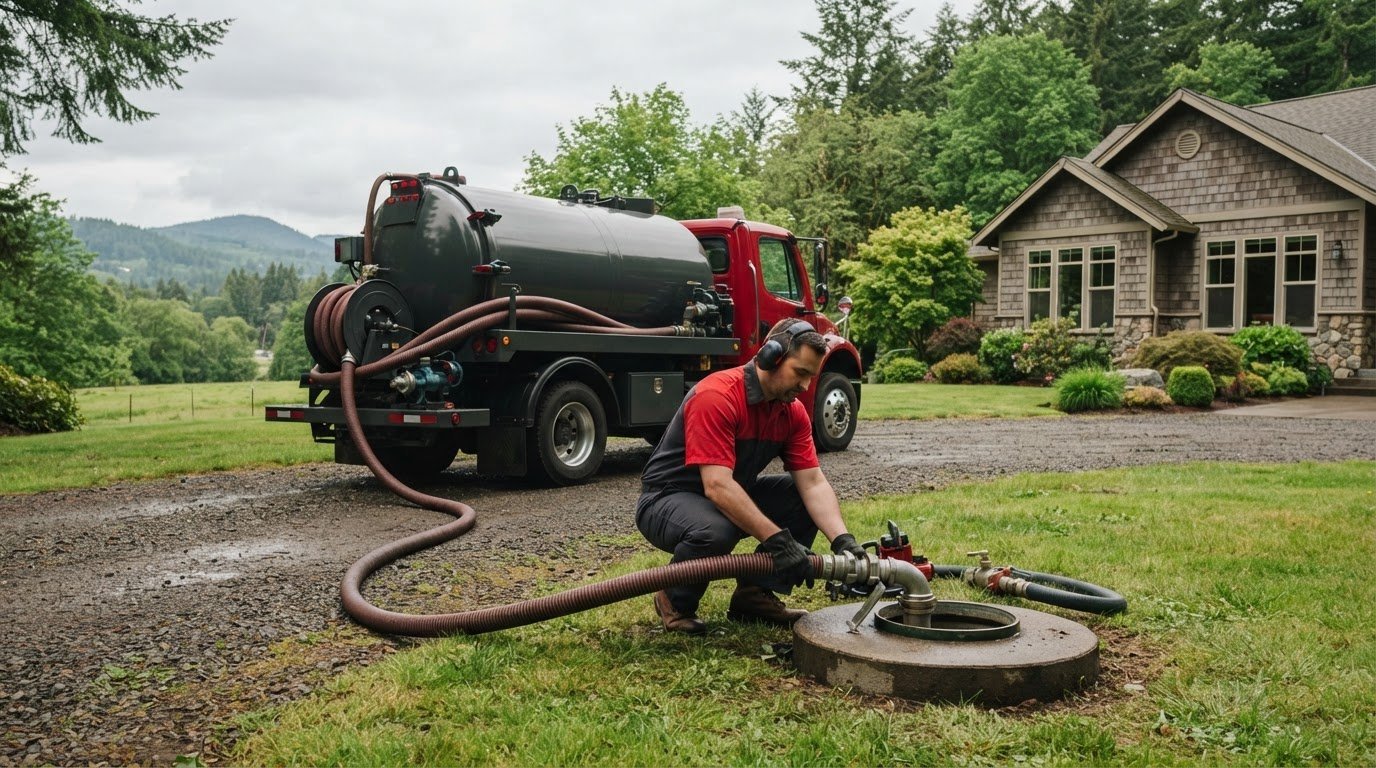
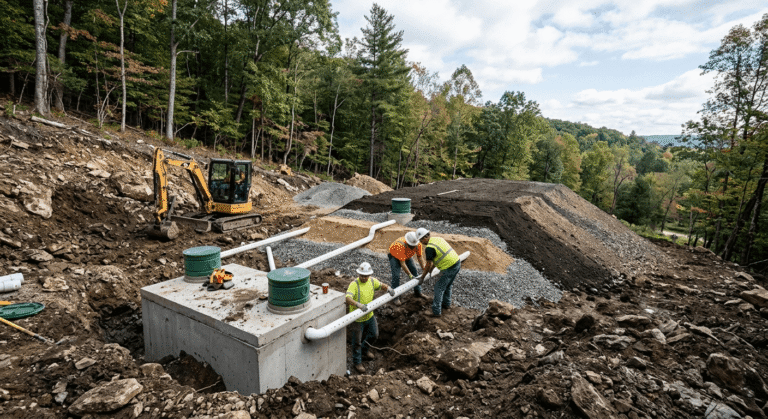
Not every property is a straightforward candidate for a standard septic system. Rocky terrain, clay-heavy soil, high water tables, and failed percolation tests are common challenges that leave homeowners and builders searching for solutions that actually work in difficult conditions.
The right septic system for a challenging site depends heavily on soil type, lot size, and local regulations — and choosing the wrong one can lead to system failure, costly repairs, and environmental violations. We’ll walk through the options that hold up under tough ground conditions, including why some sites require more than a conventional system can offer.
Whether you’re building on a hillside, dealing with saturated soil, or working with a lot that failed its perc test, understanding your options puts you in a much stronger position. We’ll cover the systems most suited to difficult conditions, explain when advanced treatment technology becomes not just helpful but necessary, and answer the questions we hear most often from homeowners and builders facing these exact challenges.
Best Septic System Solutions for Challenging Soil and Site Conditions
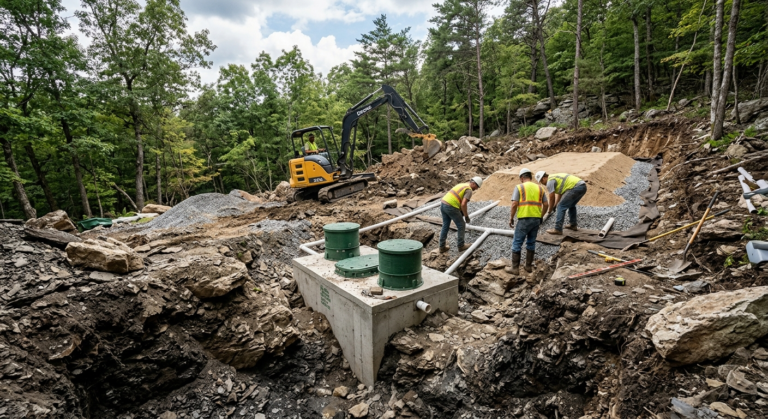
Difficult ground conditions — from high clay content to shallow bedrock — eliminate many standard septic options before a single permit is filed. Knowing which site factors create the most problems helps narrow down what systems will actually work.
Identifying Difficult Ground Conditions
Not every site looks problematic from the surface. We need to look below grade to understand what we’re actually working with.
Common indicators of difficult ground conditions include:
- Slow percolation rates — soil absorbs water at less than 1 inch per 30 minutes, often failing perc tests outright
- High clay content — clay holds water instead of filtering it, blocking proper effluent absorption
- Shallow bedrock — less than 4 feet of usable soil depth limits drain field placement
- Seasonal saturation — areas where the water table rises within 24 inches of the surface during wet months
- Compacted fill soil — previously graded or disturbed lots often have inconsistent permeability
A site can fail on one factor alone. Bedrock at 3 feet, for example, makes a conventional drain field physically impossible regardless of soil quality.
Evaluating Site Limitations: Small Lots, High Water Table, and Poor Soil
We often encounter properties where multiple limitations stack on top of each other. A small urban lot might have poor soil and limited setback distances from the property line, a well, or a structure.
| Site Limitation | Impact on Septic Design |
| Lot under 1 acre | Restricts drain field size and placement options |
| Water table within 24″ | Increases contamination risk; requires raised systems |
| Clay or silt-heavy soil | Reduces absorption capacity significantly |
| Slopes over 20% | Limits gravity-fed system placement |
A high water table is particularly problematic because untreated effluent can reach groundwater before adequate treatment occurs. This is a public health concern, not just a design inconvenience.
Conventional Septic System Shortcomings
A standard septic system relies on a drain field where soil does the final filtration work. When soil can’t perform that job, the system fails — sometimes quickly.
Where conventional systems fall short:
- They require a minimum soil depth and percolation rate that many sites simply don’t meet
- They have no mechanism to compensate for a rising water table
- A failed perc test is often an automatic disqualifier for permit approval
- They need significant horizontal space, which small lots can’t provide
We’ve seen conventional systems installed on marginal sites begin backing up within 2–5 years. The soil becomes saturated, biomat builds up in the drain field, and the system loses its ability to process effluent at all.
Advanced Treatment Technology (ATT) Systems: A Reliable Alternative
When standard septic systems fail to meet site conditions, ATT systems offer a proven path forward by treating wastewater to a higher standard before it reaches the soil. They are engineered to perform where conventional systems cannot — in clay-heavy ground, high water tables, and tight lots.
How ATT Systems Work in Problematic Environments
ATT systems use multi-stage treatment to process wastewater before dispersal. Instead of relying on the soil to do most of the work, they treat the effluent mechanically and biologically first.
Most ATT systems include:
- Primary settling – solids settle out in a tank
- Secondary treatment – aerobic bacteria break down organic matter
- Tertiary filtration or UV disinfection – removes pathogens before the effluent enters the ground
This pre-treatment reduces the biological load on the soil dramatically. In clay soils that absorb slowly, this matters because the dispersal field receives cleaner water that won’t clog soil pores as quickly. In high water table zones, reduced contaminant levels lower the risk of groundwater impact.
Advantages of ATT Over Traditional Septic Systems
Conventional septic systems push partially treated wastewater directly into a drain field. That works fine in deep, sandy, well-drained soil — but it fails in difficult ground.
| Feature | Conventional Septic | ATT System |
| Effluent quality at dispersal | Low | High |
| Suitable for clay soil | Rarely | Yes |
| High water table compatible | No | Yes |
| Required drain field size | Large | Smaller |
| Regulatory approval on failed perc sites | Unlikely | Often achievable |
ATT systems also allow for smaller drain fields, which is critical on constrained lots. Cleaner effluent disperses more efficiently, so less land area is required.
Real-World Applications and Success Stories
We frequently see ATT systems installed on properties where perc tests have failed outright. A homeowner with a half-acre lot in a high water table area, for example, may be denied a conventional permit but approved for an ATT system because the treated effluent meets stricter health department standards.
In rural areas with heavy clay soils, builders have used ATT systems to unlock lots previously considered unbuildable. The higher upfront cost — typically $15,000–$30,000 compared to $5,000–$10,000 for conventional systems — is often the only viable path to a permit and a finished structure.
Frequently Asked Questions
Difficult ground conditions raise consistent questions about soil behavior, testing outcomes, drainfield design, and the cost of operating systems that go beyond a standard septic setup. Below we address the specifics that homeowners and builders most frequently need answered when working with challenging sites.
Which septic options typically work best when the soil won’t absorb water reliably?
When soil absorption is unreliable, the two most practical directions are mound systems and drip irrigation systems. A mound system places the drainfield above the natural ground surface using imported sand fill, bypassing the poor native soil entirely. Drip irrigation systems distribute pre-treated effluent through small emitters at shallow depths, reducing the volume of wastewater the soil needs to handle at any one time.
For sites with very low permeability, an advanced treatment unit upstream of either system is often required. It reduces the strength of the effluent before it ever reaches the soil, which lowers the demand on the drainfield and extends its functional life.
How can you tell whether a high water table will limit your on-site wastewater design?
A licensed soil evaluator will dig test holes, typically 60 to 84 inches deep, and look for signs of seasonal saturation. These signs include mottled gray or orange soil coloring, which indicates periodic waterlogging, and the presence of standing water in the hole during wet months.
Regulations in most jurisdictions require a minimum vertical separation between the bottom of a drainfield and the seasonal high water table, often 24 to 36 inches. If that separation cannot be achieved at natural grade, the designer must either raise the drainfield with a mound or reduce the loading rate through advanced pretreatment.
A site with a water table at 18 inches below grade during spring does not automatically mean the lot cannot be developed. It does mean a standard in-ground trench system is off the table, and the design engineer needs to calculate whether enough vertical separation is achievable with a raised system.
What are the most common reasons a property fails a percolation test, and what can be done next?
The most frequent causes of a failed perc test are:
- Clay-heavy soil that absorbs water at fewer than 1 inch per 60 minutes
- Shallow bedrock that leaves insufficient depth for effluent to percolate safely
- High seasonal water table that reduces the effective absorption zone
- Compacted soil from prior construction activity or grading
A failed perc test does not permanently close the door on development. The next step is typically a full soil morphology evaluation, which looks at soil texture, structure, and color rather than just timed absorption rates. Some states accept this evaluation in place of a perc test and use it to size an alternative system.
If the morphology evaluation also shows limitations, an advanced treatment system that delivers a higher quality effluent may qualify the site for a reduced drainfield size or a system type that the state permits on marginal soils.
How do alternative drainfield designs differ, and when is each one appropriate for challenging sites?
The four most commonly permitted alternative drainfield designs are mound systems, drip irrigation systems, gravelless chambers, and pressure-dosed beds. Each one addresses a different site constraint.
Mound systems work where the natural soil is too slow to absorb or the water table is too high. The effluent is dosed into engineered sand above grade.
Drip irrigation is appropriate for lots with limited space or irregular shapes because the tubing can be laid out in flexible patterns. It requires effluent to be treated to a higher standard before distribution, which is why a pretreatment unit is almost always part of the design.
Gravelless chambers replace traditional stone-and-pipe trenches with plastic arch structures that increase soil contact area. They work well in sandy or moderately permeable soils where standard trenches would also perform but where reducing excavation depth matters.
Pressure-dosed beds distribute effluent evenly across a larger area by pumping it through a perforated pipe network. They reduce localized saturation, which makes them suitable for soils with moderate permeability that standard gravity systems would overload in one zone.
When is advanced treatment necessary to meet local permitting requirements on difficult lots?
Regulators require advanced treatment when a site cannot meet the minimum separation distances or loading rates required for a conventional system. The specific triggers vary by state and county, but common ones include:
- Lots within a certain distance of a wellhead protection zone or surface water body
- Sites where the perc rate is slower than the threshold for a standard system
- Properties where only a reduced drainfield area is available due to lot size or setbacks
- Locations where the seasonal high water table is within the minimum separation zone
In these cases, the advanced treatment unit is not optional. It is the mechanism that produces effluent clean enough to meet the reduced separation or smaller dispersal area that the site can physically accommodate. Without it, the permit will not be issued.
What maintenance and operating costs should homeowners expect with advanced treatment compared to a conventional system?
A conventional septic system has low annual costs. Pumping every three to five years runs roughly $300 to $600, and there are no mechanical components requiring routine service.
An advanced treatment system involves more ongoing expense. Most units require a service contract with a licensed operator, typically ranging from $200 to $600 per year depending on the system type and visit frequency. The operator inspects mechanical components, checks effluent quality, and replaces media or parts as needed.
Electricity is an added operating cost. Most advanced treatment units run a pump or blower continuously, which adds roughly $5 to $20 per month to a utility bill depending on the unit size and local rates.
Replacement parts such as blower motors, UV lamps, or filter media add periodic costs that vary by system. Budgeting $150 to $400 every few years for component replacement is a reasonable estimate for most residential-scale units. These costs are higher than a conventional system, but they are the direct trade-off for being able to develop and use a lot that would otherwise be unbuildable.