
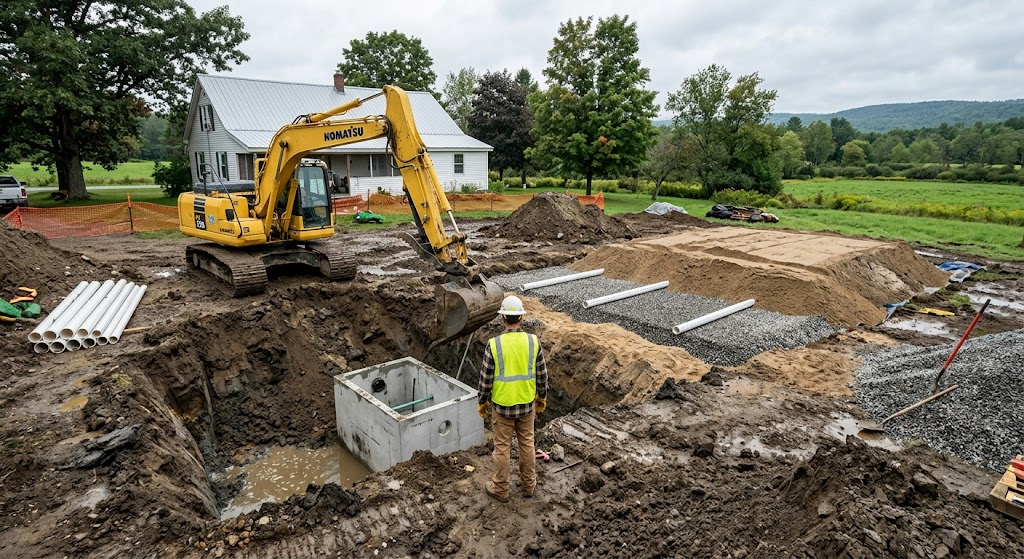
Installing a septic system on a property with a high water table is possible, but it requires careful planning and the right system design. Standard conventional septic systems often fail in these conditions because saturated soil cannot adequately treat wastewater before it reaches groundwater. This is a common and serious challenge for homeowners, builders, and real estate buyers across regions with high groundwater levels.
We see this situation regularly, and the consequences of getting it wrong go beyond a failed inspection — untreated effluent can contaminate drinking water sources and create costly repairs. The good news is that modern wastewater technology has advanced significantly, giving property owners real solutions where conventional systems simply won’t work.
In this article, we walk through the specific challenges high water tables create for septic installation, explain why Advanced Treatment Technology (ATT) systems are often the most practical and code-compliant solution, and answer the questions we hear most often from homeowners and builders navigating this issue.
Challenges of Installing a Septic System with a High Water Table
A high water table creates real obstacles for septic installation — from saturated soil that can’t treat effluent to structural risks that shorten a system’s lifespan. Knowing what we’re up against helps us make smarter decisions before breaking ground.
Understanding High Water Table Conditions
A high water table means the saturated zone of soil sits close to the surface — sometimes within 12 to 24 inches. This is common in low-lying areas, coastal regions, flood plains, and properties near lakes or rivers.
Seasonal fluctuations matter too. A water table that sits at 48 inches in August may rise to 18 inches in March after snowmelt or heavy rain. Regulators typically measure the seasonal high water table (SHWT), not just current conditions, when evaluating a site.
Key indicators of a high water table include:
- Mottled soil colors (gray, orange, or rust streaking in soil samples)
- Standing water or soggy ground after moderate rainfall
- Presence of wetland vegetation like cattails or sedges
- Shallow bedrock combined with poor drainage
Risks of Conventional Septic Systems
Conventional septic systems depend on a drain field to disperse and treat wastewater through the soil before it reaches groundwater. When the water table is too high, that treatment process breaks down entirely.
If saturated soil surrounds the drain field trenches, effluent has nowhere to go. It backs up into the tank, surfaces in the yard, or — most seriously — discharges untreated into the groundwater supply.
The minimum required separation distance between the bottom of a drain field and the seasonal high water table is typically 24 to 36 inches, depending on state or local regulations. Many high water table properties simply cannot meet this requirement with a standard system.
Impact on System Performance and Longevity
Even when a conventional system is initially approved, a high water table shortens its functional life significantly. Saturated conditions accelerate biomat formation — the layer of organic material that clogs drain field soil — far faster than normal.
We also see increased risk of:
| Issue | Cause |
| Sewage surfacing | Saturated soil rejecting effluent |
| Tank flotation | Buoyant force lifting tank out of ground |
| Premature drain field failure | Biomat buildup in waterlogged trenches |
| Groundwater contamination | Inadequate treatment before effluent reaches water table |
A failed drain field on a high water table property is rarely a simple repair. In many cases, there is no viable area left on the lot to install a replacement conventional system.
Why ATT Systems Are Essential for High Water Table Sites
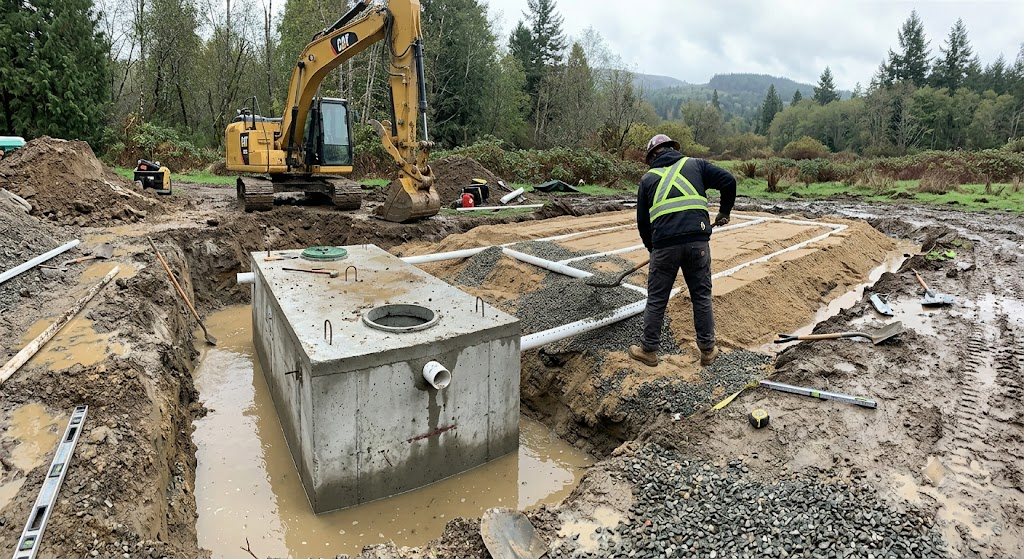
When the water table sits too close to the surface, conventional septic systems simply cannot treat wastewater safely before it reaches the groundwater. ATT systems solve this by treating effluent to a significantly higher standard before it ever enters the soil.
How Advanced Treatment Technology Works
ATT systems use a multi-stage treatment process that goes far beyond what a standard septic tank can do. Where a conventional tank only separates solids from liquid, an ATT system actively treats the effluent before dispersal.
The process typically includes:
- Primary treatment – solids separation in a tank
- Secondary treatment – biological processing using aeration, fixed-film media, or both
- Tertiary treatment – additional filtration or disinfection, often via UV light or chlorination
The result is effluent that meets much stricter quality standards — often Class I or Class II — before it reaches the drain field. This matters enormously when the saturated zone is only 12–24 inches below ground.
Critical Benefits Over Traditional Septic Systems
A conventional system relies on 36–48 inches of unsaturated soil to naturally filter effluent. That buffer simply does not exist on high water table sites, which is where ATT systems provide a concrete advantage.
| Feature | Conventional Septic | ATT System |
| Effluent quality at discharge | Partially treated | Highly treated |
| Required soil depth | 36–48 inches | As little as 12–18 inches |
| Risk to groundwater | High on saturated sites | Significantly reduced |
| Regulatory approval on wet sites | Rarely approved | Commonly approved |
ATT systems also allow for shallow drain field installation, which is critical when usable soil depth is limited. This makes lot approval possible in areas that would otherwise be unbuildable.
Real-World Successes: High Water Table Applications
In coastal regions of the Southeast, seasonal water tables commonly rise to within 18 inches of the surface. Properties in these areas routinely receive permits only after specifying an ATT system with a raised or mounded dispersal area.
We have also seen ATT systems succeed on lakefront lots in the upper Midwest, where spring snowmelt pushes the water table up for months at a time. These systems maintained compliant effluent output throughout the wet season without system failure or regulatory violations.
Florida’s strict Chapter 64E-6 regulations specifically recognize ATT systems as an approved solution for sites with limiting soil conditions, demonstrating that regulatory bodies treat this technology as a legitimate and reliable fix — not a workaround.
Frequently Asked Questions
Understanding how groundwater depth, soil conditions, and treatment technology interact is central to making sound decisions about septic system design on difficult sites.
What site conditions typically prevent approval for a standard septic design, and how can they be confirmed during a site evaluation?
The most common conditions that block approval for a conventional drainfield include a seasonal high water table within 24 inches of the proposed drainfield bottom, slow soil percolation rates exceeding 60 minutes per inch, restrictive soil layers such as hardpan or clay, and insufficient lot area to accommodate required setbacks and repair zones.
A licensed soil scientist or site evaluator confirms these conditions through soil borings, percolation tests, and in some jurisdictions, groundwater monitoring wells installed over a full seasonal cycle. Mottling — the gray, orange, or rust-colored streaking in soil — is a reliable field indicator of where saturated conditions historically occur, even when the water table is temporarily lower during the test period.
How is the seasonal high groundwater level measured, and why does it matter for drainfield placement and long-term performance?
Seasonal high groundwater (SHGW) is the highest elevation the water table reaches during wet months of the year. It is measured either through direct observation of standing water in monitoring wells during the wet season or estimated by a soil scientist interpreting redoximorphic features — particularly mottling — present in soil profiles.
It matters because a drainfield must maintain a minimum vertical separation distance between the bottom of the distribution system and the SHGW. In most states, that minimum is 24 to 36 inches. When that buffer is compromised, treated effluent cannot adequately filter through unsaturated soil before reaching groundwater, which creates a contamination risk and causes the system to back up or fail during wet conditions.
What design strategies can reduce risk of system failure on properties with limited vertical separation to groundwater?
Several approaches can reduce failure risk when vertical separation is tight:
- Mounding: Importing clean fill soil to raise the drainfield elevation above native grade, creating artificial separation above the SHGW
- Drip irrigation systems: Distributing effluent at shallow depths in small doses, reducing hydraulic loading and allowing better soil contact with aerobic zones
- Pressure distribution: Using timed, pressurized dosing instead of gravity flow to prevent any single area of the drainfield from becoming saturated
- Reducing system footprint: Pairing advanced pretreatment with a smaller, shallower absorption area
No single strategy works in every scenario. The appropriate solution depends on local regulations, available lot area, soil type, and the specific depth to SHGW confirmed during site evaluation.
When a property has a failed or marginal percolation result, what alternative septic solution options are commonly considered and why?
A failed or marginal perc test typically means the soil absorbs effluent too slowly to support a standard gravity drainfield sized for the number of bedrooms on the property. The options that regulators and engineers most commonly consider include:
- Mound systems on imported soil with better permeability
- Drip dispersal systems that distribute small, frequent doses across a wider area
- ATT systems paired with a reduced-size or modified drainfield, because higher-quality effluent requires less soil treatment distance
- Holding tanks as a last resort where no dispersal is feasible
ATT systems are increasingly the preferred path in marginal perc situations because they address two problems at once — effluent quality and siting flexibility — rather than just compensating for one by enlarging the drainfield footprint.
What are Advanced Treatment Technology (ATT) systems, and how do they change effluent quality and siting flexibility compared to conventional systems?
ATT systems are engineered wastewater treatment units that go well beyond the basic anaerobic digestion a conventional septic tank provides. They typically use a combination of aerobic processing, membrane filtration, UV disinfection, or other active treatment stages to produce effluent that meets significantly stricter quality standards before it ever reaches the soil.
A conventional septic tank produces what is classified as secondary-level effluent — still carrying a substantial biological oxygen demand, suspended solids, and pathogens. ATT systems can produce tertiary-level effluent, meaning the water leaving the unit is substantially cleaner and lower in nutrients and pathogens.
This matters enormously for high water table sites. Because the effluent entering the soil is already highly treated, regulators in many states allow reduced vertical separation requirements — sometimes as little as 12 inches rather than the standard 24 to 36 inches. That additional clearance can be the difference between a buildable and an unbuildable lot.
ATT systems also frequently qualify for a smaller drainfield footprint, which matters when site area is constrained. On a lot where a conventional system would require 3,000 square feet of absorption area, an ATT-equipped system might require significantly less, opening up design possibilities that otherwise do not exist.
What ongoing maintenance, monitoring, and operating costs should owners expect with an advanced treatment setup versus a traditional septic system?
A conventional septic system has relatively low ongoing costs — typically a pump-out every 3 to 5 years at a cost of $300 to $600 and occasional inspection. An ATT system involves more active components and therefore more consistent maintenance obligations.
Owners with ATT systems should expect:
- Annual or semi-annual service contracts with a certified O&M provider, typically ranging from $300 to $800 per year depending on system type and region
- Electricity costs to power aeration units, pumps, and UV components — usually modest, in the range of $10 to $30 per month
- Required monitoring reports submitted to the local health authority, which the service provider typically handles
- Component replacement over time, including UV bulbs, aerator membranes, and effluent filters
The trade-off is straightforward. A property that would otherwise be unbuildable or require an expensive engineered fill solution becomes viable with an ATT system. We find that most owners on constrained sites view the added maintenance cost as a reasonable and predictable expense given what the system makes possible.