The statewide septic fee table isn’t the best guide to Clackamas County’s fees. Oregon DEQ’s published septic fee table covers August 1, 2020, through June 30, 2021, and took effect July 1, 2021.
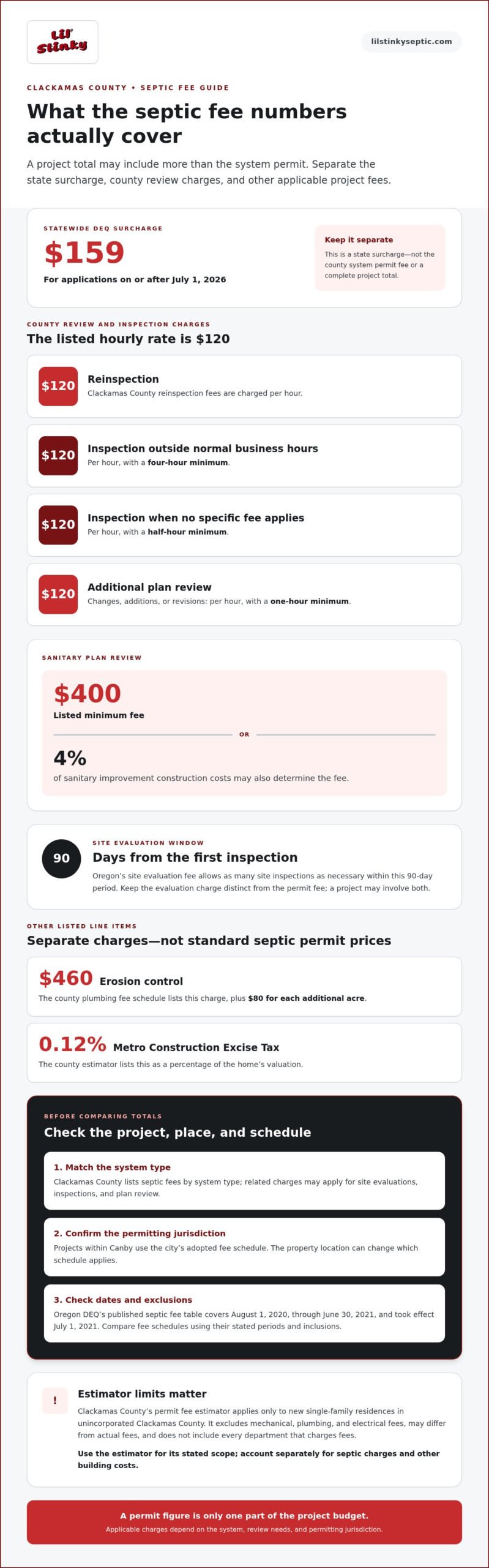
It’s understandable to want one clear number before planning a septic project. But the permit total can involve more than the system fee: Oregon’s statewide DEQ surcharge is $159 for applications on or after July 1, 2026, and other project-related fees may apply.
This guide explains how to find and interpret Clackamas County’s septic fee information, why fees vary by project, and which permitting authority handles the property. It also clarifies the limits of the county’s fee estimator so you can plan around the right charges before moving ahead.
Key Takeaways
- Separate the septic system permit fee from any state surcharge or project-related fees to build a clearer budget.
- Use the county fee estimator only for the projects it covers, and account for the fees it excludes.
- Compare county schedules carefully: Oregon counties can set different septic fee amounts.
- For a septic repair, check with Clackamas County WES to determine whether a permit is required.
- Learn when site evaluation, inspections, and plan review can add fees, and what septic services can help with the work itself.
Clackamas County septic permit fees
Clackamas County lists septic fees by system type, with separate charges potentially applying to site evaluations, inspections, and plan review. Begin with the fee for the proposed system, then account for any applicable surcharges and additional project charges.
Oregon DEQ’s statewide surcharge is $159 for applications on or after July 1, 2026.
Approval timing depends on the county’s review and whether the application is complete. Revisions, site follow-up, or additional review can affect the process, so payment alone does not establish an approval date.
Site Evaluation and Soil Testing Fees
A site evaluation fee covers the county’s assessment of whether a property can support a septic system.
Oregon’s site evaluation fee allows as many site inspections as necessary within 90 days from the first inspection. Keep this evaluation charge distinct when estimating the cost of a permit, since a project may involve both fees.
Inspection and Plan Review Fees
Inspection and plan review fees pay for county staff time spent checking work or reviewing submitted plans. Clackamas County charges $120 per hour for reinspection fees.
Inspections outside normal business hours cost $120 per hour, with a four-hour minimum. When no specific inspection fee applies, the rate is $120 per hour, with a half-hour minimum. Additional plan review required because of changes, additions, or revisions costs $120 per hour, with a one-hour minimum.
For sanitary plan review, the listed minimum is $400; the fee can also be 4% of sanitary improvement construction costs.
Fees by System Type or Property Location
The system type and permitting jurisdiction determine which fee schedule applies.
Property location matters because some projects use a city’s adopted schedule instead of the county’s. For example, projects within Canby use the city’s adopted fee schedule. Confirm the permitting jurisdiction before treating a county fee figure as your project total.
Official Fee Schedule
Clackamas County’s official fee schedule lists charges for county permits and related services. Find septic fees through the county’s onsite wastewater program information, then match the listed charges to your project type.
The county’s permit fee estimator has a limited scope: it applies only to new single-family residences in unincorporated Clackamas County. Estimates exclude mechanical, plumbing, and electrical fees, may differ from actual fees, and do not include every department that charges fees. Use the estimator and fee schedule only for their stated purposes, and budget separately for septic charges and other building costs.
County-by-county fee differences
A county septic fee schedule is the local list of charges for onsite wastewater permits and related work. Oregon Administrative Rule 340-071-0140(9)(a) allows each contract county to set its own septic fee schedule, so the same system type can carry different permit fees across county lines.
Published standard-system fees provide a useful comparison. These figures cover standard septic permits, but do not necessarily represent the full cost of every project.
Several nearby county schedules provide useful comparison points:
- Washington County standard permit fees reflect local regulatory schedules.
- Deschutes County lists base permit totals excluding state surcharges.
- Multnomah and Marion counties maintain separate fee timelines for review and installation.
Check the date and exclusions shown with each amount. Washington County’s figure applies to a schedule with stated start and end dates, while Deschutes County’s figure expressly excludes the surcharge. Comparing amounts without considering their schedule periods and inclusions can mislead your budget.
Clackamas County’s plumbing fee schedule also lists charges for specific work. Erosion control is listed at $460, plus $80 for each additional acre. The Metro Construction Excise Tax in the county estimator is 0.12% of the home’s valuation. These are separate line items, not interchangeable standard septic permit prices.
Compare like with like: match the system category, check the schedule’s effective period, and note whether a surcharge is included. Then identify related charges that apply to the proposed work. For example, include a drywell fee only when the project involves a drywell or leach line.
The location can also change which schedule applies. Projects within the City of Canby use the city’s adopted fee schedule, not just Clackamas County figures. Confirm the project’s jurisdiction before comparing totals, then check the applicable schedule for separate fees and exclusions.
Finding the office that issues a permit
For a septic repair, check with the relevant permitting office to determine whether a permit is required. First identify whether the project is a repair, a new system, or work at a property within a city.
Homeowners in Clackamas County should check with Clackamas County WES to determine whether a septic repair requires a permit. Repairs can differ from new installations, so describe the proposed work clearly when identifying the correct permit path.
Apply through the Clackamas County WES permitting process for the proposed work. Required documents depend on the permit type, so follow the requirements for that category rather than assuming a repair and a new installation need the same materials.
Use these steps to orient your application:
- Identify the property jurisdiction. Confirm whether the parcel falls under Clackamas County or a city’s permitting authority. Projects within Canby use the city’s adopted fee schedule.
- Describe the proposed work. Distinguish a repair from a new septic system or other project type before choosing a permit category.
- Use the matching application requirements. Assemble the documents requested for that application, then submit them through the applicable permitting process.
- Keep the fee schedule separate from application requirements. A fee estimate helps with budgeting, while the permit application addresses the project and its review.
Clackamas County’s online permit fee estimator serves a limited purpose: it applies only to new single-family residences in unincorporated Clackamas County. It is not a general septic permit application or an all-project fee calculator.
The estimator also excludes mechanical, plumbing, and electrical fees. Its estimates may differ from actual fees and do not include every department that charges fees. Use it only for the project type and location it covers, and plan separately for other permit requirements.
For a repair, ask Clackamas County WES whether a permit is required before planning the work. For a new project, first identify the applicable application category and jurisdiction. This helps direct the paperwork to the right permitting authority and prevents relying on an estimator outside its stated scope.
Keep copies of the application materials and county correspondence with the property records. If the project description changes during review, compare the revised scope with the permit category and application requirements. This creates a clear record of what Clackamas County WES reviewed and what the application covers.
Are site evaluation, soil testing, or septic feasibility fees charged separately in Clackamas County?
A site evaluation assesses whether a property can support a septic system. Budget for it as a separate line item when estimating project permitting costs.
Soil testing examines site conditions relevant to septic planning and can inform an evaluation. However, Clackamas County’s listed fee is specifically for a site evaluation. Keep that charge separate from the standard system permit fee rather than combining them.
Septic feasibility means whether a proposed onsite system can work at a particular property. A site evaluation helps answer that question by assessing the site.
Oregon’s site evaluation fee entitles the applicant to as many site inspections as necessary within 90 days from the first inspection. That period matters when planning follow-up visits. Keep the date of the first inspection with the application records, then track the 90-day window for any additional inspections needed during the evaluation.
List each charge separately in the project budget. For example, show the site evaluation and septic system permit as distinct entries, then add other applicable charges under their own categories. This makes clear which amount covers assessing site suitability and which applies to the proposed system.
Use this practical sequence to organize the evaluation stage:
- Identify the project type. A new system, a repair, and an evaluation address different project needs.
- Record the site evaluation fee.
- Track the first inspection date. Oregon’s 90-day period for necessary site inspections begins with that inspection.
- Keep permit charges separate. Record the system permit and any applicable additional fees apart from evaluation costs.
This breakdown helps prevent a common budgeting mistake: assuming a site evaluation and system permit are a single charge. Clackamas County lists the site evaluation fee separately, while Oregon’s 90-day inspection allowance describes what the evaluation fee covers. Use those details to organize costs and inspection records before moving to the next permitting step.
What additional fees apply to septic permits in Clackamas County, such as inspections or plan review?
Additional permit fees are charges beyond the base permit, such as inspection or plan review fees. In Clackamas County, the total can vary with inspection timing, repeat visits, plan revisions, and project type.
A reinspection fee covers another inspection after an earlier review. Clackamas County charges $120 per hour for reinspection. An inspection outside normal business hours also costs $120 per hour, with a four-hour minimum. That minimum means the charge can exceed one hour’s rate, even if the inspection itself takes less time.
Some inspections use an hourly rate when no specific fee applies. Clackamas County charges $120 per hour for these inspections, with a half-hour minimum. Keep this separate from reinspection and after-hours charges, since each applies to a different inspection circumstance.
Plan review is the county’s examination of submitted project plans. Additional review required because of changes, additions, or revisions costs $120 per hour, with a one-hour minimum charge. For sanitary plan review, the listed minimum is $400, and the fee can be 4% of the cost of constructing sanitary improvements.
The county’s estimator treats plan review differently for new single-family residences. It includes a plan-review fee equal to 65% of the building permit fee. This estimate applies only to new single-family residences in unincorporated Clackamas County, and it does not include every department that charges fees.
Use only the fee types that match the proposed work, rather than automatically adding every possible charge:
- Reinspection: $120 per hour.
- After-hours inspection: $120 per hour, with a four-hour minimum.
- Inspection without a specific listed fee: $120 per hour, with a half-hour minimum.
- Revised plan review: $120 per hour, with a one-hour minimum.
- Sanitary plan review: $400 minimum, or 4% of sanitary improvement construction costs.
For budgeting, identify whether the project involves a repeat inspection, after-hours work, or plan changes. Separate those charges from the base permit and any other department fees. This helps explain why projects can have different totals, even within the same permit category.
Need help planning the septic work behind your permit application? Talk with a septic specialist about the project’s practical next steps.
Clackamas County’s listed sewer and storm application fees are standard, but other Water Environment Services fees may apply depending on plan review. Sanitary collection sewer charges vary and do not apply to every project.
Lil’ Stinky Septic Service: Septic Tank Pumping
Lil’ Stinky Septic Service provides septic pumping for routine tank maintenance and removal of accumulated solids. Pumping maintains the tank, an inspection assesses system condition, and installation supports projects that need a new system.
Choose the service that matches the work: pumping for tank maintenance, an inspection to assess the system, or installation for a new septic system. Lil’ Stinky Septic Service also provides ATT systems for properties that need alternative treatment technology.
Permit fees and service work are separate parts of a septic project. Use the county’s fee schedule for permitting details, then plan the field work that your system needs. Contact Lil’ Stinky Septic Service to discuss your septic project and the service that fits.
Plan the work after the permit
Understanding how much a septic permit costs in Clackamas County is one part of planning. Next, coordinate the paperwork with the work your property needs so you can move forward with a clear project scope.
Lil’ Stinky Septic Service can help with septic work, including pumping for tank maintenance, inspections to assess system condition, and installation for a new system. Keeping field work and permitting distinct makes it easier to organize each part of the project. Request a free estimate with honest, upfront pricing and the Best Price Guarantee.
Bring your project details and questions together before deciding what work comes next. Contact Lil’ Stinky Septic Service to discuss septic pumping, inspection, or installation for your property. A clear next step can make a complicated project feel more manageable.
Frequently Asked Questions
Are DEQ’s published septic fees current?
No. Oregon DEQ’s published septic fee table covers August 1, 2020, through June 30, 2021, and took effect July 1, 2021. DEQ’s onsite program fees increased 33 percent effective July 1, 2026, and its statewide surcharge is $159 for applications on or after that date. For a current estimate, distinguish the older table from newer surcharge information and the county schedule used for your project.
How much is a septic permit in Oregon?
Oregon has no single septic permit price for every property because contract counties can set their own fee schedules under Oregon Administrative Rule 340-071-0140(9)(a). The county, system type, and project scope affect the amount. For applications on or after July 1, 2026, Oregon’s statewide DEQ surcharge is $159. Check the schedule for the county with jurisdiction, not just a statewide fee table.
What is the current fee for a septic permit in Clackamas County, Oregon?
A $159 statewide DEQ surcharge applies to applications on or after July 1, 2026. Projects within Canby use the city’s adopted fee schedule, so identify the property’s jurisdiction before relying on county figures.
What types of septic permits does Clackamas County issue, and how much does each cost?
Clackamas County’s listed system categories include standard and sand-filter systems. These fees relate to different parts of a project, so match each charge to the system and work involved.
How much does a new septic system installation permit cost in Clackamas County?
Applications on or after July 1, 2026, also have Oregon’s $159 statewide DEQ surcharge. System type and whether evaluation is needed shape the permit budget.
What are the septic repair or replacement permit fees in Clackamas County?
Clackamas County WES is the office homeowners should check with to determine whether a septic repair requires a permit. The applicable fee depends on the proposed work and permit category, including whether the project involves a system replacement or connection. Separate inspection or review charges may also depend on the work.