Building on a small lot comes with real constraints — limited square footage means every decision about layout, structure, and utilities directly affects how much usable yard space you have left. The good news is that thoughtful design and the right systems can help you maximize your buildable area without sacrificing outdoor living space. Whether you’re working with a tight suburban parcel or a rural lot with site limitations, the choices you make early in the process matter.
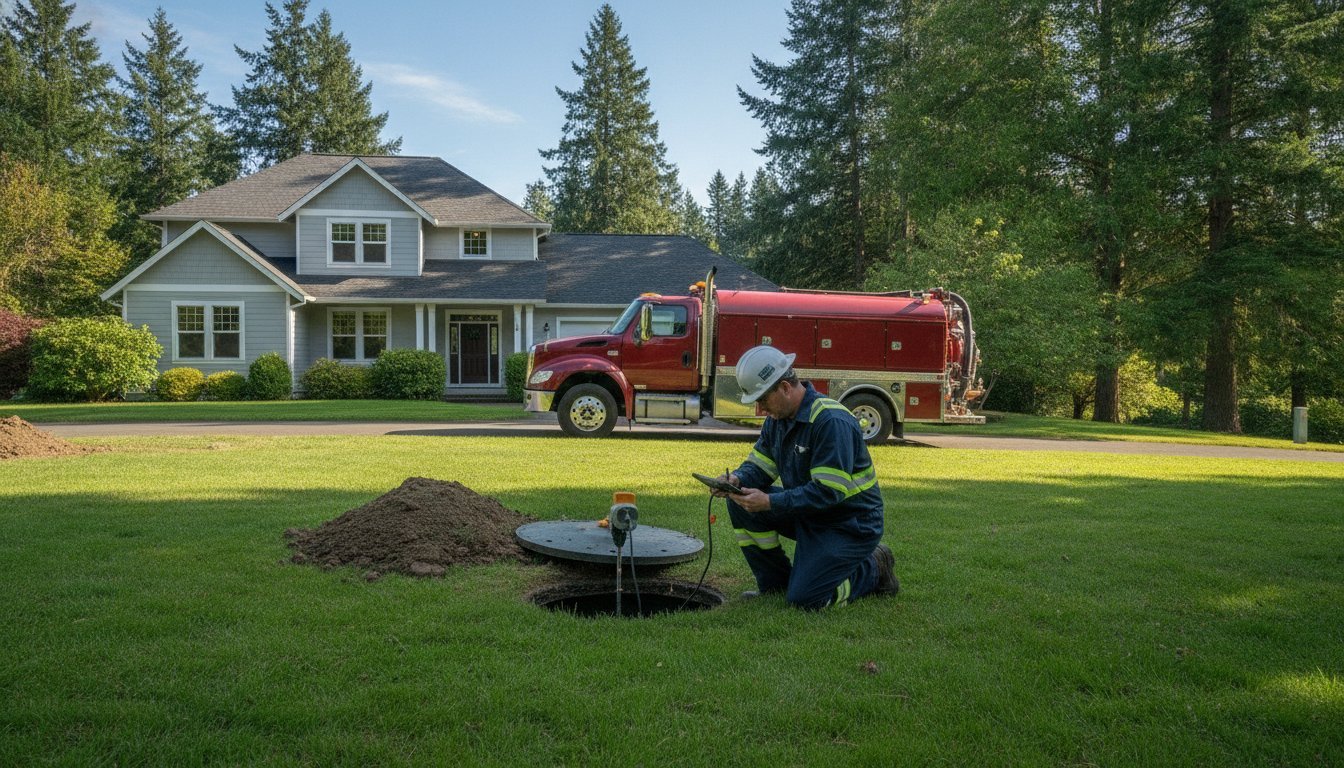
One of the most overlooked factors in small lot construction is the septic system. A conventional septic system can consume a significant portion of your yard with its drain field, leaving little room for anything else. We’ll walk through how advanced treatment technology (ATT) systems offer a more compact, efficient alternative that can free up yard space you’d otherwise lose.
We’ll also cover practical design strategies — from building orientation to underground utilities — that help you get the most out of a smaller footprint. If you’re a homeowner, builder, or real estate professional trying to make a small lot work, this article gives you concrete options to consider.
Smart Design Strategies for Building on a Small Lot
Building smart on a small lot comes down to three things: keeping the building footprint tight, using outdoor space efficiently, and letting landscaping do the heavy lifting where hardscape can’t.
Maximizing Usable Outdoor Space
The biggest mistake on small lots is treating the yard as what’s left over after the house is placed. We need to plan outdoor space intentionally from the start.
Zone your yard by function. Even a 30-foot-wide backyard can hold a patio, a lawn area, and a garden bed if each zone has a defined purpose and clear boundaries.
- Push patios and decks to the rear property line where setbacks allow
- Use vertical fencing or trellises to create privacy without consuming floor space
- Keep paths narrow — 3 feet is walkable; 4 feet feels generous on a small lot
Hardscape like pavers or gravel reduces lawn maintenance while keeping the space functional year-round.
Space-Saving Building Footprints
Going up instead of out is the most effective way to preserve yard space. A two-story home with a 900 sq ft footprint gives us the same living area as a single-story ranch at 1,800 sq ft — while returning nearly half the lot back to usable outdoor space.
| Footprint Style | Ground Coverage | Yard Impact |
| Single-story ranch | High | Minimal yard remaining |
| Two-story traditional | Medium | Moderate yard preserved |
| Narrow two- or three-story | Low | Maximum yard preserved |
Attached garages consume a significant portion of a small lot. A front-load garage tucked into the building envelope or a detached rear garage accessed by an alley keeps the side and rear yard open.
Creative Landscaping Solutions
On small lots, landscaping has to work harder. We recommend layered planting — ground cover at the base, shrubs in the middle, and a small ornamental tree as a canopy — to create depth without consuming much horizontal space.
Raised garden beds built along fences or walls keep planting contained and tidy. Permeable pavers handle drainage while doubling as usable surface area, which matters especially when lot coverage limits are tight.
Avoid large lawn areas that require significant irrigation and maintenance. Low-maintenance native plants reduce upkeep and keep the space looking intentional rather than cramped.
Optimizing Septic Performance with ATT Systems on Small Lots
On a small lot, the septic system isn’t an afterthought — it’s one of the most space-critical decisions you’ll make. ATT systems reduce drainfield footprints, work in poor soil conditions, and protect yard space in ways conventional systems simply can’t match.
Why Small Lots Demand Advanced Treatment Solutions
Conventional septic systems rely on large drainfields to slowly filter wastewater through soil. On a standard lot, that’s manageable. On a small lot — often under half an acre — that drainfield can consume the majority of usable yard space.
Many small lots also face compounding challenges:
- Poor percolation rates from clay-heavy or compacted soil
- High water tables that prevent adequate soil absorption
- Setback requirements from property lines, wells, and structures that shrink available installation zones
When a lot fails a perc test, a conventional system isn’t just inefficient — it’s not permitted at all. We frequently see homeowners stuck at this exact point, unable to build or sell because a standard design won’t work on their site.
How ATT Systems Outperform Traditional Septic Designs
ATT (Advanced Treatment Technology) systems treat wastewater to a higher standard before it reaches the soil. This means the drainfield doesn’t have to do as much work, so it can be significantly smaller.
| Feature | Conventional Septic | ATT System |
| Drainfield size | Large | Reduced by up to 50% |
| Soil quality needed | High percolation required | Works in clay, poor-perc soils |
| High water table compatibility | Limited | Designed for these conditions |
| Treatment quality | Primary/secondary | Tertiary-level output |
That smaller footprint is the key advantage for small lot owners. A reduced drainfield means more usable yard, more room for a garage, an addition, or simply green space.
Real-World Examples: Transforming Tight Sites with ATT Systems
Consider a 0.35-acre lot in a suburban infill neighborhood. A conventional system would require a drainfield covering roughly 2,500 sq ft. After failing the perc test due to clay soil, the owners installed an ATT system with a drainfield under 1,200 sq ft — preserving a functional backyard entirely.
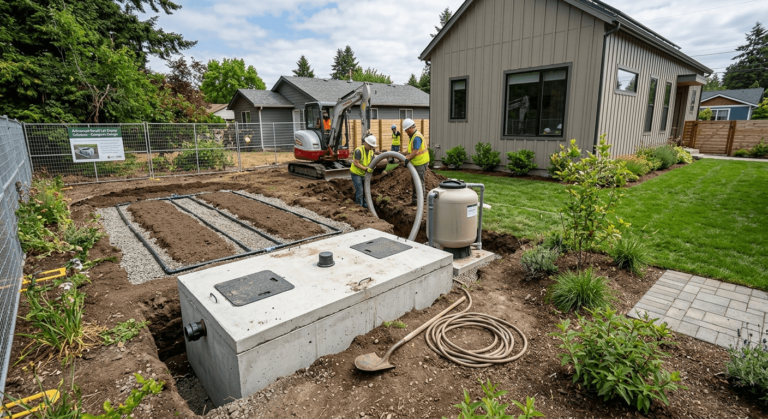
We also work with builders on narrow urban lots where setback rules leave only a narrow corridor for wastewater infrastructure. ATT systems, particularly aerobic treatment units (ATUs), fit within these corridors because the pre-treated effluent requires far less dispersal area.
In both cases, the homeowners kept their outdoor space and received permits that a conventional design could not have obtained.
Frequently Asked Questions
Building on a small lot means balancing structural needs, zoning rules, drainage requirements, and wastewater systems — all within a tight footprint. Here we address the specific questions that come up most often when homeowners and builders work through these constraints.
What design strategies help maintain usable outdoor space when building on a compact residential lot?
We recommend starting with a vertical-first approach. Stacking living space upward rather than spreading outward keeps your building footprint small and leaves more of the lot available for yard use.
Pushing the structure toward one side of the lot — rather than centering it — can consolidate usable outdoor space into one functional zone rather than splitting it into two narrow strips. Rooftop decks, second-floor balconies, and covered patios attached directly to the structure add usable square footage without consuming ground-level yard space.
- Use permeable pavers for pathways and driveways to double as functional surfaces without sacrificing green space
- Choose built-in outdoor seating or raised planters along perimeter fences instead of freestanding furniture that eats into open space
- Position utility areas like HVAC units and trash enclosures against the structure rather than in open yard zones
Which zoning, setback, and lot-coverage rules most often limit additions or new construction on smaller parcels?
Front, rear, and side setbacks are the most frequent constraints we encounter. A 5-foot side setback on both sides of a 40-foot-wide lot can immediately eliminate 10 feet of buildable width before any design work begins.
Lot coverage limits — typically expressed as a percentage of total lot area — cap how much ground the structure, garage, and paved surfaces can collectively occupy. Many municipalities set this between 40% and 60%, and accessory structures like sheds or detached garages count toward that total.
Height restrictions and floor-area ratio (FAR) rules also shape what’s possible. FAR limits the total square footage of all floors relative to lot size, which is why a two-story design on a small lot may still require a variance even if the footprint looks reasonable.
How can multi-level layouts, tuck-under garages, and smaller footprints reduce the need for a larger building pad?
A tuck-under garage uses space beneath the main living floor, typically on sloped lots, which means the garage does not require its own separate slab or footprint. We see this approach free up 400 to 600 square feet of surface area on lots where a detached or side-entry garage would have consumed significant yard space.
Multi-level layouts allow square footage to stack rather than sprawl. A 1,800-square-foot two-story home can sit on a 900-square-foot footprint, compared to a single-story design that requires the full 1,800 square feet of ground coverage.
Reducing the footprint also reduces site disturbance during construction. Less grading, fewer retaining walls, and smaller excavation areas all contribute to preserving existing topography and plantings.
What drainage, grading, and stormwater approaches prevent a small yard from becoming muddy or unusable after construction?
Proper finish grading after construction is non-negotiable. We recommend a minimum 2% slope away from the foundation across all yard areas to prevent water from pooling near the structure or in low-lying corners of the lot.
Permeable paving materials for driveways and walkways allow stormwater to infiltrate rather than run off across the yard surface. On lots under 5,000 square feet, even modest impervious surface additions can create measurable drainage problems if not managed deliberately.
French drains, channel drains at the base of slopes, and dry creek beds are practical solutions for directing water toward the street or a designated infiltration area. In jurisdictions with stormwater management requirements, a small dry well or rain garden may also be required as part of the building permit.
When is an advanced wastewater treatment system required, and how does it support homes where conventional septic won’t fit?
We see ATT systems required most often when a lot cannot support a conventional septic system due to soil conditions, lot size, or proximity to water resources. When a percolation test fails — meaning the soil drains too slowly to safely disperse effluent — a standard drain field simply cannot function as intended.
ATT systems treat wastewater to a significantly higher standard before it reaches the soil, which means the treated effluent can be dispersed across a much smaller area. This is directly relevant to small lots where there is no room for a full-size drain field and a reserve drain field area.
Setback requirements for conventional systems — typically 50 to 100 feet from wells, property lines, and surface water — can make placement impossible on compact parcels. ATT systems often carry reduced setback requirements because the treatment quality is higher, which opens up placement options that a conventional system cannot access.
How do advanced treatment systems compare with traditional septic in terms of footprint, permitting complexity, and long-term maintenance on tight sites?
A conventional septic system requires a primary drain field and, in most states, a designated reserve area of equal size. On a small lot, those two field areas alone can consume the majority of usable yard space — before accounting for the tank itself and required setbacks.
ATT systems use a fraction of that footprint. The treatment unit itself is compact, and the dispersal area required for treated effluent is substantially smaller because the effluent quality is higher. On lots where we have seen conventional systems require 3,000 to 4,000 square feet of drain field, an ATT system may require fewer than 1,000.
Permitting for ATT systems does involve more documentation than a conventional permit. Most jurisdictions require a licensed installer, a maintenance contract with a certified service provider, and periodic inspections — typically once or twice per year.
That maintenance requirement is the most meaningful long-term consideration. ATT systems have mechanical components — pumps, aerators, and controls — that require professional servicing. The trade-off is a smaller footprint, a broader range of viable installation sites, and in many cases the only available path to building on a lot that would otherwise be unbuildable.