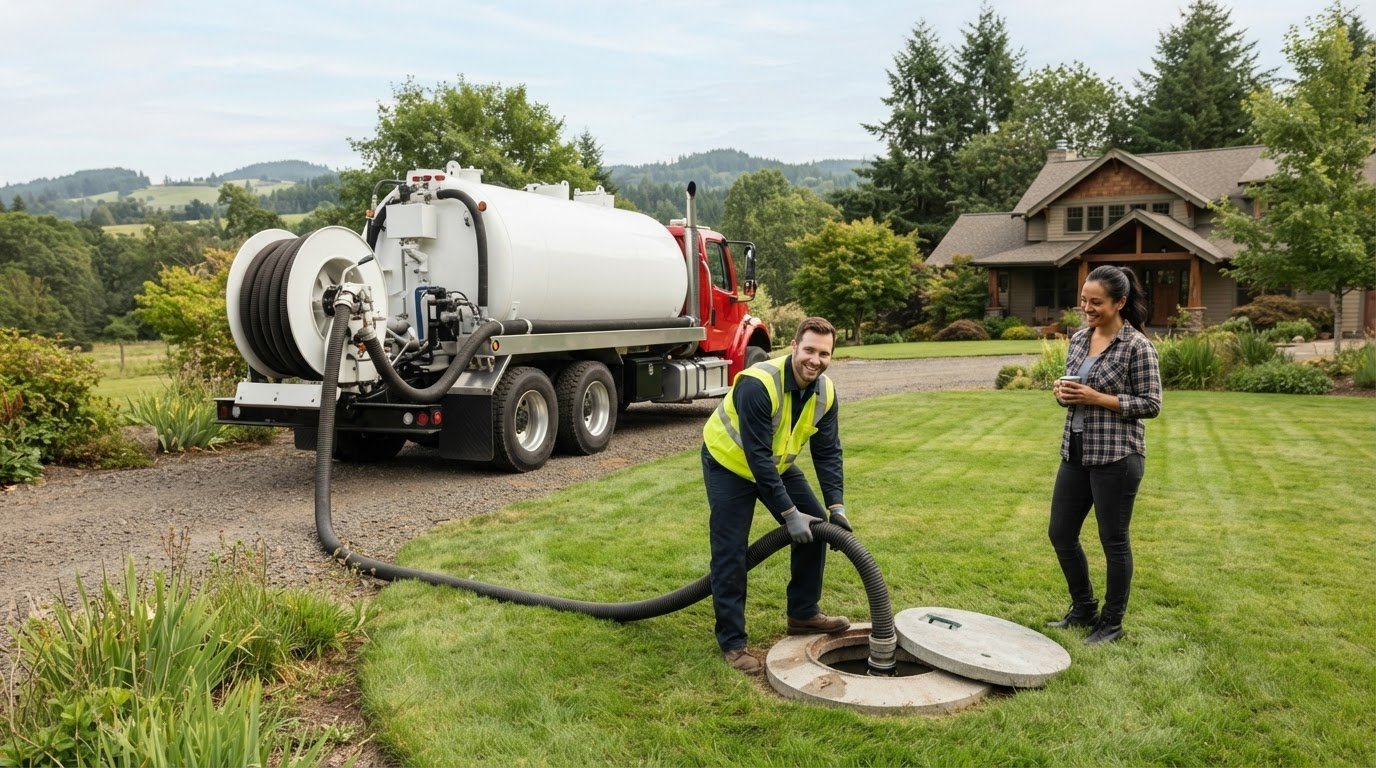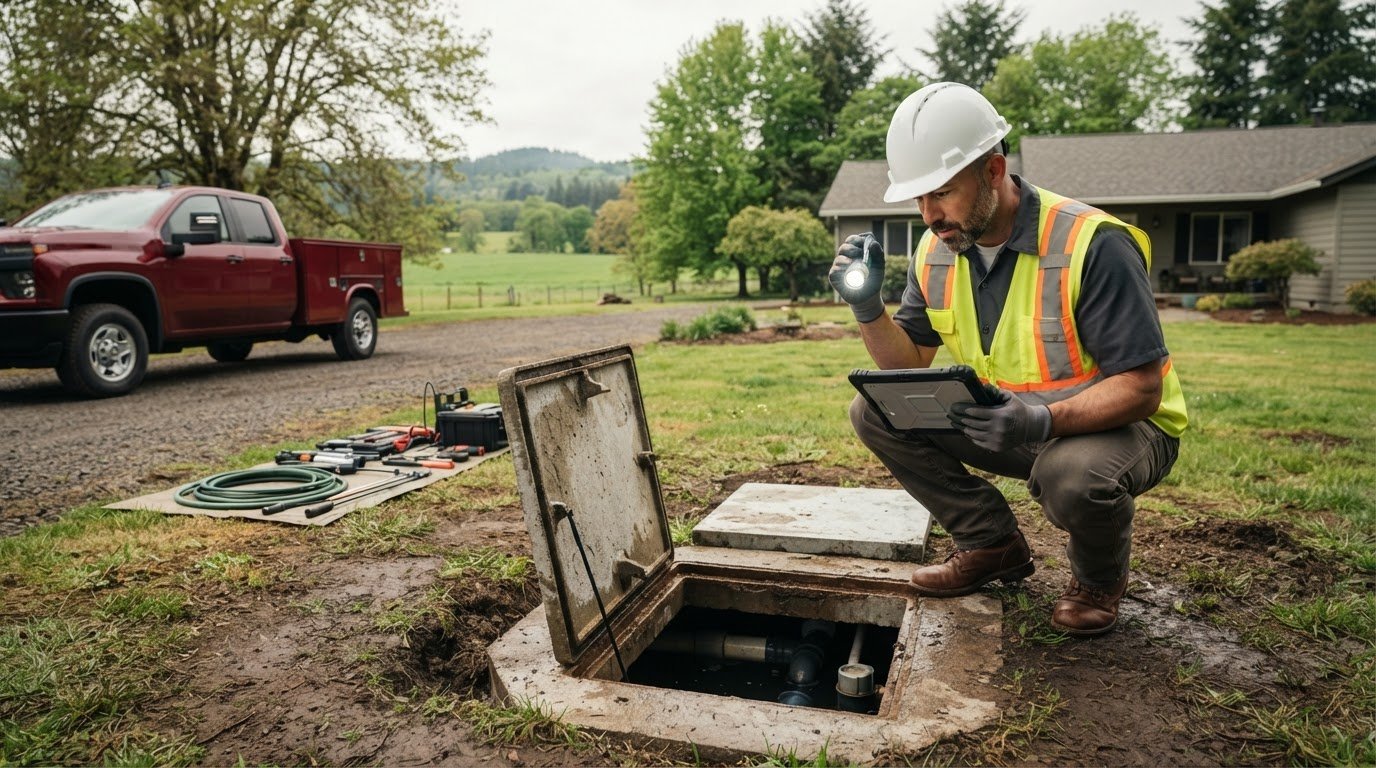
Imagine standing in your backyard with a shovel in hand, staring at a sea of green grass while your drains start to gurgle. You know the tank is out there somewhere, but the exact spot remains a total mystery. It’s a frustrating situation that many homeowners face, especially when the threat of a backup is looming. If you are trying to find septic tank lid in yard locations without turning your lawn into a series of trenches, you aren’t alone. Most people feel that same spike of anxiety about paying extra digging fees or the stress of an unexpected service delay.
The good news is that you don’t need a treasure map to get results. We’re going to show you exactly how to track down that elusive cover using the same practical advice we’ve shared with our neighbors for over 25 years. This guide covers everything from reading your property’s as-built maps to using a simple soil probe safely. You’ll learn the DIY secrets to save money on your next pumping appointment and gain the peace of mind that comes with knowing your system’s layout. Whether you’re preparing for routine maintenance or an official SepticSmart Week checkup, these steps will help you locate the lid quickly and safely.
Key Takeaways
- Save money on your next service by uncovering the access port yourself to avoid professional locating and digging fees.
- Discover how to find septic tank lid in yard spaces by identifying “scorch marks” in your grass or using a soil probe to feel for concrete.
- Use your property’s “as-built” map as a guide to narrow down the search area and avoid digging unnecessary holes in your lawn.
- Learn the proper hand-digging techniques that protect your tank from accidental cracks while preserving your healthy sod.
- Understand why installing a riser is the best way to future-proof your system and make every pumping visit faster and cleaner.
Why Locating Your Septic Tank Lid is Essential for Maintenance
The septic tank lid is the primary gateway to your home’s underground septic tank system. It serves as the only access point for technicians to perform essential pumping, cleaning, and inspections. While it might seem like a minor detail buried under a few inches of grass, knowing exactly where it sits is the foundation of responsible homeownership. When you take the time to find septic tank lid in yard areas before a service call, you transition from a reactive homeowner to a proactive one. This preparation is the first step in establishing a long-term septic maintenance plan in Portland OR, ensuring your system runs smoothly for decades.
Avoiding Unnecessary Dig Fees
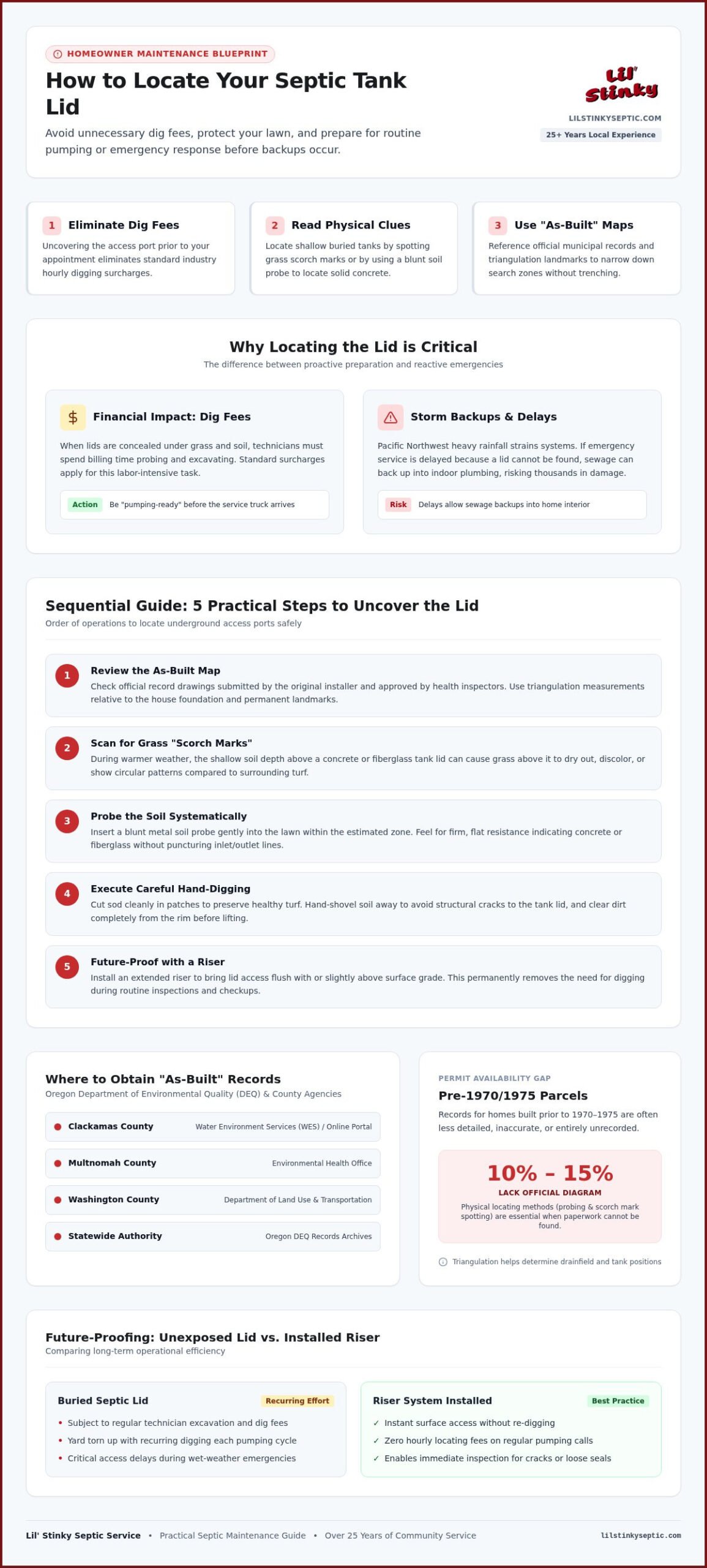
Many homeowners are surprised to see extra charges on their service bill when the lid isn’t already exposed. Most septic companies apply “dig fees,” which are standard industry surcharges for the labor-intensive work of probing and excavating unexposed lids. Technicians often bill for the time spent searching for the tank, which can add up quickly if the burial depth is significant. By being “pumping-ready” before the truck arrives, you eliminate these hourly labor costs. Finding the lid yourself ensures the technician can get straight to work, keeping your service appointment efficient and your costs predictable. It’s a simple way to respect your budget while ensuring your system gets the professional attention it needs.
Preventing Emergency Backups
In the Pacific Northwest, heavy rains can put a sudden, intense strain on your drainage system. If your tank reaches capacity during a storm, you may need emergency septic service in Portland Oregon to prevent a total failure. A hidden lid creates a dangerous delay during these crises. If a technician can’t find the access port immediately, sewage has more time to back up into your home’s pipes, potentially causing thousands of dollars in property damage. Quick access is vital for safety and hygiene. When you find septic tank lid in yard locations ahead of time, you remove the guesswork from emergency response. Our team has spent over 25 years helping local families navigate these situations, and we’ve seen firsthand how a visible lid can be the difference between a quick fix and a household disaster.
Locating the lid also allows you to check for signs of trouble, like cracks or loose seals, before they become major issues. This level of awareness keeps your property compliant with local health standards and protects the local environment. Taking control of this simple task gives you a clearer understanding of your property’s layout and prepares you for future maintenance with confidence.
Start with the Paperwork: Finding Your Septic System As-Built Map
Before you start poking holes in your lawn, check your files for an “as-built” map. This document is essentially a treasure map for your property. It is the official record drawing submitted by the installer and approved by a health inspector when the system was first put in the ground. To find septic tank lid in yard locations efficiently, your first stop should be your computer or a local records office rather than the tool shed. This map uses triangulation to show exactly where the tank and drainfield sit in relation to your home’s foundation or other permanent landmarks.
Requesting Records from Oregon DEQ and Local Counties
If you didn’t receive these documents when you bought your home, you can usually request them from the Oregon Department of Environmental Quality (DEQ) or your specific county planning department. In the Portland area, the process varies slightly depending on where you live:
- Clackamas County: Most records are managed through the Water Environment Services (WES) or the county’s online permit portal.
- Multnomah County: Requests generally go through the Environmental Health office.
- Washington County: The Department of Land Use & Transportation typically handles these property records.
Keep in mind that records for homes built before 1970 or 1975 are often less accurate or may not exist at all. Industry data suggests that roughly 10% to 15% of older parcels lack any official diagram. If you’re struggling to find your records or the map is missing, our team at Lil’ Stinky Septic Service can help you navigate the search or use electronic locating tools to find the tank for you.
How to Read a Septic Plot Map
Reading a septic map is straightforward once you know the symbols. Look for the “main line” exit point, which is where the sewer pipe leaves your house foundation. The map will typically show a straight line leading to a rectangle, which represents the tank. Following EPA septic maintenance and pumping guidelines requires regular inspections, so the map usually provides measurements from two corners of the house to the center of the tank lid.
Don’t confuse the tank with the drainfield. The tank is usually located 5 to 10 feet from the house, while the drainfield (marked by a series of parallel lines) is further out. Use a tape measure to follow the distances noted on the map. If the map says the lid is 12 feet from the back porch and 15 feet from the corner of the garage, mark that intersection. This pinpoint accuracy makes it much easier to find septic tank lid in yard areas without digging up the entire lawn.
5 Proven Methods to Find Your Septic Tank Lid in the Yard
If your property records were incomplete or missing, don’t worry. You can still find septic tank lid in yard areas by using a bit of logic and some basic tools. Most residential tanks are buried between 4 and 24 inches deep, which means they’re close enough to the surface to leave clues. Start by locating where the 4-inch sewer pipe exits your crawlspace or basement. Once you have the direction, you can use these field-tested techniques to narrow down the search area.
Probing the Soil Safely
The most reliable DIY tool is a simple soil probe or a thin piece of rebar with a T-handle. Start about 5 feet away from the house, following the path of the main sewer line. Push the probe into the soil every 12 inches. You’re listening for a specific “clink” of plastic or a solid “thud” of concrete. Don’t use a sledgehammer to force the probe; you only need hand pressure to feel the resistance. This prevents you from accidentally cracking an old concrete lid or piercing a buried pipe. Always call 811 at least two to three business days before you begin to ensure you aren’t probing near underground electrical or gas lines.
Identifying Landscape Anomalies
Nature often acts as a visual guide for buried structures. During the peak of summer, the shallow soil over a septic tank dries out faster than the surrounding yard. This often creates a rectangular “scorch mark” of dead or yellow grass. Conversely, during a wet Oregon winter, the warmth from the wastewater inside the tank might keep the grass directly above it greener and more lush. Look for slight depressions in the topography or small mounds that don’t match the rest of the lawn. Be aware that previous owners might have covered the lid with mulch, decorative rocks, or even a portable shed. These landscape indicators are detailed in the University of Georgia Extension septic system guide, which explains how environmental factors help reveal hidden system components.
If the probe and visual clues fail, try the “thump” test. Use a heavy shovel handle to strike the ground in your suspected area. A hollow, echoing sound is a strong indicator that you’re standing over the tank’s air space. Metal detectors can also work, but they’re only effective if your lid has a metal handle or a modern “tracer” ring. If you still can’t find septic tank lid in yard locations after trying these steps, it’s time to call in a professional who can use an electronic sonde to pinpoint the spot without any guesswork.
Step-by-Step Instructions for Safely Digging Up the Lid
Once you use the methods discussed earlier to find septic tank lid in yard locations, it’s time to pick up the shovel. This stage requires a delicate touch to avoid damaging the tank structure or your landscaping. Start by marking the exact center of your search area. Most residential lids sit between 6 and 24 inches below the surface, though some older systems in deep-freeze climates may sit as deep as 48 inches. By preparing the site correctly, you ensure the pumping process is fast and mess-free.
Excavation and Identification
Use a sharp spade to cut a neat square of sod about 24 inches by 24 inches. Carefully lift the grass and place it on a tarp nearby; this prevents soil from mixing with your lawn and makes the restoration much easier. Dig slowly using a hand shovel rather than a pickaxe. If you hit a hard surface, stop and clear the dirt away with a hand trowel to identify the component. You’ll likely encounter one of three common materials:
- Concrete: These are heavy, often requiring a pry bar to lift, and are the most common in older homes.
- Plastic/Polyethylene: Usually green or black, these lids are lightweight and often secured with stainless steel screws.
- Cast Iron: Found in very old systems, these are extremely heavy and prone to rusting over decades.
Make sure you haven’t accidentally uncovered the distribution box, which is smaller and sits further downstream toward the drainfield. Once the tank lid is fully exposed, use a stiff brush to clean the edges. Removing dirt and debris from the rim ensures that the pumper can achieve a tight, sanitary seal once the service is complete.
Septic Gas and Lid Safety
Safety is the most critical part of this process because the environment inside a tank is hostile. Septic tanks are officially classified as confined spaces and should never be entered under any circumstances. These systems produce lethal concentrations of methane, hydrogen sulfide, and carbon dioxide. These gases are heavier than air and can cause asphyxiation or death within seconds if inhaled. Never lean your head deep into an open tank or leave an open lid unattended, even for a minute.
While digging, inspect the structural integrity of the cover. If you notice the concrete is crumbling, the plastic is cracked, or the metal is paper-thin from corrosion, the lid needs immediate replacement. A failing lid is a significant safety risk for children, pets, and even riding lawnmowers. If you’ve managed to find septic tank lid in yard areas but discovered a damaged cover, contact Lil’ Stinky Septic Service immediately for a professional replacement and inspection.
Future-Proofing: Risers and Professional Assistance
After you spend the afternoon working to find septic tank lid in yard locations, the last thing you want is to repeat the process in three years. Digging is labor-intensive; it’s also hard on your landscaping and can be a major source of stress during an emergency. The most effective way to end the cycle of searching and excavating is to install a septic riser. A riser is a vertical extension that brings your tank’s access point up to ground level, making it permanently accessible for any future maintenance or inspections.
Installing a Septic Riser
A riser acts as a bridge between your buried tank and the surface. These components are typically made of heavy-duty polyethylene or PVC and are sealed directly to the top of your tank opening. By installing a riser, you eliminate the need for digging during every septic tank pumping in Portland OR. This simple upgrade offers several long-term benefits:
- Cost Savings: You avoid “dig fees” and labor surcharges on every future service visit.
- Lawn Preservation: No more cutting sod or creating dirt piles in your backyard every few years.
- Safety: Modern risers feature water-tight seals and child-proof, bolt-down lids to keep your family and pets safe.
You can choose to have the riser lid sit flush with the grass or just an inch below the grade. This keeps it hidden from view while remaining easy to find with a quick tap of a shovel. It’s a one-time investment that pays for itself through reduced labor costs and faster service times.
When to Call Lil’ Stinky Septic Service
Sometimes, even with the best maps and tools, you still can’t find septic tank lid in yard areas. This often happens if the tank is buried deeper than two feet or if the property records are completely missing. When the DIY methods fail, don’t keep digging holes in your lawn. Our team uses advanced electronic locators, such as flushable sondes and radio-frequency wands, to pinpoint your tank’s location within minutes without any guesswork.
With over 25 years of local experience and our best-price guarantee, we ensure your system is handled correctly the first time. If you’re buying a new home or preparing to sell, a certified septic inspection in Oregon can verify the integrity of your lids and risers to ensure they meet DEQ compliance standards. Don’t let a hidden lid cause a maintenance delay or an expensive backup. Contact Lil’ Stinky Septic Service (CCB #189693) today for professional locating, pumping, and riser installation. We value your peace of mind and are ready to be your dependable ally for all your septic needs.
Take Control of Your Septic Maintenance Today
Locating your access port is the first step toward a stress-free maintenance routine. By using property records and simple probing techniques, you can find septic tank lid in yard areas and save yourself from expensive labor surcharges. Whether you decide to dig it up yourself or install a permanent riser, you’re making a choice that protects your home and your budget for years to come.
If you run into trouble or simply want the job handled by a seasoned pro, we’re ready to step in. We’ve served the community for over 25 years with a focus on transparency and quality workmanship. As a licensed team (CCB #189693), we provide 24/7 emergency response and stand by our best-price guarantee for every customer.
Get a Best-Price Guarantee on Your Next Septic Pumping; Call Lil’ Stinky Today!
You’ve done the hard work of learning the layout of your system. Now, enjoy the confidence of knowing your home is safe and ready for its next professional service.
Frequently Asked Questions
How deep is a septic tank lid usually buried?
Most residential lids are buried between 6 and 24 inches below the surface. In some older properties or colder climates, they might sit as deep as 3 feet. If you’re trying to find septic tank lid in yard locations and haven’t hit anything after digging two feet, you may need professional locating equipment. Deep burial often makes routine pumping difficult, which is why we often recommend installing a riser to bring the access point closer to the grade.
Can I use a metal detector to find my septic tank lid?
A metal detector only works if your lid has metal components, such as a cast iron handle or a modern steel tracer ring. Many older concrete lids don’t contain enough metal to trigger a standard hobbyist detector. If your tank is plastic or fiberglass, a metal detector will likely be ineffective. In these cases, we use specialized electronic sondes that we flush down the line to pinpoint the exact location without any guesswork.
What does a septic tank lid look like?
Septic lids are typically round or square and measure about 20 to 24 inches in diameter. Depending on the age of your system in Canby, the lid is likely made of heavy concrete, green or black reinforced plastic, or occasionally cast iron. Concrete lids often have a metal handle or a recessed notch for prying. If you find a smaller 6-inch or 12-inch cover, you might be looking at an inspection pipe or a distribution box instead.
What should I do if I find a hole or a soft spot in my yard near the tank?
Treat any soft spots or sudden depressions near your tank as a serious safety hazard. These signs often indicate a failing lid, a structural collapse, or a saturated drainfield caused by a leak. Avoid walking over the area and keep pets and children away. Because septic gases are dangerous and soil instability can lead to a cave-in, contact Lil’ Stinky Septic Service immediately for an emergency inspection to secure the site and prevent a disaster.
Is it safe to dig for my septic tank lid myself?
Digging for your lid is generally safe if you use hand tools and follow basic precautions. You must call 811 at least two business days before you begin to mark public utility lines. Use a hand shovel rather than heavy machinery to avoid cracking the tank. Most importantly, never enter the tank or lean your head inside once the lid is open. The gases inside are lethal and can cause unconsciousness in just a few seconds.
Can I plant flowers or shrubs over my septic tank lid?
You can plant grass or shallow-rooted flowers over the tank, but avoid shrubs and trees. Roots are the primary enemy of septic systems and can easily crack tank walls or clog drainage pipes. If you plant anything, ensure it doesn’t obstruct access for the pumper truck. Maintaining a clear, grassy area makes it much easier to find septic tank lid in yard spaces during your next scheduled maintenance or when an emergency arises.
How much does it cost if I can’t find my septic tank lid and need a pro?
Professional locating costs vary based on the depth of the tank and the equipment required to find it. Many providers charge additional fees for the labor involved in probing and hand-digging. To ensure you get the most value, Lil’ Stinky Septic Service offers a best-price guarantee for our local customers. You can avoid these extra surcharges entirely by following our guide to locate and uncover the access port before your pumping appointment begins.
How do I get a copy of my septic system’s as-built map in Oregon?
To get an as-built map, you should contact the Oregon Department of Environmental Quality (DEQ) or your specific county’s planning department. For residents in Clackamas or Multnomah counties, these records are often available through online permit portals or by filing a formal public records request. These documents are vital for understanding your system’s layout. If your home was built before 1970, records might be missing, and you may need a professional to map the system.