Clay soil is one of the most common reasons homeowners run into trouble when planning or replacing a septic system. Unlike sandy or loamy soil, clay drains poorly, which means wastewater has nowhere to go — and that creates serious health, environmental, and financial problems. If your property has clay-dominant soil, a standard septic system may not be a legal or functional option without the right approach.
We’re going to walk through why clay soil creates such significant challenges for conventional septic systems, what your real options are, and how Advanced Treatment Technology systems offer a reliable path forward where traditional systems often can’t be installed at all. Understanding the soil beneath your property isn’t just technical knowledge — it directly affects what you can build, buy, or sell.
Whether you’re a homeowner dealing with a failed perc test, a builder planning a new construction, or a real estate professional assessing a property’s viability, the information in this article applies directly to your situation.
Septic Challenges and Solutions for Clay Soil
Clay soil absorbs water slowly, which directly limits how well a drain field can disperse wastewater. Knowing how to identify the warning signs early and understanding which system types actually work in clay can save homeowners significant time and money.
Why Clay Soil Creates Issues for Septic Systems
Clay particles are extremely fine and pack tightly together, leaving very little pore space for liquid to pass through. This creates a low percolation rate, meaning wastewater sits in the drain field instead of draining away.
When effluent can’t move through the soil fast enough, it backs up into the tank, saturates the drain field, or surfaces in the yard. Standard drain fields rely on soil absorption — and clay simply doesn’t cooperate.
Key factors that make clay problematic:
- Hydraulic conductivity is often below 0.5 inches per hour in heavy clay
- Clay expands when wet, further reducing available pore space
- Biomat buildup accelerates because effluent has nowhere to go
- Failed percolation tests are common, blocking permit approval for conventional systems
Conventional Systems vs. New Alternatives
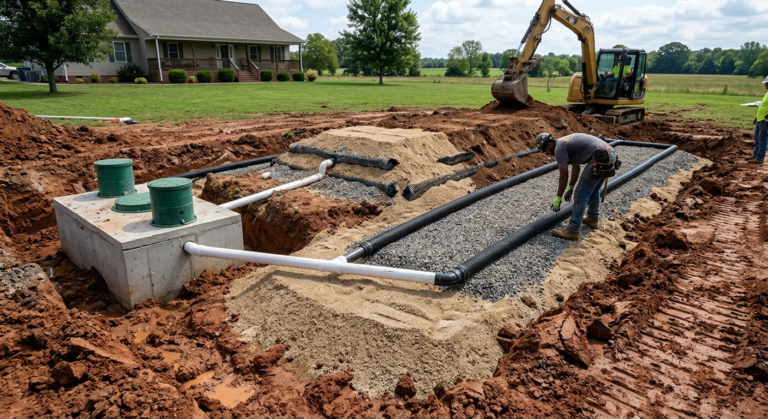
A standard gravity-fed septic system distributes effluent into a gravel-filled trench and depends entirely on soil absorption. In clay, this design fails quickly or never gets permitted in the first place.
| System Type | Works in Clay? | Why |
| Gravity drain field | No | Too slow to absorb |
| Mound system | Sometimes | Elevates drain field above clay layer |
| Drip irrigation system | Yes | Delivers small doses, reduces ponding |
| ATT/advanced treatment system | Yes | Produces higher-quality effluent, reduces soil stress |
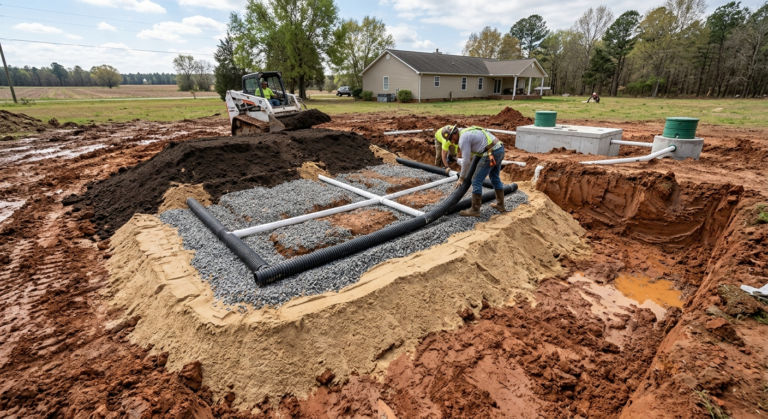
Mound systems add engineered fill above the clay layer, which helps. However, they require significant space and soil testing to confirm the underlying clay layer won’t still impede drainage over time.
Recognizing Signs of Septic Trouble in Clay Soil
We often see homeowners dismiss early warning signs as seasonal wet ground. In clay soil, those signs move fast from minor to serious.
Watch for these indicators:
- Soggy or spongy ground above or near the drain field, especially after dry weather
- Sewage odors in the yard or near outdoor drains
- Slow drains or gurgling toilets inside the home
- Unusually lush, green grass over the drain field area
- Wastewater surfacing visibly on the ground
A slow drain inside the home is often the first signal. By the time effluent is surfacing outdoors, the drain field has typically already been compromised and may need full replacement.
Advanced Treatment Technology Systems: A Superior Choice for Clay Soil
When clay soil makes conventional septic systems impractical, ATT systems provide a reliable path forward by treating wastewater to a higher standard before it ever reaches the ground.
How ATT Systems Overcome Clay Soil Limitations
Clay soil’s low percolation rate — often less than 60 minutes per inch — means that a standard drain field simply cannot disperse effluent fast enough. Untreated wastewater backs up, saturates the soil surface, and creates a public health hazard.
ATT systems address this directly. They treat wastewater to a significantly cleaner level before dispersal, which means the soil doesn’t need to do as much of the filtration work. The effluent entering the drain field from an ATT system typically meets secondary or tertiary treatment standards, with dramatically reduced biological oxygen demand (BOD) and suspended solids.
This allows ATT systems to work with smaller, shallower drain fields — or pressure-dosed drip irrigation systems — that function effectively even in tight clay soils where conventional leach fields would fail.
Key Advantages of ATT for Homeowners
ATT systems offer several practical benefits that matter most when clay soil is involved:
- Smaller footprint: Requires less drain field area, which is critical on lots where clay limits usable space
- Reduced soil dependency: Pre-treated effluent places less stress on soil absorption capacity
- Drip dispersal compatibility: Works with subsurface drip irrigation systems that distribute effluent in small, controlled doses — ideal for clay
- Regulatory approval on difficult sites: Many jurisdictions accept ATT systems on lots that fail standard perc tests
- Longevity: Less clogging of the drain field compared to conventional systems dispersing raw septic tank effluent
These systems do require routine maintenance contracts and periodic inspections, which adds ongoing cost but also ensures reliable performance.
Real-World Examples of ATT Success in Problem Soils
Consider a homeowner in a region with heavy clay subsoil who has failed two perc tests and cannot install a conventional system. With an ATT system paired with a subsurface drip dispersal field, the treated effluent is delivered at a rate the clay can absorb without saturation.
In another scenario, a builder developing a rural lot with a perc rate of 90 minutes per inch — well outside the acceptable range for conventional systems — used an ATT system to obtain a septic permit and complete the build. Without it, the lot would have been unbuildable.
These outcomes aren’t rare. ATT systems are specifically engineered to perform where conventional systems cannot, making them a practical, code-compliant solution for clay-heavy properties.
Frequently Asked Questions
Clay soil creates real complications for septic systems, from slow infiltration rates that cause drainfield saturation to permit requirements that demand soil testing before any design is approved. Understanding how soil behavior, site conditions, and treatment technology interact helps homeowners make informed decisions before problems arise.
Why does clay soil make septic drainfields fail more often than other soil types?
Clay particles are extremely fine and pack tightly together, leaving very little pore space for water to move through. A sandy soil might absorb wastewater at a rate of 1 inch per minute, while heavy clay can absorb as little as 1 inch per hour — or slower.
When a conventional drainfield releases effluent faster than clay can accept it, the liquid backs up. It saturates the soil around the distribution pipes, creates wet spots or ponding at the surface, and eventually causes sewage to push back toward the home.
What signs indicate a septic system is struggling specifically because of slow-draining soil?
Slow drains throughout the home — not just one fixture — often point to a drainfield problem rather than a plumbing clog. You may also notice:
- Wet, spongy ground over the drainfield even during dry weather
- A persistent sewage odor near the drain lines or at ground level
- Gurgling sounds from toilets and drains after flushing
- Sewage backups occurring during periods of heavy water use, such as doing multiple loads of laundry in one day
These signs tend to get worse in spring and fall when clay holds more moisture and has even less capacity to absorb additional liquid.
Which site and soil tests should be completed before choosing a wastewater treatment and dispersal approach?
A percolation test (perc test) measures how quickly water moves through the soil at a specific depth. A soil morphology evaluation performed by a licensed soil scientist goes further — it identifies soil texture, structure, color, and restrictive layers that influence where and how a system can be installed.
We also recommend a topographic survey to understand slope and drainage patterns, and a seasonal high water table assessment, which determines how close saturated soil comes to the surface during wet months. Some jurisdictions require all of these before issuing any septic permit.
Skipping these tests is one of the most common reasons homeowners end up with a system that fails within a few years of installation.
What design options help wastewater disperse properly when infiltration rates are low?
When clay limits conventional trench systems, several engineered alternatives exist:
- Mound systems raise the drainfield above native soil, using imported sand fill to create an absorption layer with better hydraulic properties
- Drip irrigation dispersal delivers small, precise doses of effluent to shallow soil zones, giving clay more time to absorb between doses
- Low-pressure pipe (LPP) systems distribute effluent more evenly across a larger field area, reducing the load on any one section
These designs work by either bypassing the worst clay layers or reducing the rate at which effluent is applied. The right choice depends on lot size, setback requirements, and how deep the clay extends.
When is an advanced treatment system required, and how does it change what can be installed on a difficult site?
Regulators require Advanced Treatment Technology (ATT) systems when a site cannot meet minimum setback distances, when perc test results fall outside the range approved for conventional systems, or when the property sits near a sensitive water resource like a well, stream, or wetland.
ATT systems treat wastewater to a significantly higher standard before it ever reaches the soil. Because the effluent leaving an ATT unit contains lower concentrations of solids, nutrients, and pathogens, regulators allow it to be dispersed in conditions that would be completely off-limits for conventional effluent. This means a site with poor perc results or shallow depth to clay may still be buildable with an ATT system in place.
A practical example: a half-acre lot in a clay-heavy region that fails its perc test for a conventional mound system may be fully approvable once an ATT unit is added to the treatment train. The treated effluent quality unlocks dispersal options — including reduced setbacks and smaller drainfield footprints — that simply aren’t available otherwise.
How do maintenance needs, operating costs, and permitting differ between conventional setups and advanced treatment options?
Conventional septic systems have relatively low ongoing costs. Pumping the tank every 3–5 years is the primary maintenance requirement, and most don’t require an operating permit beyond the initial installation approval.
ATT systems involve more moving parts — aerobic treatment units, pumps, timers, and sometimes UV disinfection components. These require:
- Annual or semi-annual inspections by a licensed service provider
- Ongoing operating permits in most states, renewed annually or biennially
- Service contracts, which typically run $150–$400 per year depending on system type and region
The tradeoff is real but straightforward. A conventional system costs less to operate on a site where it’s appropriate. On a clay-heavy site where a conventional system would fail or isn’t permitted, an ATT system isn’t just the more expensive option — it’s often the only option that gets approved and stays functional long-term.