What if that “unbuildable” lot you’ve been eyeing in Multnomah or Clackamas County is actually the perfect site for your dream home? Many homeowners feel defeated when a site evaluation reveals fast-draining soils or a high water table, fearing their property value has just evaporated. It’s completely normal to feel overwhelmed by the complex Oregon DEQ regulations that went into effect on January 1, 2026. You shouldn’t have to be an environmental engineer just to manage an ATT septic installation in the Portland area. We know the frustration of seeing a project stall because of technical jargon and shifting state rules.
This guide will show you how Alternative Treatment Technology turns “impossible” land into a viable, high-performance home site while meeting every 2026 regulatory standard. We’ll provide a clear roadmap through the permit process, explain the mandatory lifetime Operation and Maintenance (O&M) contracts, and show you how to protect your property value through professional installation. From the initial site evaluation to the final inspection, you’ll gain the clarity needed to move your project forward. You’ll learn exactly how these systems work and why they’re the gold standard for modern Portland properties.
Key Takeaways
- Learn how Alternative Treatment Technology makes “unbuildable” lots viable by acting as a high-performance wastewater treatment plant for your home.
- Discover why a professional ATT septic installation Portland area is essential for meeting the strict Oregon DEQ rule changes enacted in 2026.
- Understand the legal requirement for a lifetime Operation and Maintenance (O&M) contract and how it protects your long-term property value.
- Get a clear roadmap for navigating site evaluations, custom system design, and the current permitting delays in the Portland metro region.
- Identify the most reliable DEQ-approved technologies that offer the best local support and long-term reliability for Willamette Valley properties.
What is an ATT Septic System and Why Does Your Portland Property Need One?
Think of an Alternative Treatment Technology (ATT) system as a compact, high-efficiency wastewater treatment plant buried in your backyard. While a traditional septic system relies on a simple tank and the natural soil to filter out contaminants, an ATT system takes an active approach. It uses advanced mechanical processes to treat water to a much higher standard before it ever touches the ground. If you’ve been told your lot is “unbuildable” because of a failed percolation test, an ATT system is often the key that unlocks your property’s potential.
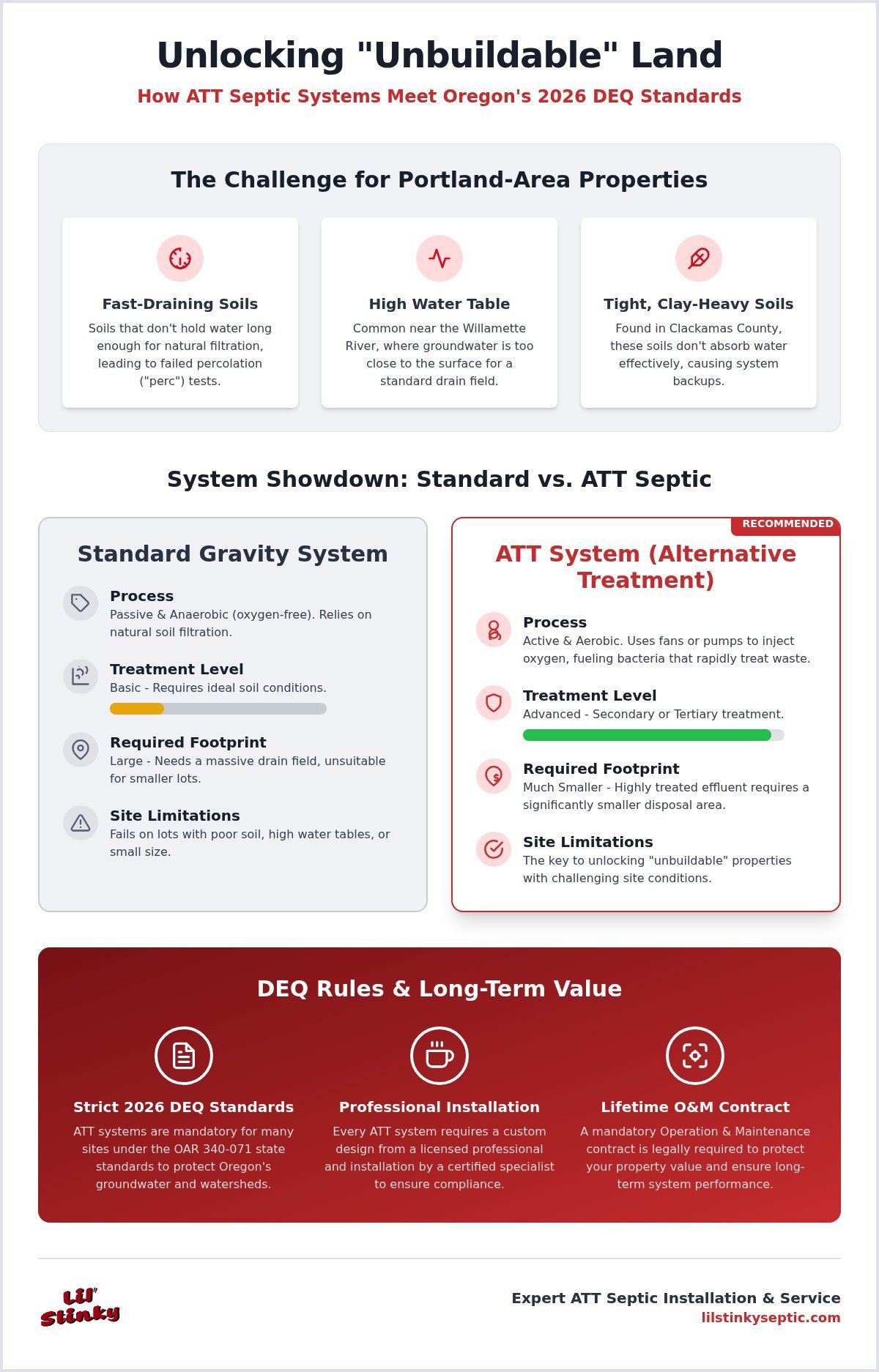
In the Portland area, we see “perc test” failures for several reasons. You might have tight, clay-heavy soils in parts of Clackamas County that won’t absorb water fast enough. Or, you could be dealing with the high groundwater tables common near the Willamette River. When the soil can’t do the heavy lifting, Oregon law requires a system that cleans the effluent more thoroughly. An ATT system produces effluent that is significantly safer for the environment than the waste found in standard anaerobic tanks.
ATT vs. Standard Gravity Systems: The Core Differences
The biggest difference lies in how the waste is processed. A standard gravity system is passive and anaerobic, meaning it lacks oxygen. In contrast, most ATT setups function as an aerobic treatment system, using fans or pumps to inject oxygen into the wastewater. This oxygen fuels “good” bacteria that break down organic matter much faster and more effectively than nature could alone.
This efficiency means you don’t need nearly as much space. For homeowners on smaller lots in Multnomah County, this is a game-changer. A standard drain field might require a massive footprint that your property simply doesn’t have. Because ATT systems reach “Secondary” or “Tertiary” treatment levels, the resulting effluent is so clean that the DEQ often allows for a much smaller disposal area, making tight lot lines a non-issue.
The Role of the Oregon DEQ in ATT Approval
The Oregon Department of Environmental Quality (DEQ) maintains a rigorous list of approved technologies. They don’t just take a manufacturer’s word for it; they require extensive field testing to ensure these systems can handle the specific climate and soil conditions of the Northwest. This is also why you can’t “DIY” an ATT design. Every ATT septic installation Portland area requires a custom design from a licensed professional and an installation by a certified specialist to ensure it meets the OAR 340-071 state standards.
The Oregon DEQ serves as the state’s environmental watchdog, setting strict performance standards for ATT systems to prevent untreated sewage from contaminating our shared groundwater and local watersheds. Working with a specialist who understands these 2026 updates ensures your system stays compliant and your permit gets approved without unnecessary delays.
DEQ-Approved ATT Technologies: Comparing Your Options in 2026
Choosing the right system isn’t just about picking a brand from a brochure. It’s about finding a technology that works with your specific lot and has a local technician who can service it. In the Willamette Valley, we look for systems that can handle our wet winters without spiking your electric bill. Most homeowners prioritize energy efficiency and low-noise operation when planning an ATT septic installation Portland area. You’ll want a system that runs quietly in the background while meeting every environmental standard.
When comparing different DEQ-approved ATT technologies, keep these practical factors in mind:
- Power consumption: Some units run internal blowers 24/7, while others use timed cycles to save energy.
- Mechanical complexity: Systems with fewer moving parts often have lower long-term repair costs.
- Maintenance access: Look for systems with clear access points that don’t require extensive digging for routine service.
- Local support: Ensure the brand you choose has a strong network of certified service providers in Oregon.
Maintenance considerations vary significantly between mechanical treatment styles. Some systems utilize submerged media where bacteria grow on fixed plastic shapes, while others use suspended growth processes. Understanding these differences helps you anticipate the frequency of media cleaning or replacement. Selecting the wrong unit can lead to high maintenance fees or difficulty finding replacement parts. If you’re unsure which technology fits your budget and soil type, the experts at Lil’ Stinky Septic Service can provide a professional recommendation based on your site evaluation.
FujiClean Systems: Compact Power for Tight Lots
FujiClean is a reliable choice for a residential ATT septic system Oregon homeowners often select for smaller properties. It uses a single-tank design, which is a massive advantage if you’re trying to preserve your landscaping or have a very small footprint. Because everything happens in one tank, there’s minimal yard disruption during the install. It’s particularly effective in the high-clay soils of Clackamas County because it treats the water so thoroughly before it reaches the drain field. This prevents the “clogging” issues that often plague standard systems in heavy, slow-draining soil.
Orenco Advantex: The Industry Standard for Durability
If you have a larger home or a commercial property, Orenco Advantex is often the go-to solution. It uses a specialized textile filter that provides incredibly consistent treatment levels, even with fluctuating water usage. It’s built to last and is famous among technicians for being easy to service. Providers appreciate the clear access points, which can save you money on labor during your mandatory O&M inspections. The textile media is remarkably durable, making it a smart long-term investment for properties with high flow requirements.
The ATT Installation Process: From Design to Final Inspection
Every successful project begins with a clear plan. Before we ever break ground, your project starts with a detailed site evaluation to determine the specific soil profile and groundwater depth on your property. This data is the foundation of a professional septic system design in Oregon. Because ATT systems are more complex than standard tanks, the county requires an engineered plan that accounts for every pipe, pump, and filter. We coordinate directly with health departments in Clackamas, Washington, and Multnomah counties to ensure your design meets their specific local requirements before the first shovel hits the dirt.
Permitting and Engineering: Avoiding Costly Delays
You can’t skip the paperwork when it comes to an ATT septic installation Portland area project. As of August 2026, the City of Portland and surrounding counties are experiencing extended delays in permit plan reviews and site evaluations. It’s vital to submit a complete, error-free application to avoid being pushed to the back of the line. An engineered plan isn’t just a regulatory hurdle; it’s your protection against system failure. At Lil’ Stinky, we take the lead on this “paperwork headache,” managing the communication with DEQ officials and county inspectors so you don’t have to decipher the technical requirements yourself.
The 2026 Operation & Maintenance (O&M) Mandate
Owning an ATT system comes with a permanent responsibility. Under OAR 340-071-0132, Oregon law requires every homeowner with an ATT system to maintain a valid, lifelong service contract with a DEQ-certified provider. It isn’t just a suggestion; it’s a legal mandate that protects your property deed. As of January 1, 2026, all new and existing ATT operation and maintenance contracts must strictly adhere to the revised DEQ standards, requiring digital reporting and specific nutrient testing protocols to ensure groundwater safety. During a semi-annual inspection, a technician will:
- Check all mechanical blowers and pumps for proper operation.
- Clean or replace internal filters to maintain high effluent quality.
- Test alarm systems to ensure you’re alerted if a component fails.
- Verify that the “good” bacteria in your aerobic unit are healthy and active.
Once the design is approved and the O&M contract is signed, the physical work begins. This involves precision excavation to set the treatment tanks and careful electrical wiring for the control panels. We prioritize a clean job site, ensuring that the heavy equipment used for an ATT septic installation Portland area causes as little disruption to your property as possible. After the final inspection by the county, your system is officially ready for decades of reliable service.
Cost vs. Value: Investing in an ATT Septic System
Is the extra investment worth it? For many homeowners, the answer is a resounding yes. While the initial septic system installation cost in Oregon is higher for advanced technology than for a standard gravity setup, you have to look at the big picture. An ATT system doesn’t just treat wastewater; it creates equity. If your lot was previously labeled “unbuildable” due to poor soil or high groundwater, this technology is the only way to secure a building permit. It transforms a piece of land with zero utility into a high-value home site.
Beyond the permit, there’s a significant long-term ROI. Because ATT systems treat effluent to a much higher standard, the water hitting your drainfield is remarkably clean. This prevents the “biomat” buildup that eventually kills traditional leach fields. By protecting your drainfield from clogging, you’re effectively doubling the lifespan of the most expensive part of your septic infrastructure. You’ll also need to budget for modest operating costs, including the electricity for internal blowers and the eventual replacement of filter media every few years.
Factors Influencing Your Total Project Cost
Every ATT septic installation Portland area project is unique. Site accessibility is a major factor; if our heavy excavators can’t easily reach the installation zone, we have to use smaller, more specialized equipment. Soil morphology also plays a role. If we hit solid rock in the West Hills or heavy Clackamas clay, excavation takes longer and requires more labor. Finally, the distance between your home, the treatment unit, and the final drainfield dictates how much piping and electrical trenching is required. A compact lot often saves on materials but might require more precision during the dig.
Protecting Your Investment with Proactive Maintenance
Don’t make the mistake of thinking advanced tech means zero maintenance. Even with aerobic treatment, solids still accumulate in the primary tank. Regular pumping is still a requirement to keep the mechanical components from being overwhelmed. The most effective way to avoid “sticker shock” from emergency repairs is to enroll in a septic maintenance plan in Portland OR. These plans ensure your system stays compliant with 2026 DEQ standards while catching small issues before they become five-figure failures.
Ready to see how an ATT system can work for your property? Contact Lil’ Stinky Septic Service today for an expert consultation on your installation options.
Why Choose Lil’ Stinky for Your Portland ATT Installation?
Finding a contractor for an ATT septic installation Portland area doesn’t have to be a gamble. You need a team that understands the local landscape and the specific regulatory hurdles of 2026. Lil Stinky Septic Service brings over 25 years of local experience to every job site. We aren’t just installers; we are your long-term partners in property safety. Holding CCB license #189693, our team is fully bonded and DEQ-certified to handle even the most complex aerobic systems.
Our comprehensive “Design-to-Maintenance” service means we handle every single step. We manage the initial site evaluation, draft the engineering plans, secure the county permits, and perform the physical installation. Because Oregon law now mandates lifetime O&M contracts, our 25-year history provides the stability you need. You can trust that we’ll be here to perform your semi-annual inspections and keep your system in compliance for decades to come. We also offer a best-price guarantee. You get top-tier workmanship and DEQ-approved technology without the inflated markups often found with larger corporate firms.
We pride ourselves on being a neighborly guide through what can be a stressful process. Whether you need a standard setup or a specialized septic installation in Canby Oregon, we treat your property with the same care we’d give our own. Our goal is to protect your property value while taking the technical burden off your shoulders.
Our “Straight-Talk” Approach to Complex Systems
We believe in transparency. Our technicians explain your system’s operation in plain English, avoiding the “engineer-speak” that leads to confusion. We provide clear, honest timelines and keep you updated throughout the permitting process. Having worked in the Willamette Valley for a quarter-century, we know Clackamas and Multnomah county soils better than anyone. We anticipate soil issues before they cause delays, ensuring your project stays on track. You’ll always get a straight answer from us, whether it’s about system capacity or maintenance requirements.
Ready to Start Your Project?
Starting your project is simple. When you call our team, have your property address and any existing site evaluation reports ready. We’ll walk you through the next steps and schedule an initial consultation to look at your lot. We know the current permitting delays in the Portland area can be frustrating, so we move quickly to get your application into the queue. Don’t let a “perc test” failure stall your build. Contact Lil’ Stinky for an ATT Installation Quote and let us handle the DEQ headache for you. We are ready to help you unlock the full potential of your property.
Secure Your Property’s Future with a Modern ATT System
Navigating the 2026 DEQ updates doesn’t have to be a roadblock for your construction plans. You’ve learned how Alternative Treatment Technology turns environmentally sensitive lots into viable home sites and why selecting the right approved technology is critical for long-term reliability. From managing the complex permitting process to securing the mandatory lifetime O&M contract, the right preparation ensures your investment is protected. An ATT septic installation Portland area requires precision, but it also offers the peace of mind that your wastewater is being treated to the highest possible standards.
Lil Stinky Septic Service is here to handle the technical details for you. With over 25 years of local experience, CCB license #189693, and our best-price guarantee, we provide the expert guidance you need to get your project moving. Our DEQ-certified technicians are ready to guide you from the first site evaluation to the final inspection. We take pride in our “straight-talk” approach and our commitment to doing things correctly the first time.
Get a Professional Quote for Your Portland ATT Installation today. Your dream home is closer than you think, and we’re ready to help you build it on a solid foundation.
Frequently Asked Questions
Do ATT septic systems smell more than regular ones?
Actually, ATT systems usually produce less odor than traditional gravity systems because they are aerobic. By injecting oxygen into the wastewater, the system supports bacteria that break down waste more efficiently without the “rotten egg” smell of anaerobic tanks. If you notice a strong odor, it usually indicates a mechanical issue with the blower or a filter that needs cleaning. Regular maintenance ensures your system runs quietly and remains virtually scent-free.
How often does an ATT system need to be serviced in Oregon?
Under current Oregon DEQ regulations, you must have a valid Operation and Maintenance (O&M) contract with a certified provider. Most ATT septic installation Portland area projects require semi-annual inspections, meaning a technician visits twice a year. These checks are essential to verify that the mechanical components are functioning and to test the effluent quality. Skipping these services can lead to system failure and legal compliance issues with your local county health department.
Can I install an ATT system myself if I have the DEQ manual?
No, you cannot self-install an ATT system in Oregon. State law requires that all Alternative Treatment Technologies be designed by a licensed engineer or designer and installed by a DEQ-certified business. Because these systems involve complex electrical components and specific media filtration, the permitting process requires professional certification. Attempting a DIY install will result in a denied permit and could lead to significant fines or the requirement to remove the unpermitted work.
What happens if the power goes out to my ATT system?
Your system will stop treating wastewater actively, and most units have a limited reserve capacity for emergencies. You should minimize water usage immediately to prevent the tanks from overflowing. Once power is restored, the system usually restarts automatically, but you might hear an alarm if the water levels rose too high during the outage. If the alarm doesn’t clear within a few hours of power returning, you should contact your service provider for an inspection.
How much electricity does an ATT system use per month?
Most residential ATT units are surprisingly efficient, typically using about as much electricity as a standard lightbulb or a small refrigerator. On average, you can expect a modest increase in your monthly utility bill, often ranging from $5 to $15 depending on the specific model and your local rates. Systems like FujiClean use high-efficiency blowers designed to run quietly while keeping the aerobic bacteria active without consuming excessive amounts of power.
Are ATT systems required for all new builds in the Portland area?
No, they are only required if your property cannot support a standard gravity or sand filter system. This usually happens if a site evaluation shows poor soil depth, high groundwater, or proximity to sensitive water sources. However, as of January 1, 2026, counties can mandate an ATT system in specific nitrate sensitive areas to protect groundwater quality. Your designer will determine if your specific lot triggers these advanced treatment requirements during the permitting phase.
How long does a typical ATT installation take from start to finish?
The physical installation usually takes three to five days once we break ground. However, the entire process from initial site evaluation to final inspection can take several months due to current 2026 permitting delays in Multnomah and Clackamas counties. Scheduling the design work early is the best way to keep your construction timeline on track. We handle the coordination between the engineer and the county inspectors to move the project along as quickly as possible.
What is the lifespan of an ATT treatment unit like FujiClean?
With proper maintenance, a high-quality treatment unit can last 25 to 30 years or more. The structural tanks are typically made of durable fiberglass or reinforced plastic designed for long-term burial. While mechanical parts like blowers or pumps may need replacement every 5 to 10 years, the core treatment unit is a permanent fixture. Sticking to your O&M contract is the single most important factor in maximizing the lifespan of your ATT septic installation Portland area investment.